Everyday Science

Why Do Pencils Write?

Graphite is essentially just a very cooperative form of carbon, and it has been leaving marks on paper since 1565. Press a pencil to paper and drag it across the surface. Marks appear effortlessly, cleanly, and reversibly. This works because of a layered molecular structure discovered in a 16th-century English mine, which happens to be one of the most unusual materials ever to find its way into a stationery cupboard. The answer involves graphite's extraordinarily slippery molecular layers, the texture of paper, and why a pencil mark can be erased while pen ink cannot.

Quick answer

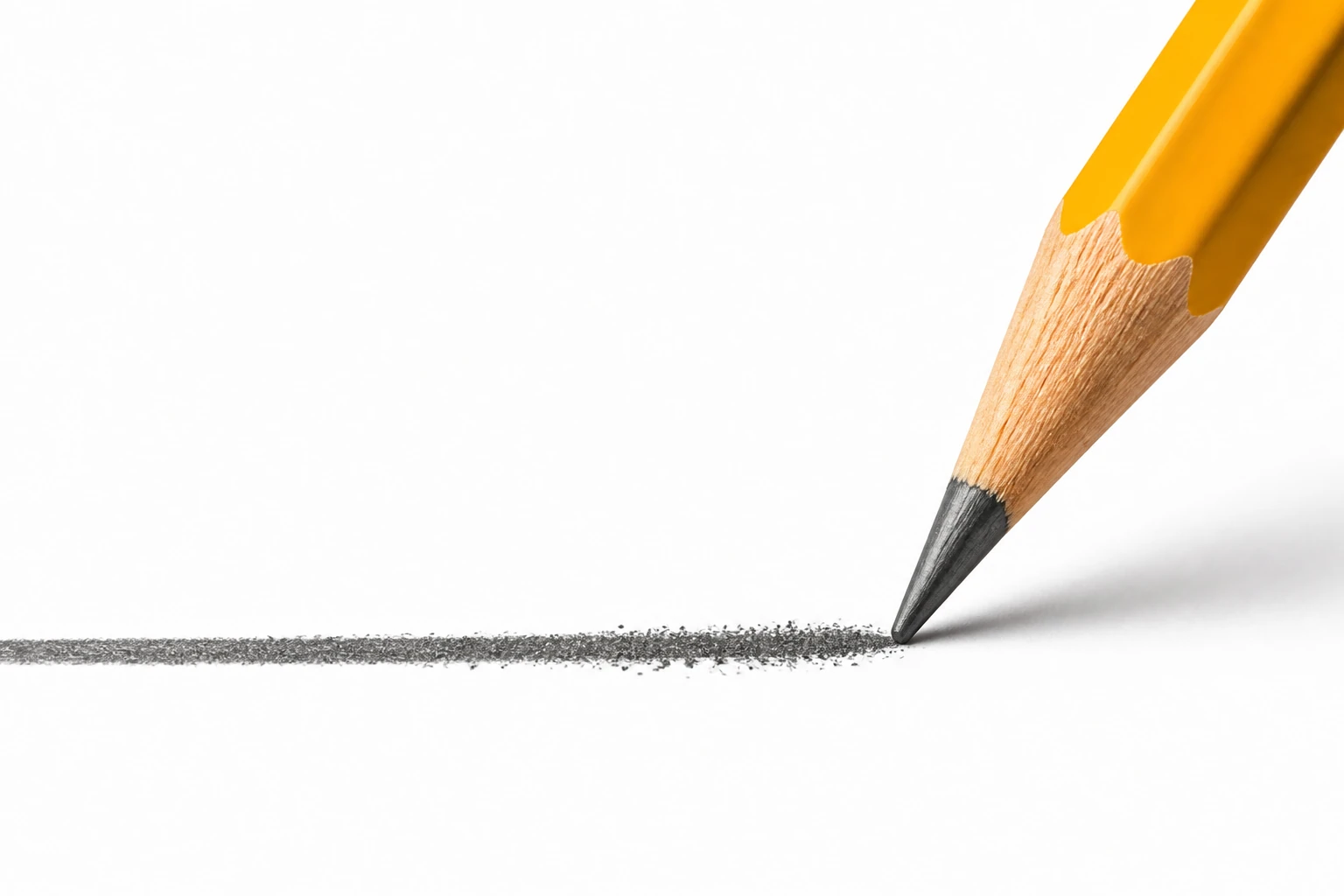
Pencils write because graphite is composed of layers of carbon atoms held together loosely by weak forces, and when dragged across paper's microscopically rough surface, these layers shear off easily, depositing thin films of carbon that are visible as a mark. Pencil marks are not pressed into the paper - the graphite deposits itself into the tiny surface irregularities of the paper fibers, which is why erasing works by physically lifting those particles out rather than chemically dissolving them.
Why Do Pencils Write? hero image

The mystery

The answer involves graphite's extraordinarily slippery molecular layers, the texture of paper, and why a pencil mark can be erased while pen ink cannot.

The short answer

Pencils write because graphite is composed of layers of carbon atoms held together loosely by weak forces, and when dragged across paper's microscopically rough surface, these layers shear off easily, depositing thin films of carbon that are visible as a mark.

The twist

Pencil marks are not pressed into the paper - the graphite deposits itself into the tiny surface irregularities of the paper fibers, which is why erasing works by physically lifting those particles out rather than chemically dissolving them.

Common mistake

Many people refer to pencil cores as 'lead,' implying they contain the metal.

Graphite's layers are the entire secret

A pencil writes because graphite has one of the most unusual molecular structures of any common material.

Graphite is stacked layers of carbon that slide easily

Graphite's carbon atoms are arranged in flat hexagonal layers, held tightly within each layer but connected between layers only by weak van der Waals forces.

This makes graphite almost uniquely easy to shear along these layer planes - which is exactly what happens when a pencil dragged across paper deposits thin carbon films on the surface.

Graphite writes because its layers have no particular loyalty to each other and will slide apart at the smallest provocation.

Paper provides texture for the graphite to catch on

Paper is not as smooth as it looks - at a microscopic level, it has a fibrous, irregular surface full of small peaks and valleys.

As the pencil tip is dragged over this surface, graphite layers catch on the raised fibers and are deposited, embedding tiny carbon particles into the paper's textured structure.

Paper grabs pencil marks the way rough ground grabs footprints - through texture, not adhesion.

Hardness grades control the layer transfer rate

Pencil grades from H (hard) to B (soft) indicate the ratio of graphite to clay binder in the core. More clay means harder, lighter marks; more graphite means softer, darker deposits.

The grade adjusts how easily the graphite layers shear off, not the chemistry of the graphite itself.

A soft pencil sheds layers more readily; a hard pencil holds them together until more pressure compels them to let go.

From pencil tip to visible mark

A short sequence explains how a pencil tip turns into a readable line.

1

01. Pencil tip contacts paper surface

The graphite core meets the microscopically textured paper fibers.

2

02. Weak interlayer forces in graphite are overcome by dragging force

Layers of carbon shear off from the graphite core.

3

03. Carbon particles deposit on paper fibers

Tiny graphite layers become trapped in the paper's surface texture.

4

04. Deposited carbon reflects light and appears as a mark

The visible line is a thin film of carbon sitting in the paper's texture.

What graphite's structure means for erasability

Because graphite is mechanically deposited into paper texture rather than chemically bonded to the paper, it can be removed by a different mechanical process - the eraser lifts, rather than dissolves, the graphite particles.

This is fundamentally different from most inks, which form chemical bonds with paper fibers and cannot be mechanically lifted without damaging the paper itself.

Surprising graphite and pencil facts

Graphite and diamond are the same element
Both are pure carbon, with diamond's tetrahedral bonding making it the hardest natural material while graphite's layered bonding makes it one of the softest.
The first pencils used solid graphite
Discovered in Borrowdale, England in 1565, the first pencils were sticks of pure graphite wrapped in string or wood.
Astronauts cannot use pencils in space
Graphite particles broken off during writing can float freely in microgravity and pose risks to electronics and eyes, which is why NASA invested in pressurized ballpoint pens instead.

Isn't pencil lead actually lead?

Myth

Many people refer to pencil cores as 'lead,' implying they contain the metal.

The historical error of calling graphite 'black lead' when it was first discovered in England has persisted in the everyday language of pencils ever since.

Reality

Pencil cores have contained no actual lead since Roman styluses - modern pencil cores are graphite and clay, which were mistaken for a form of lead when first discovered in 1565.

Pencil cores have contained no actual lead since Roman styluses - modern pencil cores are graphite and clay, which were mistaken for a form of lead when first discovered in 1565.

Where graphite's sliding layers matter beyond writing

Graphite as lubricant
The same easy-sliding layer structure makes graphite an effective dry lubricant used in locks, hinges, and industrial applications.
Graphene - one layer of graphite
Isolating a single layer of graphite produces graphene, a material with extraordinary electrical, thermal, and mechanical properties.

Why this humble material deserves more appreciation

Graphite's layered molecular structure makes it simultaneously an effective writing medium, a lubricant, and the raw material for one of the most exciting materials in modern physics.

The same structure that makes pencils work also makes graphene possible, connecting a centuries-old stationery item to cutting-edge materials science.

Worth noting

A remarkably simple material doing a surprisingly elegant job

Every pencil mark is just carbon atoms choosing, under the gentle persuasion of paper texture, to leave their stack and settle down on the page. Few materials are more cooperative, or have been appreciated less for it, than graphite.

Quick answers

Common questions

Can pencil marks ever become permanent?

Over very long periods, graphite may oxidize or bond more firmly to paper fibers, making extremely old pencil marks harder to erase - but this takes decades.

Everyday Science

Related questions

More pressure shears more graphite layers from the core, depositing a thicker carbon film.

The discovery that launched the pencil

The Borrowdale Graphite Deposit

Discovered in Cumberland, England around 1565, this unusually pure graphite deposit led directly to the first modern pencils and established Britain as the center of pencil manufacturing for generations.

Where graphite's sliding layers matter beyond writing

Graphite as lubricant

The same easy-sliding layer structure makes graphite an effective dry lubricant used in locks, hinges, and industrial applications.

Where graphite's sliding layers matter beyond writing

Graphene - one layer of graphite

Isolating a single layer of graphite produces graphene, a material with extraordinary electrical, thermal, and mechanical properties.

Isn't pencil lead actually lead?

Pencil cores have contained no actual lead since Roman styluses - modern pencil cores are graphite and clay, which were mistaken for a form of lead when first discovered in 1565.

Pencil cores have contained no actual lead since Roman styluses - modern pencil cores are graphite and clay, which were mistaken for a form of lead when first discovered in 1565.