Myth vs Reality
Surface degradation from abrasive erasing is the primary cause
Even high-quality markers on a scratched surface will ghost. The condition of the coating determines whether the board stays clean, not the markers alone.
Everyday Objects
A brand-new whiteboard wipes perfectly clean. A year-old one never quite does. The markers haven't changed, the surface has.
Quick answer
Whiteboards stain because their surface physically degrades with use. Most whiteboards are coated with melamine, porcelain, or painted steel, a smooth, non-porous layer that dry erase ink sits on top of rather than soaking into. Dry erase ink contains a release agent that prevents pigment from bonding permanently. On a smooth surface, the eraser lifts both the pigment and the release agent cleanly. But repeated erasing, especially with abrasive erasers, paper towels, or fingernails, creates microscopic scratches in the coating. Ink settles into those grooves. After the solvent evaporates, the pigment is lodged below the eraser's reach, leaving the characteristic grey ghost image that accumulates with every use.
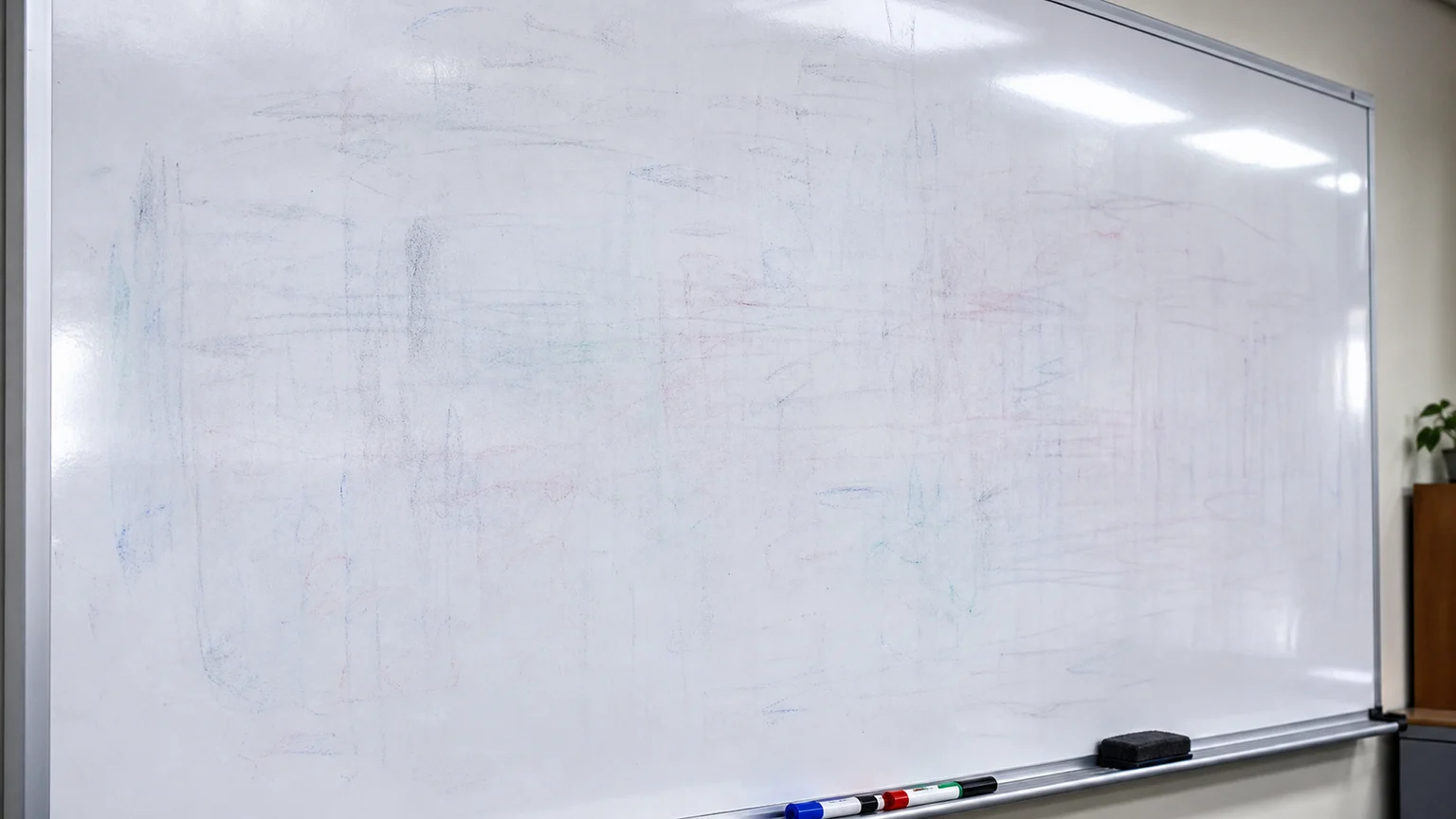
It is surface damage, not bad markers
Microscopic scratches in the coating trap pigment the eraser can no longer reach.
Abrasive erasing speeds it up
Paper towels, hard erasers, and fingernails scratch the surface coating far faster than soft felt erasers.
Leaving ink on accelerates staining
The longer ink sits, the more the solvent evaporates, embedding pigment more firmly in any surface irregularities.
Myth: cleaning spray can fix a stained board
Cleaners remove surface residue but cannot repair microscopic scratches. Once the coating is damaged, staining continues regardless.
Everyday Objects
Wiping a stained board with 70–90% isopropyl alcohol removes surface ink residue. It cannot repair microscopic scratches. A board that keeps staining after cleaning has physical surface damage and will continue to worsen.
Myth vs Reality
Even high-quality markers on a scratched surface will ghost. The condition of the coating determines whether the board stays clean, not the markers alone.
Continue learning
Everyday Objects
Both explain how common stationery and office products fail at a material level.
Everyday Objects
Both involve tools designed around the reality that surfaces and edges degrade with use.
Everyday Objects
Both involve the chemistry of everyday writing and marking tools.