1
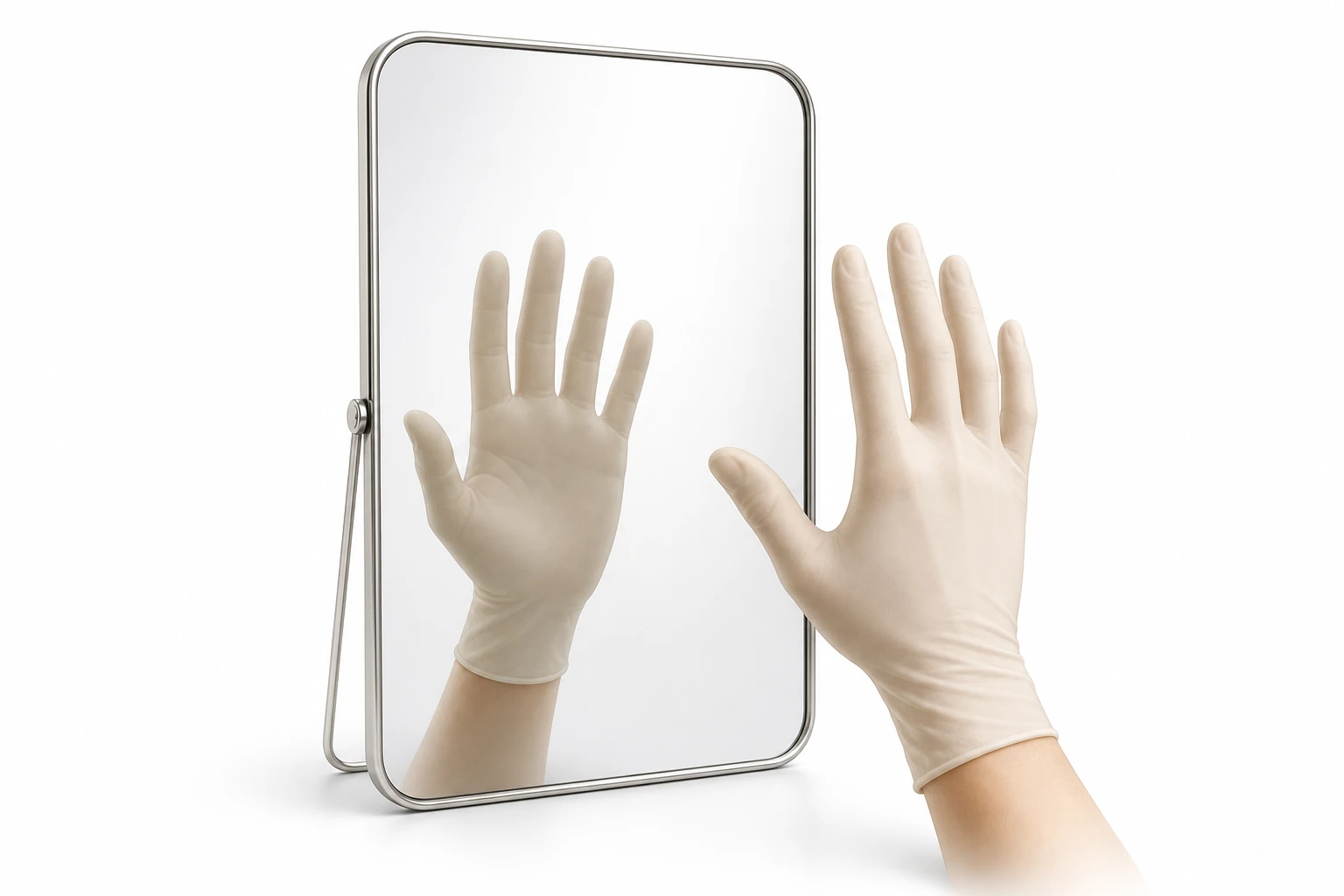
01. Mirror reverses the depth axis only
Each point is reflected straight back perpendicular to the mirror surface.
Everyday Science
A question so deceptively simple that it has occupied philosophers for centuries. Look in a mirror and your left hand appears on the right side of your reflection. If you raise your right hand, the reflection raises its left. The mirror seems to reverse left and right - but bizarrely, it does not reverse up and down. Why does a flat mirror flip one axis and not the other? The answer requires thinking carefully about what a mirror actually does, which turns out to be rather different from what it seems to do. The answer involves depth, not left-right orientation, and a specific confusion between how mirrors work physically versus how we interpret what we see.
Quick answer
Mirrors do not actually reverse left and right at all - they reverse front and back, reflecting the depth axis. The left-right reversal is a perceptual interpretation that humans make when mentally rotating the image to compare it to themselves, not something the mirror physically does. A mirror treats all three axes identically - it never reverses left-right more than it reverses up-down. Both appear unchanged because of how humans interpret the image.
The mystery
The answer involves depth, not left-right orientation, and a specific confusion between how mirrors work physically versus how we interpret what we see.
The short answer
Mirrors do not actually reverse left and right at all - they reverse front and back, reflecting the depth axis. The left-right reversal is a perceptual interpretation that humans make when mentally rotating the image to compare it to themselves, not something the mirror physically does.
The twist
A mirror treats all three axes identically - it never reverses left-right more than it reverses up-down. Both appear unchanged because of how humans interpret the image.
Common mistake
The universal experience of mirror reversal makes it feel like a physical fact about mirrors.
Everyday Science
Because turning a page to face the mirror rotates it around the vertical axis, which the mirror then reflects straight back.
The physicist who finally solved the mirror paradox
The 19th-century Austrian physicist whose analysis of sensory perception provided one of the clearest early explanations of why the mirror reversal is perceptual rather than physical.
Where mirror reflection creates practical effects
AMBULANCE is written mirror-reversed on ambulance fronts so it reads correctly when seen in a rearview mirror.
Where mirror reflection creates practical effects
Dentists work with reversed mirror images of teeth and are trained to perform fine motor tasks using mirror-image feedback.
Doesn't the mirror literally flip left and right?
Mirrors reverse depth only; the left-right reversal is a perceptual construction added by the viewer.
Continue learning
Everyday Science
Another familiar question explained by simple physics.

Everyday Science
Another familiar question explained by simple physics.
Everyday Science
Another familiar question explained by simple physics.