Everyday Science

Why Do Clouds Float?

A single cloud can weigh more than a jumbo jet, and somehow it just hangs there. Look up on a clear day and you will likely see something that, by any reasonable accounting, should not be possible: an enormous mass of water, suspended in midair, going nowhere in particular. A modest cumulus cloud can weigh hundreds of thousands of kilograms. And yet it floats, calmly, as if water had simply decided gravity did not apply to it that day. The answer involves droplets too small to fall, rising air that keeps refilling the cloud, and a surprising amount of math behind something that looks effortless.

Quick answer

Clouds float because they are made of countless tiny water droplets so small and light that air resistance almost perfectly balances the pull of gravity, allowing them to fall only extremely slowly while rising air continuously replenishes the cloud from below. Clouds are technically falling all the time - just so slowly, and so constantly replaced by rising moisture, that they appear to stay still.
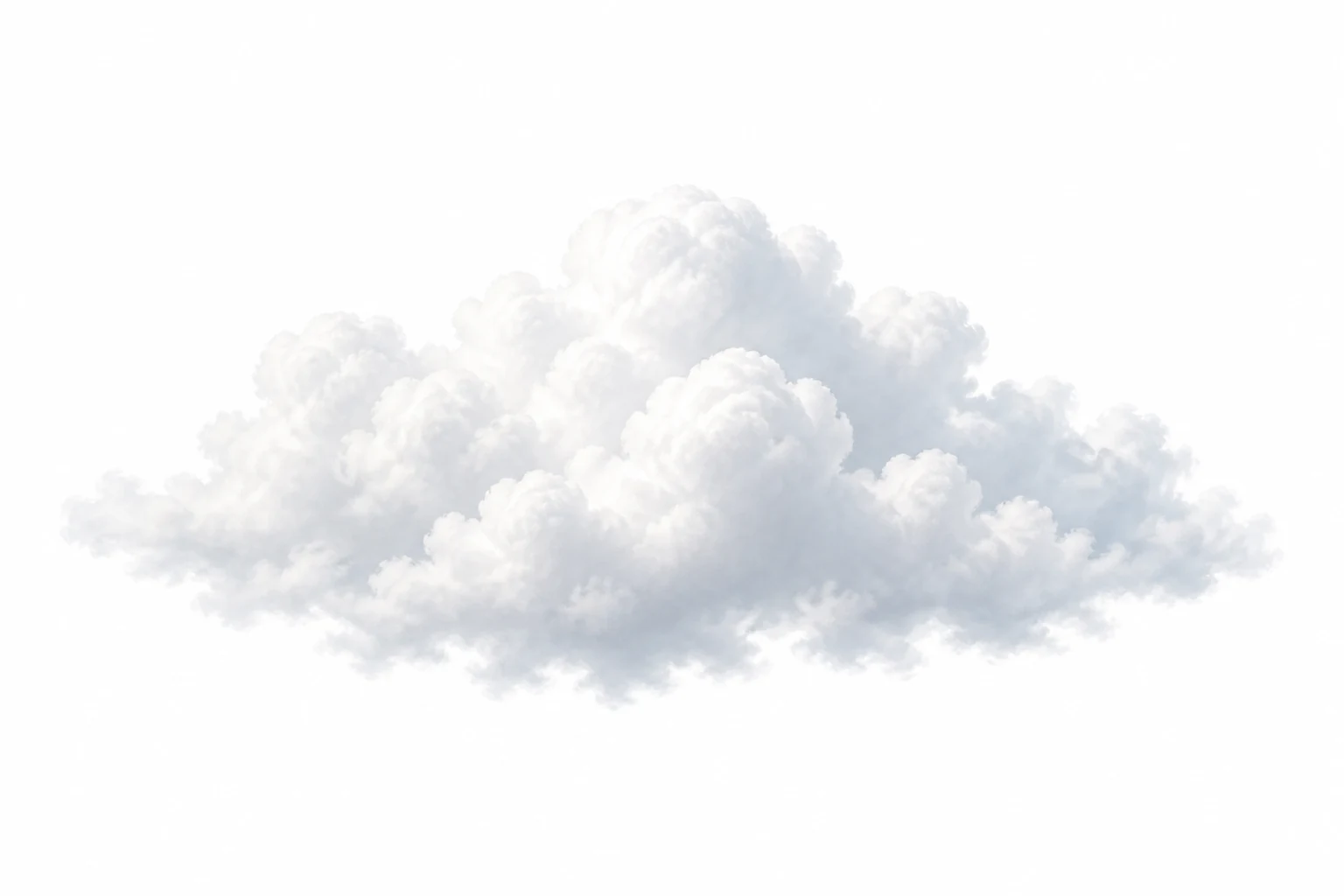
Why Do Clouds Float? hero image

The mystery

The answer involves droplets too small to fall, rising air that keeps refilling the cloud, and a surprising amount of math behind something that looks effortless.

The short answer

Clouds float because they are made of countless tiny water droplets so small and light that air resistance almost perfectly balances the pull of gravity, allowing them to fall only extremely slowly while rising air continuously replenishes the cloud from below.

The twist

Clouds are technically falling all the time - just so slowly, and so constantly replaced by rising moisture, that they appear to stay still.

Common mistake

Many people assume clouds are mostly air and therefore extremely light overall.

The trick is in the size of the drops

A cloud's apparent weightlessness comes down almost entirely to how small its individual droplets are.

Tiny droplets fall incredibly slowly

A typical cloud droplet is only about 10 to 15 micrometers across - far smaller than a raindrop, which forms only once droplets merge and grow heavy enough to fall properly.

At that tiny size, air resistance dominates over gravity, slowing the droplet's fall to a crawl, sometimes just a few centimeters per second.

A cloud droplet does not defy gravity; it simply falls so slowly that gravity barely notices the win.

Rising air constantly resupplies the cloud

Warm, moist air rises from the ground and continues feeding the cloud with fresh water vapor, which condenses into new droplets even as old ones slowly drift downward.

This constant turnover makes the cloud look stationary, even though its actual water content is endlessly being replaced.

A cloud is less like a static object and more like a fountain that happens to look frozen in place.

Why rain eventually falls

When droplets collide and merge enough times, they grow large enough that air resistance can no longer keep them aloft, and they fall as rain.

A cloud essentially floats right up until its droplets get too big to keep playing along.

Rain is simply what happens when a cloud's droplets finally get too big for the game they were winning.

From vapor to visible cloud

Several stages turn invisible water vapor into a floating, visible mass.

1

01. Warm air rises

Heated air near the surface expands and rises, carrying water vapor upward.

2

02. It cools and condenses

As rising air cools, water vapor condenses around tiny particles of dust or salt to form droplets.

3

03. Droplets stay suspended

Each droplet is light enough that air resistance keeps it nearly stationary.

4

04. Growth eventually causes rain

Droplets merge over time until they are heavy enough to fall as precipitation.

What clouds reveal about scale and physics

Clouds are a striking demonstration that the rules governing how objects fall change dramatically with size - a principle that also explains why insects can survive falls that would be fatal to larger animals.

At very small scales, air resistance is not a minor inconvenience; it is the dominant force in the equation.

Surprising cloud facts

Clouds are extremely heavy overall
Despite floating, an average cumulus cloud can weigh as much as several hundred elephants.
Fog is technically a cloud
Fog forms by the exact same droplet process, just at ground level instead of high in the atmosphere.
Clouds can move faster than they appear
Their enormous size and distance from observers makes their actual wind-driven movement look deceptively slow.

Doesn't a cloud just weigh almost nothing?

Myth

Many people assume clouds are mostly air and therefore extremely light overall.

Clouds look soft and weightless, which makes their actual mass deeply counterintuitive.

Reality

A cloud's total water content is often enormous; it floats not because it is light overall, but because that weight is divided among countless tiny, slow-falling droplets.

A cloud's total water content is often enormous; it floats not because it is light overall, but because that weight is divided among countless tiny, slow-falling droplets.

Where similar physics applies

Dust particles in sunbeams
Visible dust motes drift slowly through the air for the same air-resistance reasons as cloud droplets.
Aerosol sprays
Fine mist particles stay suspended in air far longer than larger water droplets would.

Why understanding clouds matters

Cloud physics underpins weather forecasting, climate modeling, and our basic understanding of the water cycle.

Small errors in modeling droplet behavior can significantly affect the accuracy of rainfall and climate predictions.

Worth noting

An everyday miracle of scale

Clouds float not because they break the rules of gravity, but because, at a small enough scale, the rules simply work differently. Every cloud overhead is technically falling, just patiently enough that nobody has ever noticed.

Quick answers

Common questions

How much does an average cloud actually weigh?

Estimates for a typical cumulus cloud range into the hundreds of thousands of kilograms, depending on its size and density.

Why don't airplanes get weighed down flying through clouds?

Cloud droplets are far too small and dispersed to add meaningful weight to a passing aircraft.

Everyday Science

Related questions

Thicker clouds with larger droplets scatter less light, making them appear darker.

The scientist who classified the sky

Luke Howard

An English chemist who, in 1802, created the cloud classification system still used by meteorologists today.

Related questions

Why does fog disappear as the day warms up?

Rising temperatures cause the suspended droplets to evaporate back into invisible water vapor.

Where similar physics applies

Dust particles in sunbeams

Visible dust motes drift slowly through the air for the same air-resistance reasons as cloud droplets.

Where similar physics applies

Aerosol sprays

Fine mist particles stay suspended in air far longer than larger water droplets would.

Doesn't a cloud just weigh almost nothing?

A cloud's total water content is often enormous; it floats not because it is light overall, but because that weight is divided among countless tiny, slow-falling droplets.

A cloud's total water content is often enormous; it floats not because it is light overall, but because that weight is divided among countless tiny, slow-falling droplets.