Everyday Science

Why Do Atoms React?

Everything that has ever happened in chemistry began with one atom wanting something it did not have. Iron rusts. Wood burns. Bread rises. Dynamite explodes. Every one of these is atoms rearranging themselves - pulling apart, joining together, swapping partners - in a ceaseless molecular reshuffling that has been going on since the universe had atoms to reshuffle. The question is: why? What makes one atom reach for another? The answer involves the outer shells of electrons, a desperate atomic drive for stability, and the reason noble gases famously refuse to attend any chemistry at all.

Quick answer

Atoms react because their outermost electrons are not in the most stable possible arrangement, and atoms can reach greater stability by sharing, transferring, or rearranging those electrons with other atoms - which is exactly what a chemical reaction is. The noble gases - helium, neon, argon - have full outer electron shells and therefore almost never react with anything. Their chemical inertness was once mistaken for a kind of aloofness; it is actually a form of contentment.
Why Do Atoms React? hero image

The mystery

The answer involves the outer shells of electrons, a desperate atomic drive for stability, and the reason noble gases famously refuse to attend any chemistry at all.

The short answer

Atoms react because their outermost electrons are not in the most stable possible arrangement, and atoms can reach greater stability by sharing, transferring, or rearranging those electrons with other atoms - which is exactly what a chemical reaction is.

The twist

The noble gases - helium, neon, argon - have full outer electron shells and therefore almost never react with anything. Their chemical inertness was once mistaken for a kind of aloofness; it is actually a form of contentment.

Common mistake

It is tempting to think of highly reactive atoms like fluorine or sodium as inherently aggressive or dangerous.

Chemistry is driven by one thing: wanting stability

Almost every chemical reaction in the universe is ultimately an atom's attempt to achieve a more stable electronic configuration.

Electrons live in shells, and the outermost shell decides everything

Electrons surrounding an atom are arranged in layers called shells, and the outermost shell has a specific capacity for electrons that determines how reactive that atom will be.

Atoms are most stable when their outermost shell is full, and most reactive when it is nearly full or nearly empty.

An atom's reactivity is almost entirely a story about one shell, and how desperately it wants to be complete.

Atoms share or steal electrons to get what they need

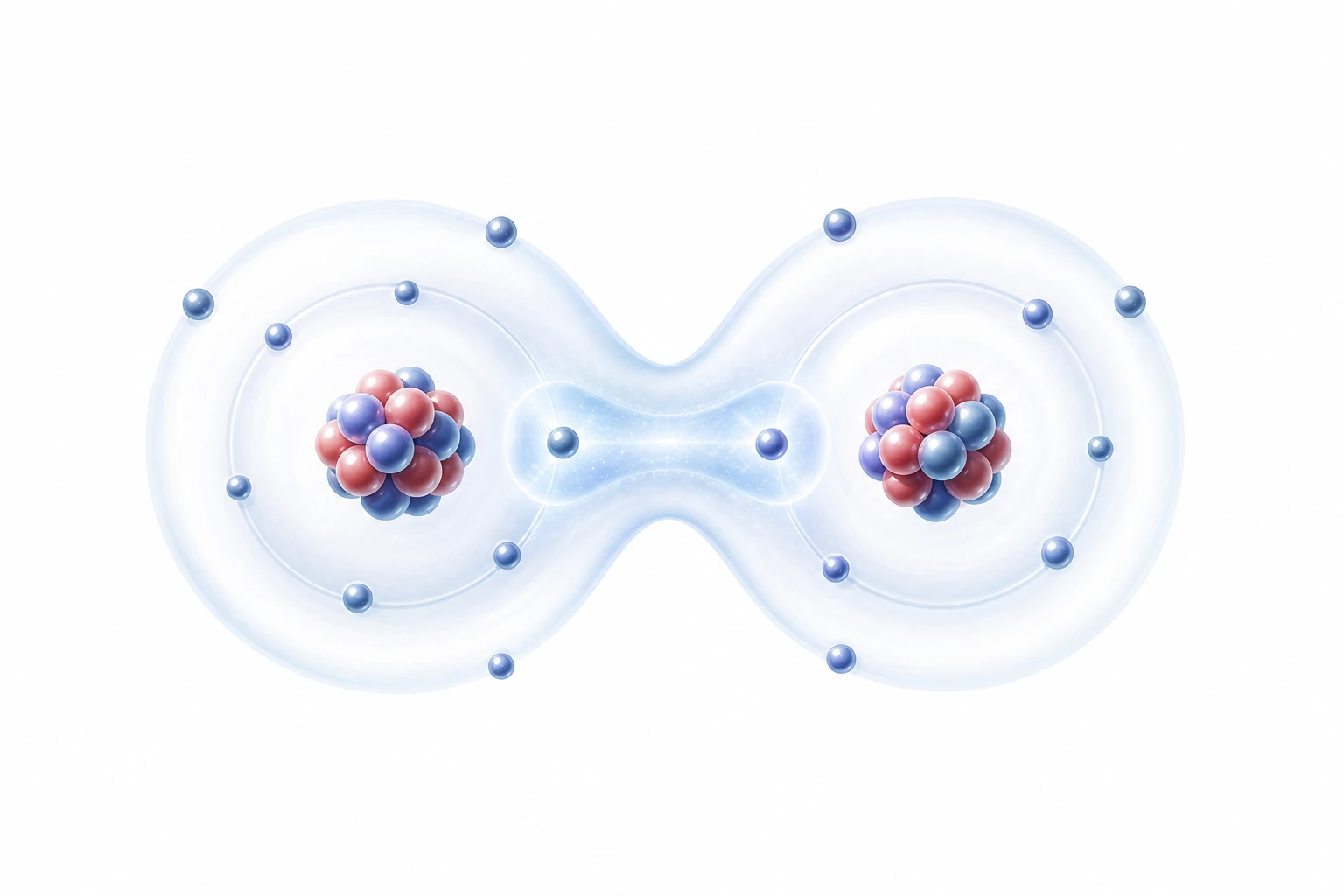
Some atoms share electrons with neighbors to mutually complete each other's outer shells, forming covalent bonds. Others transfer electrons outright from one atom to another, forming ionic bonds.

Both are strategies for achieving the same goal: a more stable outer electron arrangement.

Every chemical bond is really just two atoms agreeing that they are better off together than apart.

Energy release drives reactions forward

When atoms form more stable arrangements, they release energy - sometimes gently, as in metabolism, sometimes dramatically, as in combustion.

This energy release is why reactions happen spontaneously: nature consistently tends toward lower-energy, more stable states.

Explosions and respiration run on the same principle - atoms falling into more comfortable arrangements and releasing the difference as energy.

From unstable to stable, step by step

A short sequence explains how atomic instability leads to chemical change.

1

01. An atom has an incomplete outer electron shell

This creates a drive toward gaining, losing, or sharing electrons.

2

02. It encounters another atom with a complementary need

One may have too many outer electrons, the other too few.

3

03. Electrons are shared or transferred

A bond forms as both atoms move toward more stable configurations.

4

04. Energy is released as stability is achieved

The more stable product has lower energy, and the difference is released as heat, light, or other energy.

Why noble gases stay out of it

The noble gases - helium, neon, argon, krypton, and others - have completely full outer electron shells, giving them no drive to gain, lose, or share electrons with any other atom.

This electronic completeness is the chemical equivalent of being entirely self-sufficient: they have nothing to gain from reacting and have been largely ignoring the rest of the periodic table ever since.

Surprising facts about atomic reactivity

Sodium explodes in water, yet is safe in table salt
Sodium's one outer electron makes it explosively reactive alone, but bonded to chlorine in salt, both atoms achieve stability and become entirely harmless.
Noble gases can react, just very reluctantly
Under extreme laboratory conditions, xenon and krypton have been forced to form compounds, though they do so with deep chemical reluctance.
Every drug you take works through atomic reactivity
Medications interact with biological molecules through precisely the same electron-sharing and transfer principles that govern all chemistry.

Aren't some atoms just naturally aggressive?

Myth

It is tempting to think of highly reactive atoms like fluorine or sodium as inherently aggressive or dangerous.

Dramatic reactions produce dramatic results, making reactive atoms feel temperamental even though they are simply following the same universal drive for stability as every other atom.

Reality

Reactivity is not aggression; it is simply a measure of how far an atom's outer shell is from a complete, stable state. Danger and reactivity are different things.

Reactivity is not aggression; it is simply a measure of how far an atom's outer shell is from a complete, stable state. Danger and reactivity are different things.

Where atomic reactivity shapes everyday life

Cooking
Heat causes food molecules to break apart and recombine into new ones, driven by the same electronic stability-seeking that drives all chemistry.
Rust formation
Iron atoms react with oxygen because both achieve more stable electronic arrangements in iron oxide than they had as separate atoms.

Why this single principle explains all of chemistry

Understanding that chemical reactions are driven by the pursuit of electronic stability is enough to conceptually explain every reaction from respiration to nuclear chemistry.

It is one of the most compact and powerful explanatory principles in all of science.

Worth noting

The restlessness that built everything

Every substance in the universe, from a star to a strawberry, exists because atoms reached for stability and found it in each other. Chemistry is not complex. It is simply a very large number of atoms, each trying to feel complete.

Quick answers

Common questions

Do atoms react the same way in all conditions?

No, temperature, pressure, and the presence of catalysts can dramatically alter how readily atoms react with one another.

Can a single atom react with itself?

Not in the bonding sense, though individual atoms can be in excited states that make them more reactive with other atoms.

Everyday Science

Related questions

Fluorine needs only one electron to complete its outer shell and has a very strong pull on nearby electrons.

The scientist who organized reactivity

Dmitri Mendeleev

The Russian chemist whose periodic table, first published in 1869, organized elements in a way that made their reactivities and bonding behaviors predictable.

Related questions

Why doesn't gold rust?

Gold's electron configuration makes it exceptionally stable and reluctant to share or transfer electrons with common reactants.

Where atomic reactivity shapes everyday life

Cooking

Heat causes food molecules to break apart and recombine into new ones, driven by the same electronic stability-seeking that drives all chemistry.

Where atomic reactivity shapes everyday life

Rust formation

Iron atoms react with oxygen because both achieve more stable electronic arrangements in iron oxide than they had as separate atoms.

Aren't some atoms just naturally aggressive?

Reactivity is not aggression; it is simply a measure of how far an atom's outer shell is from a complete, stable state. Danger and reactivity are different things.

Reactivity is not aggression; it is simply a measure of how far an atom's outer shell is from a complete, stable state. Danger and reactivity are different things.