Animal Facts

How Do Horses Sleep Standing Up?

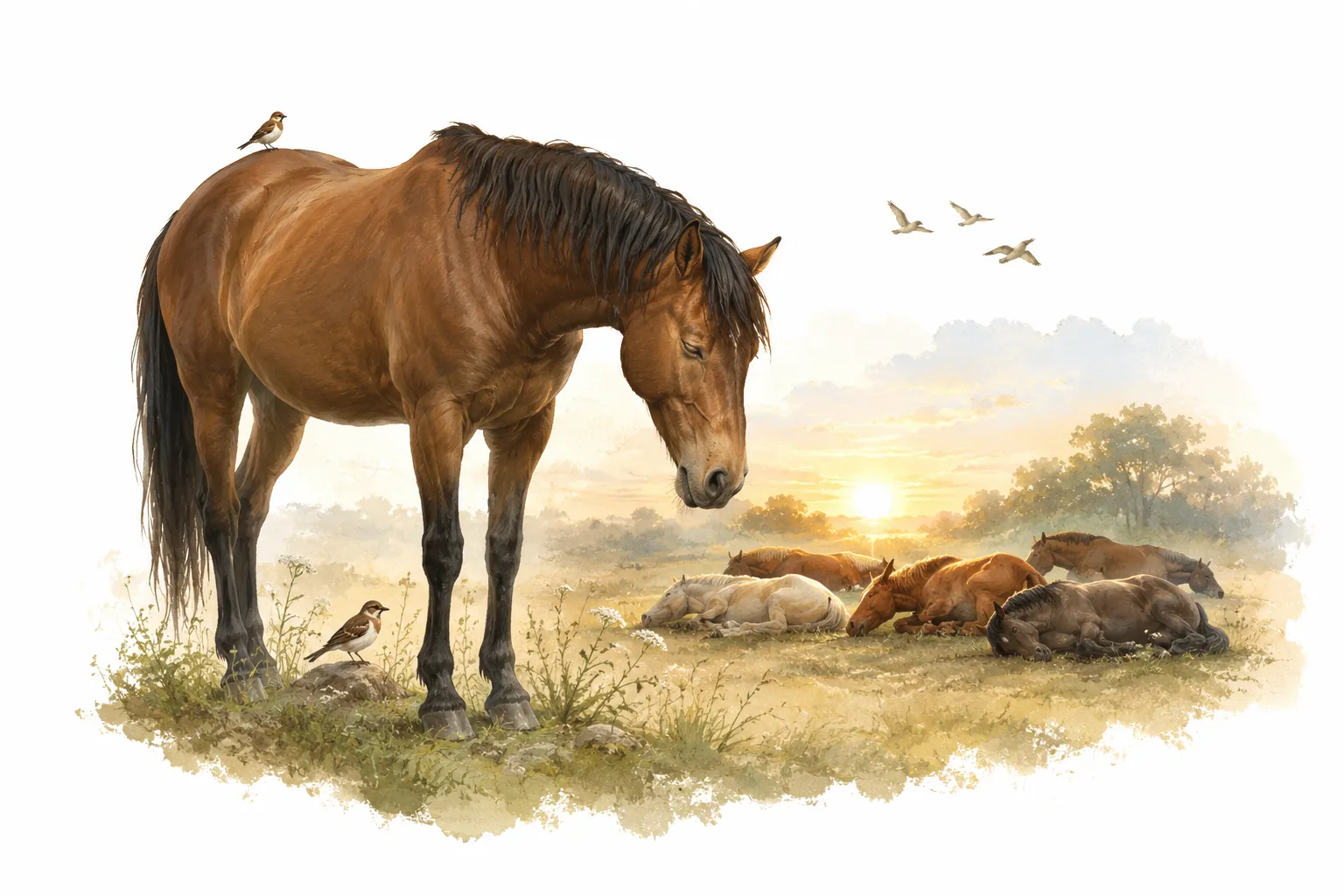
The strange leg mechanism that lets a half-ton animal doze off without falling over. Picture a horse asleep in a field. It is standing perfectly upright, head low, eyes half closed, weight balanced on four thin legs, and it is not, contrary to how this looks, one gust of wind away from toppling over. Horses have quietly solved a problem that would defeat most large animals: how to relax completely while remaining on your feet, ready to run from a predator at a moment's notice. The trick involves a locking mechanism in the legs that works something like a folding chair clicking into place.

Quick answer

Horses can sleep standing up because of a set of tendons and ligaments called the stay apparatus, which locks their leg joints in position without requiring muscular effort. But standing sleep is only ever a light doze. For deep, dream-filled sleep, a horse still has to lie down, and it needs its herd to feel safe enough to do it.
How Do Horses Sleep Standing Up? hero image

The mystery

The trick involves a locking mechanism in the legs that works something like a folding chair clicking into place.

The short answer

Horses can sleep standing up because of a set of tendons and ligaments called the stay apparatus, which locks their leg joints in position without requiring muscular effort.

The twist

But standing sleep is only ever a light doze. For deep, dream-filled sleep, a horse still has to lie down, and it needs its herd to feel safe enough to do it.

Common mistake

Many people assume horses sleep exclusively standing up and essentially never lie down.

A skeleton built like scaffolding

The stay apparatus is essentially a biological hack: a way of using ligaments, which don't get tired, to do a job normally done by muscles, which do.

Ligaments instead of muscles

In most animals, standing still for long periods requires continuous muscular effort, which is exhausting. Horses have evolved a network of tendons and ligaments in their legs that can lock the knee and hock joints in an extended position.

Once locked, the horse's skeleton essentially holds itself up, like a tent held taut by its poles, freeing the muscles to relax almost entirely.

A sleeping horse isn't balancing on muscle. It's resting on its own skeleton, locked into place like a deck chair.

Why prey animals evolved this

Horses are prey animals, and prey animals that take too long to get up when a predator appears don't tend to survive long enough to pass on their genes. Standing sleep means a horse can react to danger in a fraction of a second.

This is also why horses, unlike humans, only need a small amount of deep sleep each day — usually just a few hours, taken in short stretches rather than one long block.

Millions of years of being chased have taught horses to nap with one foot already out the door.

The part where they still have to lie down

Standing sleep only covers light dozing. True REM sleep, the deep stage where dreaming happens, requires horses to lie down, because the stay apparatus can't fully relax every muscle needed for that stage.

Horses typically only need thirty minutes to a few hours of lying-down sleep per day, and they generally only do it when they feel safe, often with other horses standing watch nearby.

Even a horse that sleeps standing up has to trust someone enough to eventually lie down.

How the stay apparatus actually locks in place

It sounds almost mechanical, and in a sense, it is. Here's the sequence.

1

01. Weight shifts onto three legs

A resting horse typically shifts most of its weight onto three legs, letting the fourth relax and rest the tip of its hoof on the ground.

2

02. Tendons pull the joint straight

In the weight-bearing legs, a system of tendons pulls the knee and hock into a locked, straightened position, similar to how a folding ruler clicks rigid when fully extended.

3

03. The horse periodically switches legs

Because no single leg bears the full load forever, the horse periodically shifts its weight and rests a different leg, cycling through the group over the course of its nap.

A trait shared by other large grazers

Horses aren't entirely alone in this ability — other large hooved animals, including some cattle and giraffes, have variations of a stay-like mechanism that allows extended standing.

What sets horses apart is how completely they can relax while locked in place, dozing lightly enough to look almost fully asleep while remaining instantly ready to bolt.

Surprising horse sleep facts

Horses only need about three hours of total sleep
Combining standing dozes and brief lying-down REM periods, most horses get by on roughly two to three hours of actual sleep per day.
A horse deprived of lying-down sleep can collapse from exhaustion
If a horse feels too unsafe to lie down for extended periods, sleep deprivation can eventually cause it to briefly collapse mid-stand from an uncontrollable episode of REM sleep.

Do horses never lie down at all?

Myth

Many people assume horses sleep exclusively standing up and essentially never lie down.

Because horses spend the vast majority of their resting time standing, and because people rarely watch a horse around the clock, the brief lying-down periods are easy to miss entirely.

Reality

Horses do lie down regularly, just briefly — typically for short stretches totaling under a few hours a day, reserved for the deep REM sleep standing rest can't provide.

Horses do lie down regularly, just briefly — typically for short stretches totaling under a few hours a day, reserved for the deep REM sleep standing rest can't provide.

Where this adaptation matters most

Wild herds on open plains
In predator-rich environments, the ability to sleep while standing lets herd members stay alert and mobile, with a few animals often remaining more watchful while others doze.
Working and transported horses
Horses that travel frequently or stand in unfamiliar environments, like show or competition horses, rely heavily on standing rest since they may not feel secure enough to lie down away from home.

Why this matters for horse owners

Understanding standing versus lying sleep helps owners and caretakers recognize when a horse isn't getting adequate rest, which can be an early sign of stress, pain, or an unsafe environment.

Veterinarians often check whether a horse is getting enough lying-down REM sleep, since chronic deprivation can lead to fatigue-related collapses and broader health issues.

Worth noting

A nap built for survival

The stay apparatus is one of evolution's quieter masterpieces: a way of letting a prey animal rest without ever fully surrendering its ability to run. A horse asleep on its feet isn't defying physics. It's using its own skeleton as a piece of furniture.

Quick answers

Common questions

Can a horse sleep standing up its entire life without ever lying down?

No — a horse needs periodic lying-down REM sleep for long-term health, and prolonged avoidance of it can lead to serious sleep deprivation.

Animal Facts

Related questions

Yes — evidence of REM sleep during their lying-down rest periods suggests horses likely experience dreams, though what they dream about remains unknown.

The naturalist who documented equine rest patterns

Jean-Baptiste Lamarck

An early naturalist whose broader work on animal adaptation helped set the stage for later scientists to study specialized anatomical traits like the horse's stay apparatus.

Where this adaptation matters most

Wild herds on open plains

In predator-rich environments, the ability to sleep while standing lets herd members stay alert and mobile, with a few animals often remaining more watchful while others doze.

Where this adaptation matters most

Working and transported horses

Horses that travel frequently or stand in unfamiliar environments, like show or competition horses, rely heavily on standing rest since they may not feel secure enough to lie down away from home.

Do horses never lie down at all?

Horses do lie down regularly, just briefly — typically for short stretches totaling under a few hours a day, reserved for the deep REM sleep standing rest can't provide.

Horses do lie down regularly, just briefly — typically for short stretches totaling under a few hours a day, reserved for the deep REM sleep standing rest can't provide.