Body & Health

What Causes Dandruff?

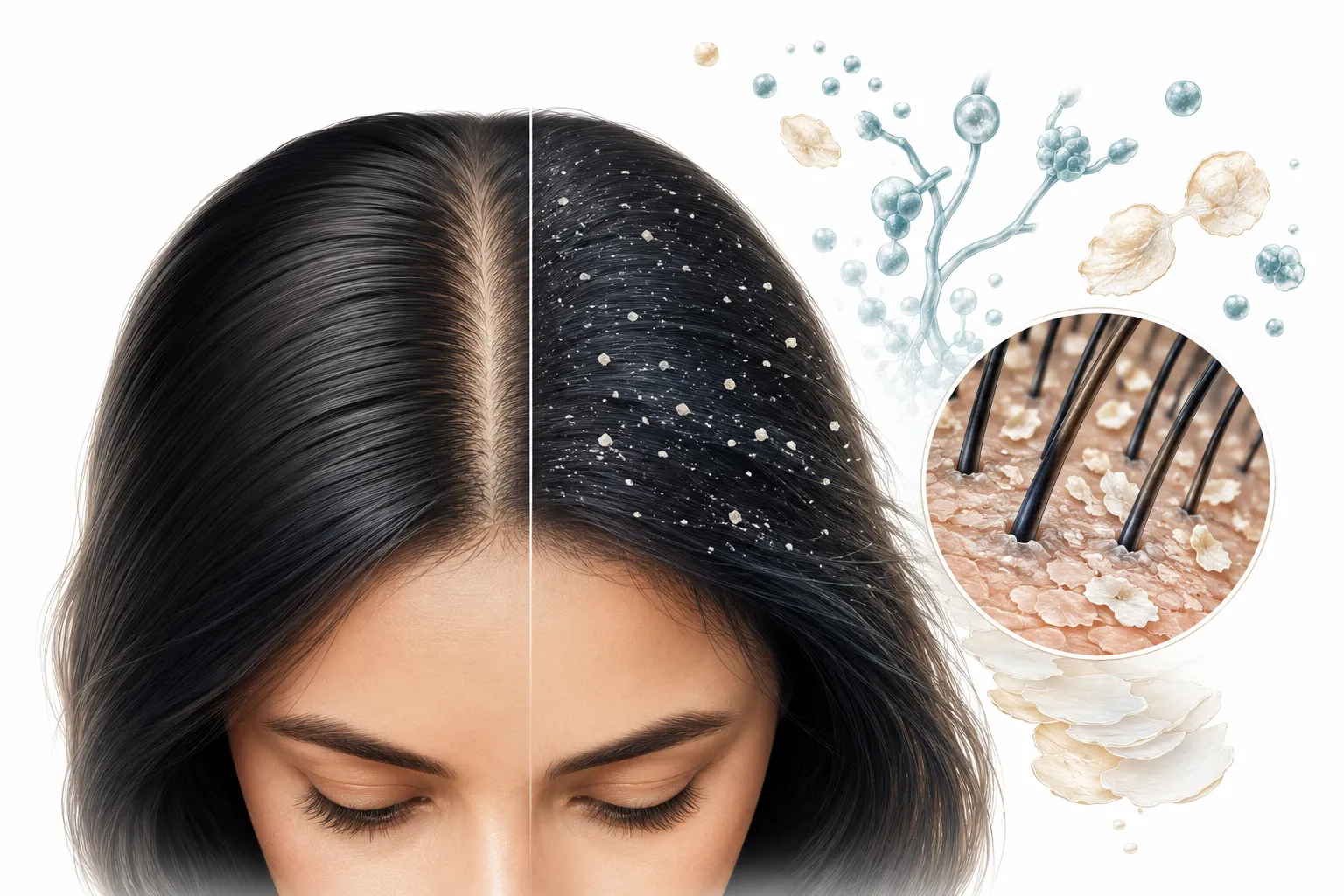
It has almost nothing to do with how often you shower, and almost everything to do with a fungus that lives on everyone's head. There is a persistent myth that dandruff is a hygiene problem — a sign of a scalp that hasn't been washed enough. This is mostly untrue, and mildly unfair to the millions of scrupulously clean people who deal with it anyway. The real cause is a microscopic yeast that lives on almost every human scalp, clean or not, and occasionally decides to throw a party your skin cells did not agree to. The story involves a fungus everyone already has, an oily buffet it feeds on, and a skin reaction that speeds up cell turnover into something visible.

Quick answer

Dandruff is mainly caused by an overgrowth of Malassezia, a yeast-like fungus naturally present on the scalp, which irritates skin and speeds up cell shedding. You can't actually get rid of the fungus completely — it lives on virtually everyone's skin. The goal is only ever to manage it, not evict it.
What Causes Dandruff? hero image

The mystery

The story involves a fungus everyone already has, an oily buffet it feeds on, and a skin reaction that speeds up cell turnover into something visible.

The short answer

Dandruff is mainly caused by an overgrowth of Malassezia, a yeast-like fungus naturally present on the scalp, which irritates skin and speeds up cell shedding.

The twist

You can't actually get rid of the fungus completely — it lives on virtually everyone's skin. The goal is only ever to manage it, not evict it.

Common mistake

A common assumption is that dandruff means someone isn't washing their hair often enough.

The fungus that's already on your head

Malassezia isn't some rare invader. It's a normal resident of human skin, present on scalps around the world, usually causing no trouble at all.

A yeast that eats oil, not you

Malassezia feeds on sebum, the natural oil your scalp produces. For most people, this is a quiet, uneventful relationship — the yeast eats, the scalp doesn't notice, and life goes on.

But in some people, Malassezia breaks down that oil into byproducts, including oleic acid, that irritate the skin. The scalp responds the way irritated skin usually does: it speeds up.

Dandruff isn't dirt building up. It's your scalp's immune system overreacting to a fungus that was never going anywhere.

Skin cells on fast-forward

Normally, scalp skin cells mature and shed on roughly a monthly cycle, small enough to be invisible. When irritated by Malassezia byproducts, that cycle can speed up dramatically, sometimes to just a week or two.

Cells shed before they're fully mature, clumping together into the visible white or yellowish flakes most people recognize as dandruff.

Those flakes aren't dead skin building up over time — they're skin cells evicted before they were ready to leave.

Why some people get it and others don't

Not everyone with Malassezia on their scalp develops dandruff, which suggests individual sensitivity matters as much as the fungus itself. Genetics, oil production, stress, and even climate can tip the balance.

Dry scalps can flake too, but that's usually a different mechanism — simple dehydration rather than a fungal-irritation response — which is part of why dandruff shampoos don't work for everyone equally.

Two people can share a fungus and only one of them ends up needing a special shampoo.

How dandruff actually forms, step by step

It's a short chain of cause and effect, but each link matters for understanding why treatments work the way they do.

1

01. Sebum production feeds the yeast

Scalp oil glands produce sebum, which Malassezia uses as its primary food source. More oil generally means more fuel for the yeast population.

2

02. Byproducts irritate the skin barrier

As Malassezia metabolizes sebum, it releases fatty acid byproducts that can penetrate and irritate the outer layer of scalp skin in sensitive individuals.

3

03. The scalp overcorrects with rapid shedding

Irritated skin responds by accelerating cell turnover, pushing new cells to the surface faster than they can mature, which is what produces visible flaking.

Why treatment targets the yeast, not the flakes

Most effective anti-dandruff shampoos work by reducing the Malassezia population on the scalp, using antifungal ingredients rather than simply trying to scrub flakes away.

This is why switching shampoos occasionally can help — different antifungal compounds target the yeast slightly differently, and rotating them can prevent the fungus from settling into a comfortable, resistant routine.

Surprising dandruff facts

Dandruff often gets worse in winter
Indoor heating dries the air, and combined with cold outdoor temperatures, this can stress the scalp barrier and worsen flaking for many people.
Severe dandruff has a medical name
When flaking is accompanied by redness and more significant irritation, it's often reclassified as seborrheic dermatitis, a related but more intense condition.

Is dandruff caused by poor hygiene?

Myth

A common assumption is that dandruff means someone isn't washing their hair often enough.

Because flakes look similar to visible debris, and because washing can temporarily reduce their appearance, it's easy to mistake a fungal-irritation issue for a simple dirt problem.

Reality

Dandruff is driven primarily by fungal activity and individual skin sensitivity, not cleanliness — in fact, over-washing can sometimes irritate the scalp further.

Dandruff is driven primarily by fungal activity and individual skin sensitivity, not cleanliness — in fact, over-washing can sometimes irritate the scalp further.

Where dandruff commonly shows up

Stress-related flare-ups
Many people notice worsened dandruff during high-stress periods, likely linked to stress's effect on oil production and immune response.
Certain skin conditions
People with oily skin types or conditions like eczema often experience more persistent dandruff, since these conditions can alter the scalp's oil balance and barrier function.

Why understanding the cause changes the treatment

Knowing dandruff is fungal rather than hygiene-related shifts the entire treatment approach — from simply washing more to specifically targeting the yeast population with antifungal ingredients.

This understanding has shaped the entire anti-dandruff shampoo industry, which centers its formulas around antifungal compounds rather than stronger cleansers.

Worth noting

A flake with a fungal backstory

Dandruff turns out to be less about cleanliness and more about a delicate truce between your scalp and a fungus you've been carrying around your whole life. You're not dirty. You're just hosting a slightly overenthusiastic tenant.

Quick answers

Common questions

Can diet affect dandruff?

Some evidence suggests diets low in zinc, B vitamins, or certain fats may worsen scalp health, though diet alone is rarely the primary cause for most people.

Body & Health

Related questions

No — Malassezia is already present on almost everyone's scalp, so dandruff isn't something you catch from someone else.

The scientist who identified the fungal link

Raymond Sabouraud

A French dermatologist working in the early 20th century whose research into scalp conditions helped establish the connection between microorganisms and dandruff-like symptoms.

Where dandruff commonly shows up

Stress-related flare-ups

Many people notice worsened dandruff during high-stress periods, likely linked to stress's effect on oil production and immune response.

Where dandruff commonly shows up

Certain skin conditions

People with oily skin types or conditions like eczema often experience more persistent dandruff, since these conditions can alter the scalp's oil balance and barrier function.

Is dandruff caused by poor hygiene?

Dandruff is driven primarily by fungal activity and individual skin sensitivity, not cleanliness — in fact, over-washing can sometimes irritate the scalp further.

Dandruff is driven primarily by fungal activity and individual skin sensitivity, not cleanliness — in fact, over-washing can sometimes irritate the scalp further.