Visual answer
From Gene to Protein
DNA is transcribed to mRNA, which is translated by ribosomes into a protein chain.
Transcription
RNA polymerase reads the DNA template and synthesizes messenger RNA (mRNA).
mRNA Processing
Introns are removed; a cap and tail are added before mRNA leaves the nucleus.
Translation
Ribosome reads mRNA codons and assembles amino acids into a protein.
Protein Folding
The amino acid chain folds into a functional three-dimensional shape.
The four-letter code
The Mystery: How Do Four Letters Run All of Life?
There are only four DNA bases - adenine (A), thymine (T), cytosine (C), and guanine (G) - yet they encode every inherited trait across all known life. The secret is positional: groups of three bases form a 'codon,' and each codon specifies one of 20 amino acids. Because 4 cubed equals 64 possible codons and only 20 amino acids are needed, the code has built-in redundancy and error-tolerance, which is why minor copying mistakes usually go unnoticed.
Reading the code
The Secret Mechanism: Reading the Code
DNA carries information but cannot act directly. The cell's molecular machinery reads the code in two stages - transcription and translation - converting a DNA sequence into a functional protein.
The key components include the double helix (stable storage), RNA polymerase (transcription enzyme), ribosome (protein factory), DNA polymerase (replication enzyme), and histones with chromosomes (packaging and regulation).
Step by step
Step-by-Step: From Gene to Protein
1. Unwinding: When a gene needs to be expressed, proteins called transcription factors bind to a promoter region, signaling RNA polymerase to unzip the double helix at that location.
2. Transcription: RNA polymerase moves along one DNA strand, reading the bases and assembling a complementary mRNA strand using the same pairing rules (except uracil replaces thymine in RNA).
3. mRNA Processing: In eukaryotes, the raw mRNA is edited: introns (non-coding sections) are spliced out and a protective cap and tail are added before the mRNA travels to the cytoplasm.
4. Translation: A ribosome clamps onto the mRNA and reads each codon in sequence. Matching tRNA molecules deliver the correct amino acids, which are joined by peptide bonds into a growing protein chain.
5. Protein Folding: The finished amino-acid chain spontaneously folds into a three-dimensional shape determined by its sequence. This shape determines what the protein does - enzyme, structural fiber, hormone, or antibody.
6. DNA Replication (for cell division): Before a cell divides, helicase unwinds the double helix and DNA polymerase copies both strands. The result is two identical DNA molecules, each consisting of one original and one new strand - a process called semi-conservative replication.
Evolutionary purpose
Why Did DNA Evolve?
DNA likely succeeded earlier RNA-based genetic systems because its chemical stability - owing to the 2-deoxyribose sugar rather than ribose - greatly reduces the rate of spontaneous mutations. A more stable, accurate blueprint allows complex organisms to accumulate the thousands of precisely encoded genes needed to build organs, immune systems, and nervous systems.
Benefits include: high-fidelity copying (DNA polymerase's proofreading reduces errors to one per billion bases), heritability (each daughter cell receives a complete copy), variation through mutation (rare copying errors generate diversity for natural selection), and gene regulation (packaging into chromatin allows tissue-specific gene expression).
DNA vs RNA
DNA vs RNA: Key Differences
Sugar
DNA: Deoxyribose / RNA: Ribose
Strandedness
DNA: Double helix / RNA: Usually single strand
Bases
DNA: A, T, C, G / RNA: A, U, C, G
Function
DNA: Long-term information storage / RNA: Messenger, transfer, ribosomal
Stability
DNA: Very stable / RNA: Easily degraded
Myths vs reality
Myth vs Reality: DNA
What people think
Your DNA determines everything about you
Genes are destiny; you cannot change what your DNA says.
What actually happens
Genes provide predispositions, not destinies
Gene expression is profoundly shaped by environment, diet, stress, and epigenetic modifications that switch genes on or off.
Surprising facts
Surprising Facts About DNA
Only about 1-2 percent of human DNA codes for proteins. The rest - once dismissed as 'junk DNA' - includes regulatory sequences, structural elements, and remnants of ancient viruses that may influence gene expression.
Humans share roughly 98.7 percent of their DNA with chimpanzees. The roughly 1.3 percent difference across three billion base pairs still amounts to tens of millions of sequence changes that collectively produce the biological differences between the two species.
DNA replication takes only a few hours despite copying 3 billion base pairs. Because replication begins at thousands of origin sites simultaneously and proceeds in both directions from each origin, the cell copies its entire genome in just a few hours.
Quick answers
Common questions
What is DNA made of? +
DNA is made of nucleotides. Each nucleotide has three parts: a deoxyribose sugar, a phosphate group, and one of four nitrogenous bases - adenine (A), thymine (T), cytosine (C), or guanine (G).
How does DNA replicate? +
An enzyme called helicase unwinds and separates the two strands. DNA polymerase then reads each strand and builds a new complementary strand, producing two identical double helices from one. Because each new helix contains one old strand and one new strand, the process is called semi-conservative replication.
What is the difference between DNA and a gene? +
DNA is the entire molecule containing all genetic information. A gene is a specific segment of DNA that contains instructions for making one protein or functional RNA molecule. Humans have roughly 20,000-25,000 genes, which make up only about 1-2 percent of total DNA.
Why is DNA called a double helix? +
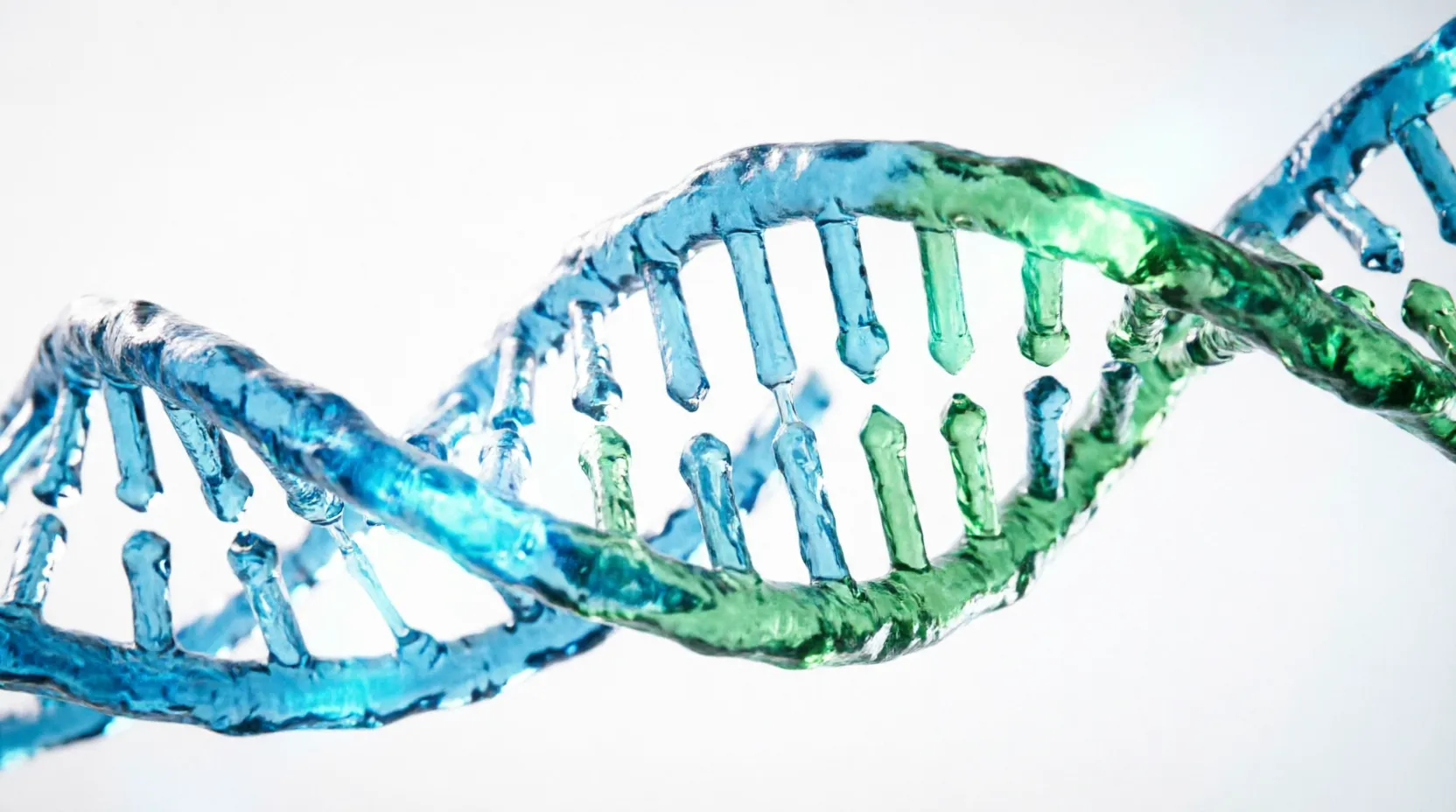
Because the molecule consists of two complementary strands that wind around a central axis in a spiral (helix) shape - similar to a twisted ladder. James Watson and Francis Crick described this structure in 1953.
Can DNA be damaged? +
Yes. UV radiation, chemicals, oxidative stress, and replication errors all damage DNA. Cells have multiple repair systems that fix most damage, but unrepaired mutations can lead to cancer or genetic disorders.