Visual answer
Tsunami Propagation
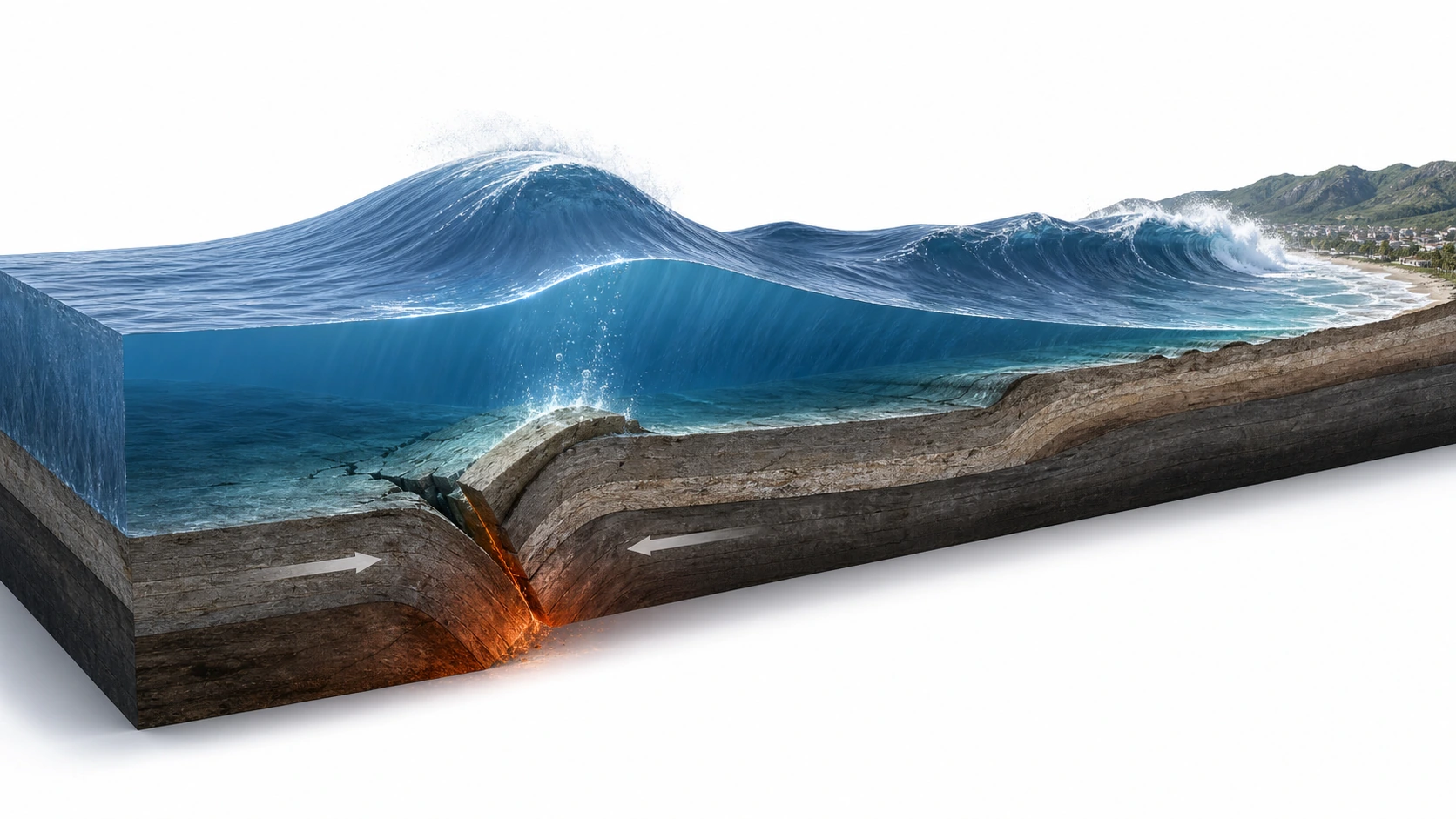
Deep ocean: fast and low. Continental shelf: slowing and compressing. Coastline: slower, taller, and destructive.
Seafloor shifts
A fault rupture lifts or drops a large area of ocean floor.
Water column moves
The water above the moving seafloor is displaced from bottom to surface.
Wave spreads outward
Energy radiates across the ocean as long waves.
Shallow water slows it
As depth decreases, the wave slows and compresses.
Height increases
The same energy concentrates into a taller wave near shore.
Surges repeat
Several waves can arrive minutes apart.
Answer
The Quick Answer
Tsunamis form when earthquakes, landslides, or eruptions suddenly displace a huge column of water, sending long waves across the ocean that grow taller as they slow in shallow water.
A wave can travel at the speed of a jet airplane and cross an ocean before anyone at the shore sees it.
Mechanism
From Fault To Shore
A tsunami moves the whole water column, not just the surface.
- 1
Seafloor shifts
A fault rupture lifts or drops a large area of ocean floor. Analogy: A loaded spring releasing.
- 2
Water column moves
The water above the moving seafloor is displaced from bottom to surface. Analogy: Lifting an entire bathtub.
- 3
Wave spreads outward
Energy radiates across the ocean as long waves. Analogy: Ripples scaled to a planet.
- 4
Shallow water slows it
As depth decreases, the wave slows and compresses. Analogy: Traffic bunching at a lane closure.
- 5
Height increases
The same energy concentrates into a taller wave near shore. Analogy: Momentum compressed into a smaller space.
- 6
Surges repeat
Several waves can arrive minutes apart. Analogy: A sequence of incoming pulses.
Curiosities
Details That Make It Stranger
These are the facts that turn the simple explanation into a better story.
Warning systems matter
The lack of an Indian Ocean warning system worsened the 2004 disaster.
Megatsunamis exist
Landslides in confined bays can create waves far taller than ocean tsunamis.
Ancient layers record them
Paleotsunamis leave marine sand sheets far inland.
Lakes can slosh too
Earthquakes can create seiches in enclosed bodies of water.
Story
Tilly Smith And The Beach That Evacuated
Ten-year-old Tilly Smith recognized the sea retreat before the 2004 tsunami from a school geography lesson and warned adults on a Thai beach.
Her story became a powerful example of why public education about natural warning signs saves lives.
Hidden mechanism
The Memory Of The Ocean
Large tsunamis can keep reflecting across ocean basins for days, like the ocean ringing after a planetary strike.
The deeper insight
The ocean and atmosphere are connected systems; huge water displacement can leave signals around the world.
Myths
Common Myths
What people think
Tsunamis are giant surfing waves
Tsunamis are giant surfing waves
What actually happens
Reality
They are usually fast surges or walls of water, not curling beach waves.
Another Misconception
What people think
Every earthquake causes a tsunami
Every earthquake causes a tsunami
What actually happens
Reality
Only events that significantly displace water, especially vertical seafloor movement, generate major tsunamis.
Quick answers
Common questions
Can you survive underwater? +
Divers at sufficient depth may be safer than people near shore, where turbulence and debris dominate.
How much warning time is typical? +
Local tsunamis may arrive in minutes; distant tsunamis may allow hours.
Why does the sea pull back? +
The trough of the wave can arrive first, drawing water seaward.
Can tsunamis happen in lakes? +
Yes, earthquake-driven seiches can slosh lake water violently.