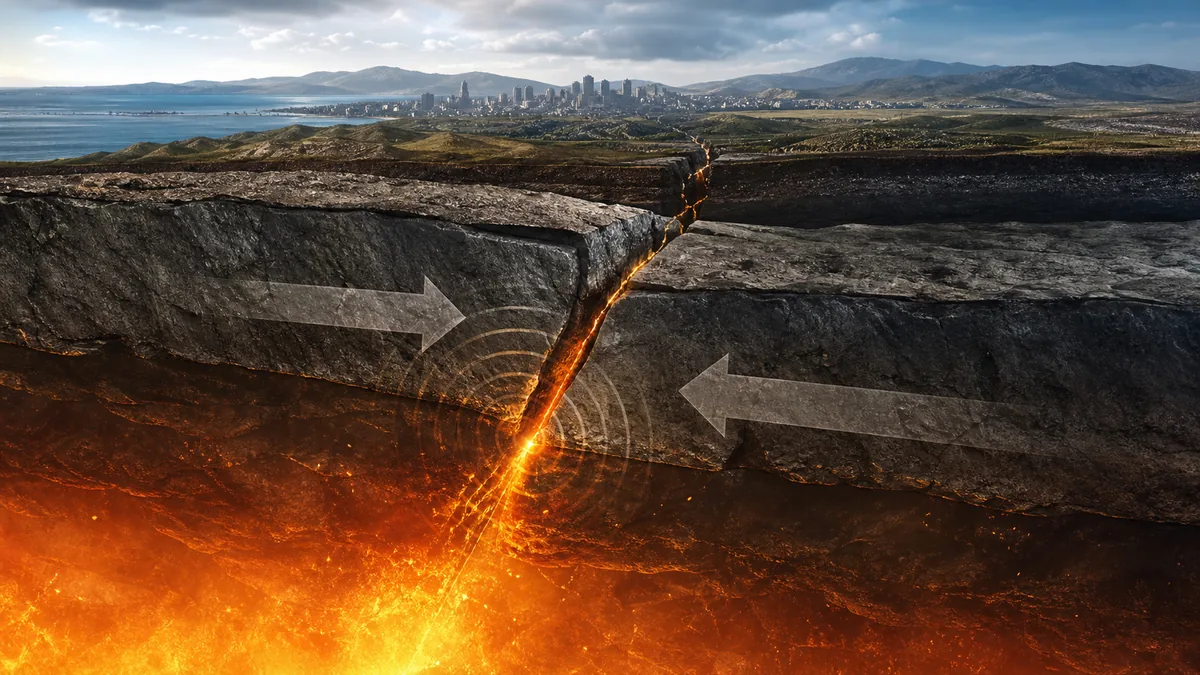
Visual answer
How an Earthquake Happens
From slowly moving plates to shaking ground, the six stages of an earthquake.
Tectonic plates slowly move
The Earth's outer shell is divided into large plates that drift continuously, a few centimetres per year, driven by heat from deep inside the planet.
Rocks become locked by friction
Where two plates meet, rough edges catch on each other. The plates want to keep moving but cannot. Stress begins to accumulate.
Stress builds underground
For years, decades, or even centuries, elastic energy accumulates in the rocks around the locked fault, like a spring being compressed.
Fault suddenly slips
Eventually the stress exceeds the friction holding the rocks in place. The fault snaps, rocks lurch metres in an instant, releasing all the stored energy at once.
Energy radiates outward
The sudden movement sends seismic waves radiating through the Earth in all directions from the point of rupture, called the hypocentre.
Ground shakes as waves pass
When seismic waves reach the surface, the ground shakes. The intensity depends on wave type, distance from the epicentre, and local geology.
How they work
How Do Earthquakes Work?
The Earth's outer layer, the crust, is not one solid piece. It is broken into roughly twenty large sections called tectonic plates, along with many smaller ones. These plates sit on a layer of partly molten rock and drift very slowly, driven by heat currents rising from deep inside the planet.
Most of the time this movement happens without incident. But where plates meet, the edges grind together. Rock is rough. Friction holds the edges in place even as the plates behind them keep pushing. Stress builds, slowly, invisibly, underground, like compressing a giant spring.
When the stress finally exceeds what friction can hold, the rocks snap. In the span of seconds, plates that have been locked for decades lurch forward by metres. That sudden movement sends energy radiating outward in all directions as seismic waves. When those waves reach the surface, the ground shakes. That is an earthquake.
Tectonic plates
How Do Tectonic Plates Cause Earthquakes?
Picture two enormous pieces of rock the size of continents, moving toward each other at roughly the pace your fingernails grow. When they meet, they do not glide smoothly past each other. They lock. The rocky surfaces catch on each other the way two rough sheets of sandpaper would if you pressed them together and tried to slide one sideways.
The plates keep moving but the locked edges refuse to go with them. The rock in and around the fault bends slightly, elastically, absorbing the stress. This can go on for hundreds of years. The longer it goes on, the more energy is stored, and the larger the eventual earthquake when the fault finally gives way.
The point underground where the rupture actually happens is called the hypocentre, or focus. The point on the surface directly above it is the epicentre, the place that usually experiences the most violent shaking.
Elastic rebound
What Is Elastic Rebound?
Elastic rebound is the name for what happens when a locked fault finally snaps. Think about bending a wooden stick. As you apply pressure, the stick bends, it is storing energy elastically. The moment it breaks, all that stored energy releases at once. The two halves spring back toward their original shapes.
Rock works the same way. The crust around a locked fault bends very slightly over years and decades, absorbing the stress from the moving plates. When the fault finally ruptures, the rock on either side of it snaps back, rebounding elastically, which is the sudden movement that generates the seismic waves.
The bigger the area of fault that ruptures, and the greater the displacement, how far the rocks actually move, the more energy is released and the larger the earthquake.
Away from fault lines
Can Earthquakes Happen Away From Fault Lines?
Most major earthquakes occur at or near the boundaries of tectonic plates, which is where the vast majority of known fault lines are. But earthquakes can happen far from those boundaries too, and the reasons are more varied than people expect.
Intraplate earthquakes occur in the middle of a tectonic plate, well away from its edges. Ancient faults that formed millions of years ago and have been dormant for centuries can still rupture if stress builds up for other reasons, changes in underground water pressure, the weight of glaciers being removed, or simply the long-term redistribution of stress within the plate.
Constructive plate boundaries, where plates are moving apart and new crust is being created, also produce earthquakes, though usually smaller ones than the massive collisions at convergent boundaries. The stretching and fracturing of crust as it pulls apart generates its own seismic activity. Mid-ocean ridges, where new seafloor is constantly being formed, are a continuous source of small quakes most people never hear about.
Measuring earthquakes
How Are Earthquakes Measured?
Earthquake size is measured in magnitude, a number that represents how much energy was released at the source. The key thing to understand about magnitude scales is that they are logarithmic. That means each whole number step represents roughly 31 times more energy than the one below it. A magnitude 7 earthquake does not release twice as much energy as a magnitude 6, it releases about 31 times more.
This is why the difference between a magnitude 5 and a magnitude 8 feels almost incomprehensible when you do the maths. A magnitude 8 earthquake releases roughly 30,000 times more energy than a magnitude 5.
Magnitude measures energy at the source. Intensity is a different measurement, it describes what the shaking actually feels like at a specific location, which depends on distance from the epicentre, depth of the quake, and the type of ground beneath your feet. Soft sediments amplify shaking far more than solid bedrock.
The Richter Scale
What Is the Richter Scale?
The Richter Scale was developed by seismologist Charles Richter in 1935. It was the first widely used method for assigning a single number to an earthquake's size, calculated from the amplitude of seismic waves recorded on a specific type of seismometer.
For decades it was the standard. Saying a quake measured 6.5 on the Richter Scale was universally understood. The scale was also logarithmic, each step up meant roughly ten times greater ground motion and about 31 times more energy released.
Modern seismologists mostly use the moment magnitude scale now, which handles very large earthquakes more accurately and works with a wider range of seismometer types. But the numbers look similar enough that the media and public still often say 'Richter Scale' when they mean moment magnitude. The practical difference rarely matters outside scientific reporting.
Seismometers
How Does a Seismometer Detect an Earthquake?
A seismometer works on a beautifully simple principle: the ground moves, but a suspended mass does not want to move with it. If you hang a heavy weight from a spring and shake the frame, the weight stays roughly still while everything around it moves. A seismometer uses this difference to record the motion.
In a traditional seismometer, the suspended mass has a pen attached to it. The pen rests against a slowly rotating drum of paper. When the ground shakes, the drum moves but the mass and pen stay almost still, so the pen draws a squiggly line on the paper that precisely records every vibration. That record is called a seismogram.
Modern seismometers are digital and far more sensitive. They can detect earthquakes happening on the other side of the planet, measure the tiny tremors from distant traffic, and distinguish the seismic signature of a nuclear test from a natural earthquake.
Finding the location
How Do Scientists Find an Earthquake's Location?
Seismic waves travel outward from the hypocentre in all directions. Different types of waves travel at different speeds, P-waves (primary waves) arrive first, S-waves (secondary waves) follow a little later. The gap between their arrivals at a seismometer tells scientists how far away the earthquake was.
One seismometer gives a distance but not a direction, the quake could be anywhere on a circle of that radius. A second seismometer gives a second circle. A third gives a third. Where all three circles overlap is the earthquake's location. This is triangulation.
With a global network of seismometers, scientists can pinpoint the epicentre of a major earthquake within minutes of it happening, and determine its depth underground with reasonable accuracy. The depth matters, a shallow earthquake directly beneath a city is far more destructive than a deep earthquake of the same magnitude in the same place.
Early warning systems
How Do Earthquake Early Warning Systems Work?
Earthquake early warning is not prediction, nobody can predict earthquakes. It is a race between the speed of seismic waves and the speed of electronic signals. Electronic signals travel at close to the speed of light. Seismic waves travel at a few kilometres per second. This gap, small as it is, can be enough to make a difference.
When a large earthquake begins, seismometers near the epicentre detect the first, weaker P-waves within seconds. That detection is instantly transmitted electronically to a warning system. Cities further from the epicentre receive the alert before the more damaging S-waves and surface waves arrive.
The warning time might be five seconds in some locations, thirty seconds in others, occasionally a minute or more for distant areas. That is enough time to stop trains, open firehouse doors, pause surgeries, move people away from dangerous positions, and trigger automated safety systems. It is a short window, but it saves lives.
Earthquakes in Pakistan
Do Earthquakes Happen in Pakistan?
Yes. Pakistan sits in one of the most seismically active regions on Earth. The Indian Plate is moving northward and colliding with the Eurasian Plate, the same geological collision that built the Himalayas and continues to push them higher by a few millimetres every year.
This ongoing collision generates enormous stress along multiple fault systems that run through Pakistan, Afghanistan, and northern India. The northern and western regions of Pakistan, including Khyber Pakhtunkhwa, Azad Kashmir, and Balochistan, experience the most significant seismic activity.
The 2005 Kashmir earthquake, which measured magnitude 7.6 and caused catastrophic destruction, was a direct result of this tectonic setting. Earthquake preparedness is a genuine and ongoing concern for the region, not a distant possibility.
Misconception
Common Misconception
What people think
Scientists can predict when earthquakes will happen.
Scientists can predict when earthquakes will happen.
What actually happens
Reality
No reliable method for predicting earthquakes exists. Scientists can identify regions of high seismic risk and estimate long-term probabilities, but the precise timing, location, and magnitude of any individual earthquake cannot currently be forecast. Early warning systems detect earthquakes as they start, they do not predict them in advance.
Quick answers
Common questions
What causes earthquakes? +
Earthquakes are caused by the sudden release of stress that has built up in the Earth's crust, usually along fault lines where tectonic plates meet. When friction holding the rocks in place is finally overcome, the rocks snap and move, releasing energy as seismic waves.
Can earthquakes happen away from fault lines? +
Yes. While most major earthquakes occur at tectonic plate boundaries, intraplate earthquakes can happen in the middle of a plate where ancient faults exist. Changes in underground pressure or the slow redistribution of stress within a plate can also trigger earthquakes far from obvious fault lines.
What is elastic rebound? +
Elastic rebound describes what happens when a locked fault finally snaps. The rocks on either side have been bending under stress for years. When the fault ruptures, they spring back toward their original positions, that sudden movement releases the stored energy as an earthquake.
How are earthquakes measured? +
Earthquakes are measured using magnitude scales, which quantify the energy released at the source. The scales are logarithmic, each whole number step represents roughly 31 times more energy. A magnitude 8 earthquake releases around 30,000 times more energy than a magnitude 5.
What is the Richter Scale? +
The Richter Scale was the original standard magnitude scale, developed in 1935. It is logarithmic, with each step representing about ten times greater ground motion. Modern seismologists typically use the moment magnitude scale, which is more accurate for large earthquakes, but the two scales give similar numbers.
How does a seismometer work? +
A seismometer uses a suspended mass that stays still when the ground shakes around it. The difference in movement between the stable mass and the moving frame records the vibration precisely. Modern digital seismometers are sensitive enough to detect earthquakes occurring on the opposite side of the Earth.
How do scientists locate earthquakes? +
Scientists use the time difference between P-wave and S-wave arrivals at multiple seismometer stations to calculate the distance to an earthquake. Where the distance circles from three or more stations overlap is the epicentre. This is triangulation.
Do earthquakes happen in Pakistan? +
Yes. Pakistan sits at the collision zone between the Indian Plate and Eurasian Plate, one of the most seismically active regions on Earth. Northern and western Pakistan experience significant earthquake risk, including the devastating 2005 Kashmir earthquake of magnitude 7.6.
Can earthquakes be predicted? +
Not currently. No reliable method exists to predict the precise time, location, or magnitude of an earthquake before it occurs. Scientists can identify high-risk regions and estimate long-term probabilities. Earthquake early warning systems detect quakes as they begin and send alerts before damaging waves arrive, but that is detection, not prediction.
What is the difference between magnitude and intensity? +
Magnitude measures the energy released at the earthquake's source, it is a single number for the whole event. Intensity measures how violent the shaking is at a specific location, which varies with distance, depth, and local geology. The same earthquake can feel very different in two different cities.