Visual answer
The ISS Sleep Environment
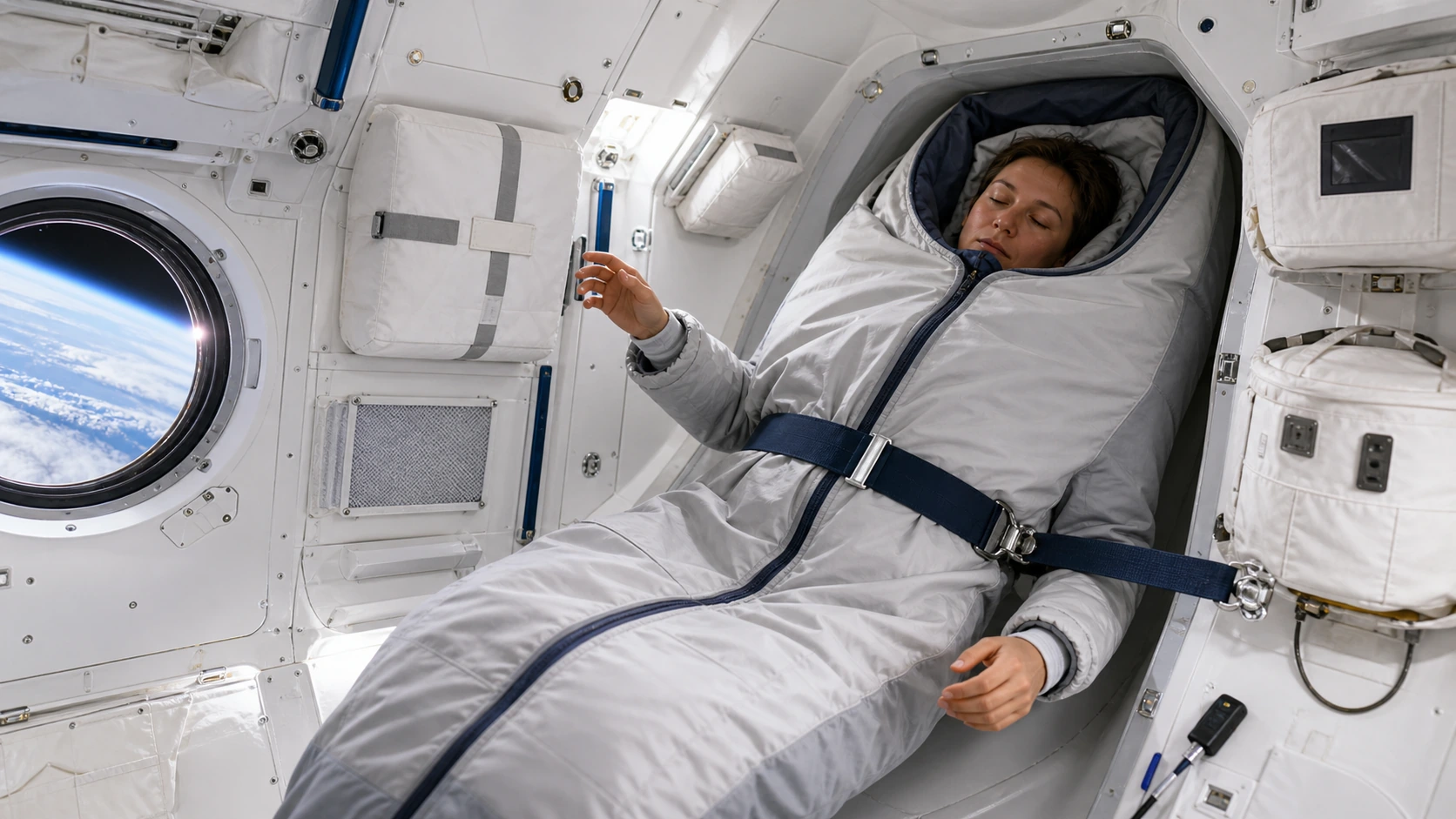
Astronaut sleep depends on pods, tethered sleeping bags, artificial lighting schedules, airflow, and noise control.
Light cues break
Rapid sunrises and sunsets confuse natural circadian timing.
Melatonin timing shifts
The body struggles to release sleep hormones at the expected time.
CO2 pools near the face
Without convection, exhaled air can linger unless fans move it away.
Noise fragments sleep
Fans, pumps, and equipment create constant background sound.
Pods create a sleep cue
Small personal compartments provide darkness, airflow, and psychological boundaries.
Answer
The Quick Answer
Astronauts sleep in small pods or tethered sleeping bags, using scheduled lighting, eye masks, ventilation, and routine to compensate for microgravity, noise, and 16 sunrises per day.
There is no up or down. No sunrise or sunset you can trust. Your body has no idea what time it is.
Mechanism
Fighting The Circadian System
Space disrupts almost every cue the human sleep system evolved to use.
- 1
Light cues break
Rapid sunrises and sunsets confuse natural circadian timing. Analogy: A watch being reset every 90 minutes.
- 2
Melatonin timing shifts
The body struggles to release sleep hormones at the expected time. Analogy: A conductor losing the tempo.
- 3
CO2 pools near the face
Without convection, exhaled air can linger unless fans move it away. Analogy: Breathing under a blanket.
- 4
Noise fragments sleep
Fans, pumps, and equipment create constant background sound. Analogy: Sleeping beside a running appliance.
- 5
Pods create a sleep cue
Small personal compartments provide darkness, airflow, and psychological boundaries. Analogy: A bedroom reduced to its essentials.
Curiosities
Details That Make It Stranger
These are the facts that turn the simple explanation into a better story.
Apollo sleep was rough
Early crews slept in cramped spacecraft with little privacy.
Naps are studied
NASA has researched strategic naps for alertness and performance.
Artificial gravity may help
Rotating habitats could improve fluid distribution and sleep.
Moon days are extreme
A lunar day lasts about 29 Earth days, requiring artificial light cycles.
Story
Scott Kelly And The Year In Space
NASA astronaut Scott Kelly spent 340 days on the ISS while his twin Mark remained on Earth, giving researchers a rare comparison of spaceflight effects.
The twins study helped inform planning for long-duration missions, including Mars.
Hidden mechanism
Sleep Debt In Orbit
Astronauts may underestimate cognitive impairment from lost sleep, even while objective reaction time and decision quality decline.
The deeper insight
For long missions, sleep is not comfort. It is a mission-critical system.
Myths
Common Myths
What people think
Astronauts float freely while sleeping
Astronauts float freely while sleeping
What actually happens
Reality
They are usually tethered or inside sleeping pods so they do not drift.
Another Misconception
What people think
Spacecraft interiors are silent
Spacecraft interiors are silent
What actually happens
Reality
Inside a spacecraft, life support and equipment are constantly noisy.
Quick answers
Common questions
Can astronauts dream in space? +
Yes. REM sleep and dreaming still occur, though sleep can be shorter and more fragmented.
What if they cannot sleep before a spacewalk? +
Critical tasks can be delayed when fatigue creates operational risk.
How do they know it is morning? +
The ISS uses scheduled lighting and clocks to simulate a day.
Do arms float during sleep? +
Yes, in microgravity limbs naturally drift without support.