Visual answer
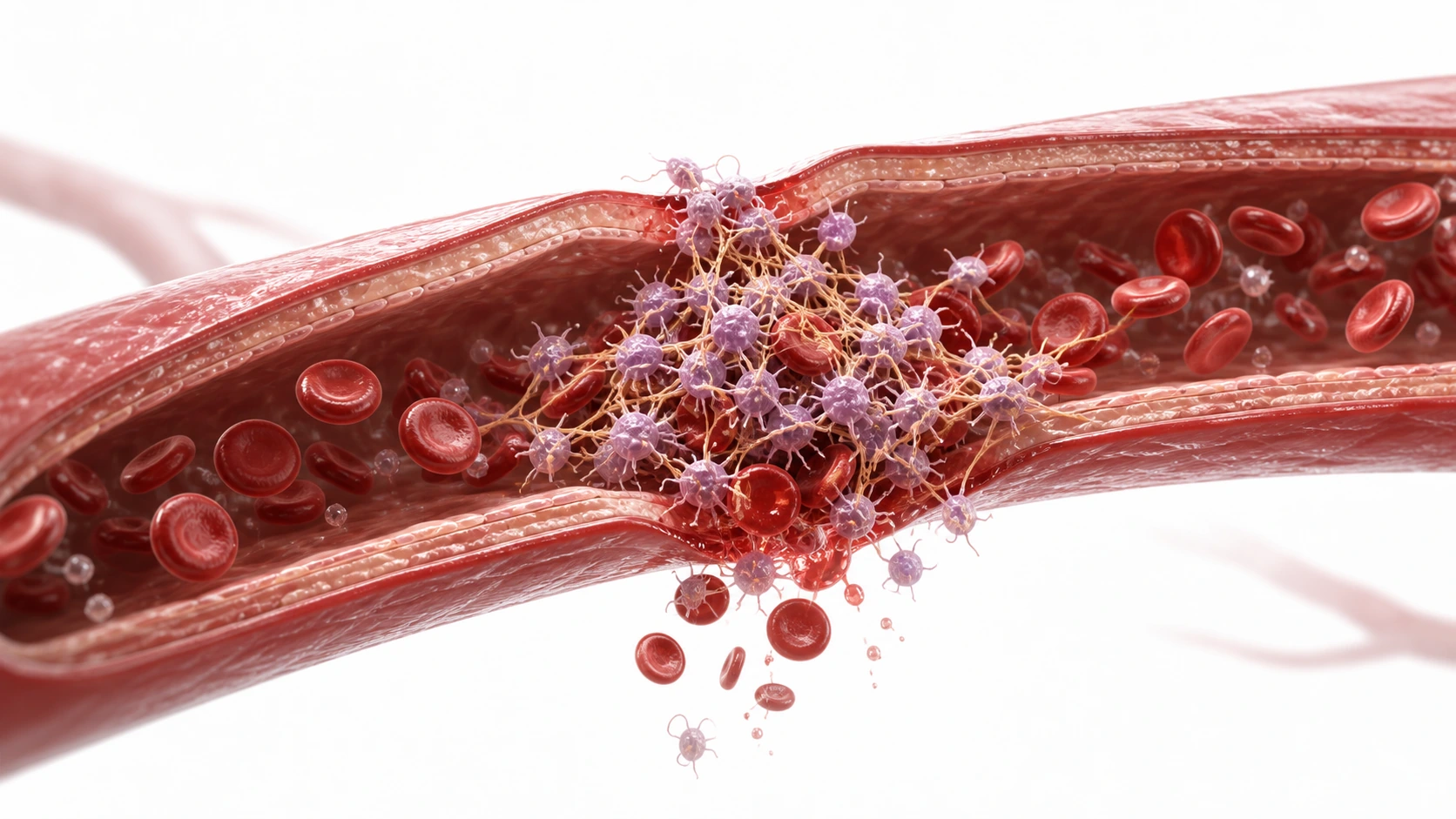
The Coagulation Cascade
Platelets create a temporary plug while clotting factors generate thrombin and fibrin, turning a fragile patch into a stable seal.
Vessel narrows
The injured vessel contracts to reduce blood loss.
Platelets stick
Exposed collagen attracts platelets, which activate and clump.
Cascade begins
Clotting factors activate one another with amplification.
Thrombin appears
Thrombin converts fibrinogen into fibrin strands.
Fibrin mesh forms
Fibrin traps cells and strengthens the plug.
Clot dissolves later
Plasmin cuts fibrin apart after healing.
Answer
The Quick Answer
Blood clotting is a cascading chemical relay that turns liquid blood into a tough fibrin mesh, sealing wounds quickly while trying to keep the clot limited to the injured area.
A tiny cut bleeds. Then it stops. What your body just did in 10 minutes would take engineers weeks to design.
Mechanism
Blood's Emergency Protocol
Clotting is a fast plug followed by a protein-reinforced seal.
- 1
Vessel narrows
The injured vessel contracts to reduce blood loss. Analogy: Pinching a leaking hose.
- 2
Platelets stick
Exposed collagen attracts platelets, which activate and clump. Analogy: Emergency sandbags.
- 3
Cascade begins
Clotting factors activate one another with amplification. Analogy: A row of larger and larger dominoes.
- 4
Thrombin appears
Thrombin converts fibrinogen into fibrin strands. Analogy: Turning liquid glue into solid thread.
- 5
Fibrin mesh forms
Fibrin traps cells and strengthens the plug. Analogy: Pouring concrete over sandbags.
- 6
Clot dissolves later
Plasmin cuts fibrin apart after healing. Analogy: Removing scaffolding.
Curiosities
Details That Make It Stranger
These are the facts that turn the simple explanation into a better story.
Vitamin K matters
Several clotting factors require vitamin K to function.
Leeches block clotting
Hirudin in leech saliva is a potent anticoagulant.
Snake venom targets clotting
Many venoms disrupt the clotting cascade.
Bruises are leaked blood
A bruise is blood outside vessels being broken down by the body.
Story
The Royal Disease
Queen Victoria carried hemophilia into European royal families. Alexei Romanov's hemophilia helped draw the Russian court toward Rasputin.
A mutation in one clotting factor gene affected family politics and European history.
Hidden mechanism
The Clot That Saves Or Kills
Clotting evolved to stop bleeding from injuries, but the same response can be triggered by ruptured arterial plaque.
The deeper insight
The system is ancient and brilliant, but modern vascular disease can activate it in the wrong place.
Myths
Common Myths
What people think
Bleeding stops because blood dries
Bleeding stops because blood dries
What actually happens
Reality
A clot is actively built from platelets and fibrin proteins, not passively dried blood.
Another Misconception
What people think
Blood thinners thin blood
Blood thinners thin blood
What actually happens
Reality
They reduce clot formation by inhibiting clotting steps; they do not simply dilute blood.
Quick answers
Common questions
What causes a bruise? +
Blood leaks from small vessels into tissue and later changes color as hemoglobin breaks down.
Can stress affect clotting? +
Stress hormones can increase platelet activity and clotting tendency.
Why do clots form on long flights? +
Immobility slows blood flow in leg veins, increasing clot risk.
Is thick blood dangerous? +
Hypercoagulable states increase the risk of stroke, heart attack, and embolism.