Visual answer
Innate Versus Adaptive Immunity
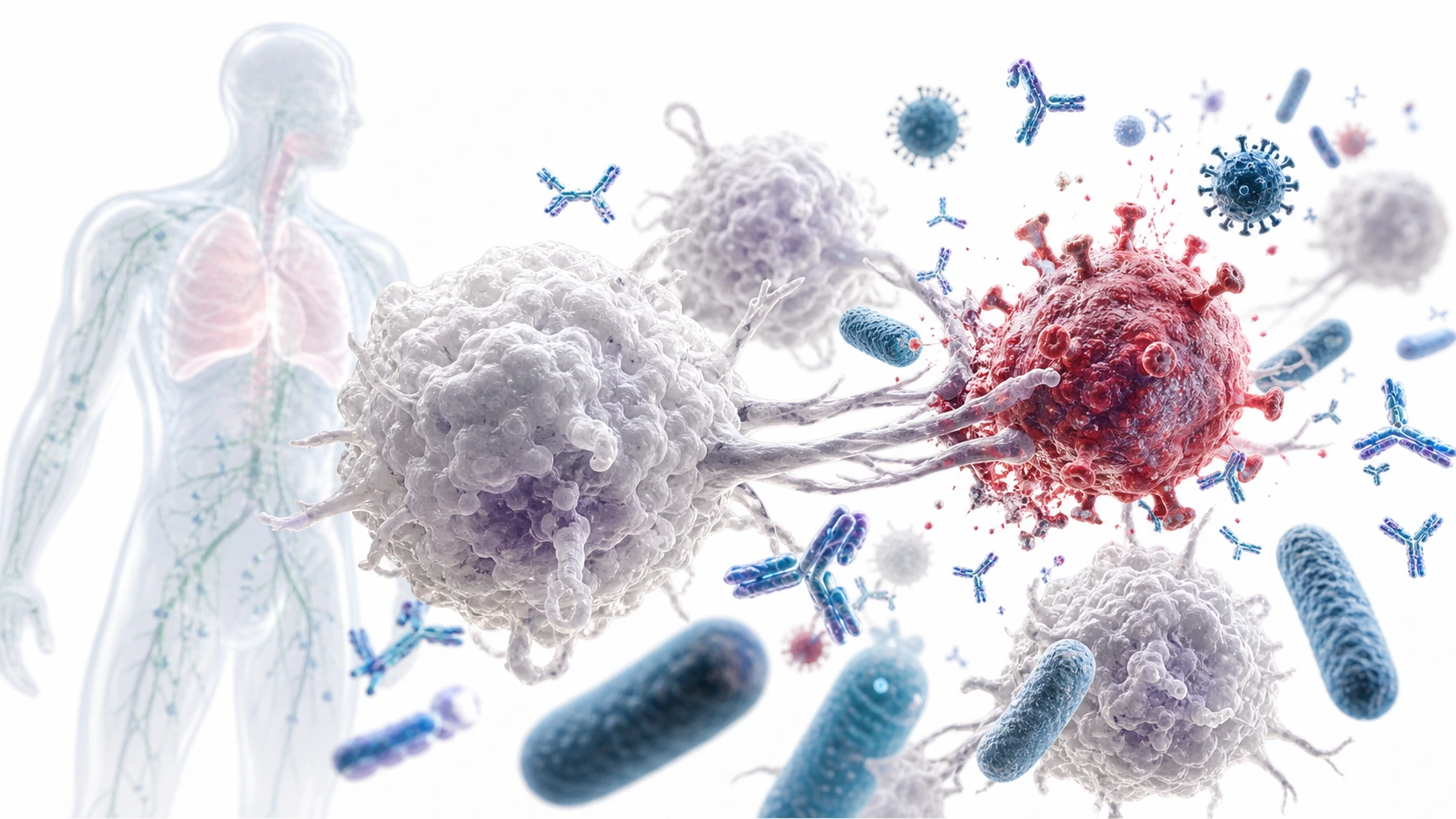
Innate immunity is fast and broad. Adaptive immunity is slower but specific and memorable. Vaccines exploit the adaptive layer by building memory without severe disease.
Physical barriers block entry
Skin, mucus, tears, stomach acid, and cilia stop many pathogens before immune cells are needed.
Innate immunity responds fast
Macrophages, neutrophils, and natural killer cells recognize broad danger patterns and attack quickly.
Inflammation calls reinforcements
Cytokines dilate vessels and summon immune cells, creating redness, heat, swelling, and pain.
Adaptive immunity learns the target
Dendritic cells show pathogen fragments to T and B cells, selecting the cells that match.
Antibodies neutralize invaders
B cells produce antibodies that bind specific targets and mark them for destruction.
Memory cells remain
After infection, long-lived memory cells persist so the next response is faster.
Answer
The Quick Answer
The immune system is a layered defense network of barriers, rapid innate cells, and precise adaptive cells that learn to recognize threats and remember them for future attacks.
Your body is fighting a war right now. You just cannot feel it.
Mechanism
Three Lines of Defense
The immune system acts through nested layers that detect, attack, learn, and remember.
- 1
Physical barriers block entry
Skin, mucus, tears, stomach acid, and cilia stop many pathogens before immune cells are needed. Analogy: A castle wall and moat.
- 2
Innate immunity responds fast
Macrophages, neutrophils, and natural killer cells recognize broad danger patterns and attack quickly. Analogy: Police responding before a detective arrives.
- 3
Inflammation calls reinforcements
Cytokines dilate vessels and summon immune cells, creating redness, heat, swelling, and pain. Analogy: A local alarm calling every nearby unit.
- 4
Adaptive immunity learns the target
Dendritic cells show pathogen fragments to T and B cells, selecting the cells that match. Analogy: A wanted poster for one specific criminal.
- 5
Antibodies neutralize invaders
B cells produce antibodies that bind specific targets and mark them for destruction. Analogy: Custom handcuffs for one suspect.
- 6
Memory cells remain
After infection, long-lived memory cells persist so the next response is faster. Analogy: Veterans who can train a new army overnight.
Curiosities
Details That Make It Stranger
These are the facts that turn the simple explanation into a better story.
Babies borrow immunity
Maternal antibodies cross the placenta and enter breast milk, giving newborns temporary protection.
The appendix may help
It appears to act as a reserve for beneficial gut bacteria after intestinal infections.
A sneeze spreads droplets
Sneezing can launch thousands of droplets, which is why respiratory pathogens exploit it.
Immune surveillance fights cancer
Immune cells can destroy abnormal cells before they become detectable cancer.
Story
The Boy in the Bubble
David Vetter was born with severe combined immunodeficiency and lived inside sterile plastic enclosures because ordinary microbes could kill him.
His case transformed SCID research and helped lead to modern screening and gene therapy approaches.
Hidden mechanism
The Discrimination Problem
The immune system's hardest job is deciding what not to attack. Every cell presents molecular identity tags that help immune cells distinguish self from danger.
The deeper insight
The immune system does not just defend you. It continuously defines the boundary between you and everything else.
Myths
Common Myths
What people think
Boosting your immune system is always good
Boosting your immune system is always good
What actually happens
Reality
An overactive immune system can cause allergies, autoimmunity, and dangerous inflammation. Calibration is the goal.
Another Misconception
What people think
Antibiotics help viral infections
Antibiotics help viral infections
What actually happens
Reality
Antibiotics target bacteria, not viruses.
Quick answers
Common questions
Can the immune system be trained? +
Yes. Vaccination and some allergy therapies deliberately train immune memory and tolerance.
Why does immunity weaken with age? +
The thymus shrinks and T-cell diversity falls, reducing responses to new threats.
Do animals have immune systems? +
All multicellular life has defense systems, though adaptive immunity is most developed in vertebrates.
How long does natural immunity last? +
It depends on the pathogen; measles immunity can be very long-lasting, while flu immunity changes quickly.