Quick Facts
Quick Facts
Herodotus is our main source for the battle. He wrote about 50 years after it happened.
The Greek force was not just 300 Spartans. It included several thousand other Greek soldiers.
The Spartans were not the only ones who stayed to fight. Other Greeks stayed as well.
The battle lasted three days. The Greeks held the pass for two. On the third, they were surrounded.
Leonidas was beheaded by the Persians after the battle. Xerxes ordered his head displayed on a pole.
Visual answer
The Battle of Thermopylae
What actually happened.
Day 1
The Greeks hold the pass. The Persian infantry is repulsed.
Day 2
The Persians attack again. The Greeks hold. Xerxes is frustrated.
Night 2
A Greek traitor, Ephialtes, shows the Persians a mountain path that bypasses the pass.
Day 3
Leonidas dismisses most of the Greek army. He and 1,500 Greeks, including 300 Spartans, stay to fight.
Day 3, Afternoon
The Greeks are surrounded. They fight to the last man. Leonidas is killed.
Story in brief
Story in Brief
480 BC
The Persian king Xerxes invades Greece with a massive army and navy.
August 480 BC
A Greek force, led by Leonidas, takes a position at the pass of Thermopylae.
The pass is narrow. It neutralizes the Persian numerical advantage.
Day 1
The Greeks hold the pass. The Persians cannot break through.
Day 2
The Greeks hold again. Xerxes is desperate.
Night 2
A Greek traitor named Ephialtes shows the Persians a mountain path.
The Greeks will now be surrounded.
Day 3
Leonidas dismisses most of the Greek army. He and a rearguard of about 1,500 Greeks, including his 300 Spartans, stay to fight.
The rearguard fights to the death. Leonidas is killed. The Persians march south and burn Athens.
The Story
What Herodotus Actually Wrote
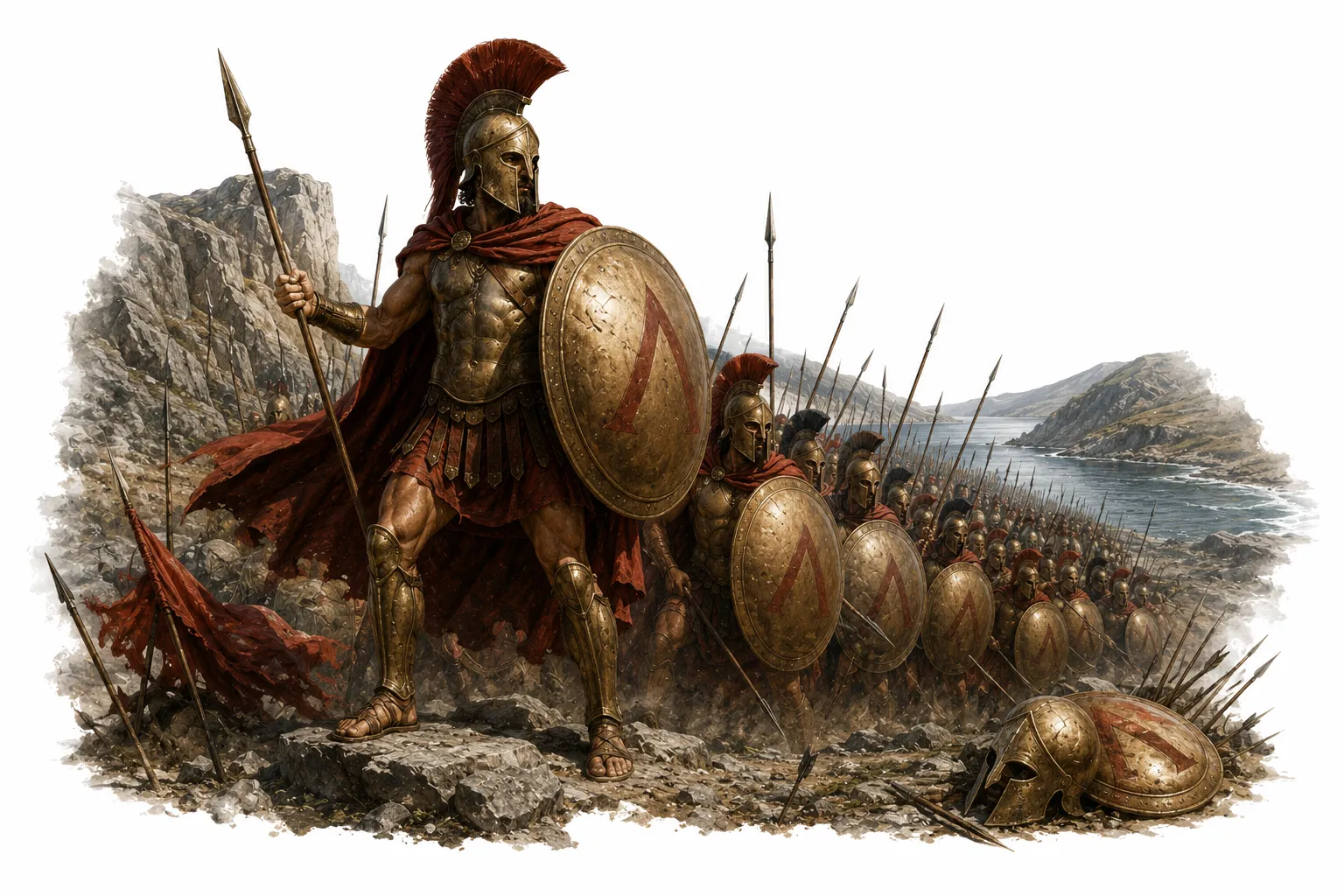
The Battle of Thermopylae is famous because of the 300 Spartans. But the real battle was larger. Herodotus, the Greek historian, wrote that Leonidas brought 300 Spartans. But he also brought several thousand other Greek soldiers. The total Greek force was about 7,000.
The battle lasted three days. For two days, the Greeks held the pass. The Persians could not break through. Then a Greek traitor, Ephialtes, showed the Persians a mountain path. The Greeks would be surrounded.
Leonidas dismissed most of the Greek army. He kept a rearguard of about 1,500 men, including his 300 Spartans. They fought to the last man. Leonidas was killed. The Persians beheaded him and displayed his head on a pole. The battle was a defeat. But it became a symbol. The 300 Spartans became legendary. The other Greeks were forgotten.
From Herodotus
"Go, stranger, and tell the Spartans that here, obedient to their orders, we lie."
, Herodotus, The Histories
Herodotus attributes these words to an epitaph carved on the Spartan tomb at Thermopylae. It is one of the most famous epitaphs in history.
Evidence
What Historians Agree On
Leonidas was a historical king of Sparta.
StrongThe Battle of Thermopylae happened in 480 BC.
StrongThe Greeks were defeated. Leonidas was killed.
StrongThe story of the 300 has been embellished. The real force was larger.
StrongKey Points
Key Points So Far
Leonidas was a real king of Sparta. He fought at Thermopylae in 480 BC.
The Greek force was not just 300 Spartans. It included thousands of other Greeks.
The Greeks held the pass for two days. On the third, they were outflanked.
Leonidas dismissed most of the army. He and a rearguard fought to the death.
He was killed and beheaded by the Persians.
Analogy
Like the Alamo
The familiar part
The Alamo is a famous last stand. A small group of defenders holds out against a much larger force. They all die. The story becomes a symbol.
How it applies
That is Thermopylae. The Spartans did not win. They died. But their sacrifice inspired the Greeks to keep fighting. The Persians were eventually defeated.
Where the analogy breaks
The Alamo defenders were not fighting a global superpower. The Spartans were.
Curiosity Notes
Details Most People Miss
Why this still matters
Why This Still Matters
The story of Thermopylae is still told because it is a story of courage. A small force facing impossible odds. A king who chose death over retreat. A sacrifice that inspired a nation. The details have been embellished. But the core is true. Leonidas was real. His sacrifice was real. That is why we still remember him.
Key Findings
- ✓Core findingLeonidas was a real king of Sparta. He fought at Thermopylae in 480 BC.
- ✓Strong evidenceThe Greek force was not just 300 Spartans. It included thousands of other Greeks.
- ⚠Main consequenceThe Greeks held the pass for two days before being outflanked.
- ✓Wider legacyLeonidas dismissed most of the army and fought to the death with a rearguard.
- ★Bottom lineHe was killed and beheaded by the Persians.
Final insight
A Last Thought
Leonidas was real. His 300 Spartans were real. The battle was real. But the story we tell is a simplification. It leaves out the thousands of other Greeks who fought alongside the Spartans. It leaves out the Greek traitor who betrayed them. It leaves out the Persians who won the battle but lost the war. The simplification is not a lie. It is a story. Stories are how we remember. The real history is messier. The real heroism is still there. Leonidas was real. That is enough.
Quick answers
Common questions
Was the movie '300' accurate? +
No. The movie exaggerated almost everything. The Spartans did not fight monsters. Xerxes was not a giant. The real battle was impressive enough without fantasy.
What happened to Leonidas's body? +
After the battle, Xerxes ordered Leonidas's head cut off and displayed on a pole. Forty years later, the Spartans retrieved his remains and buried them with honors.