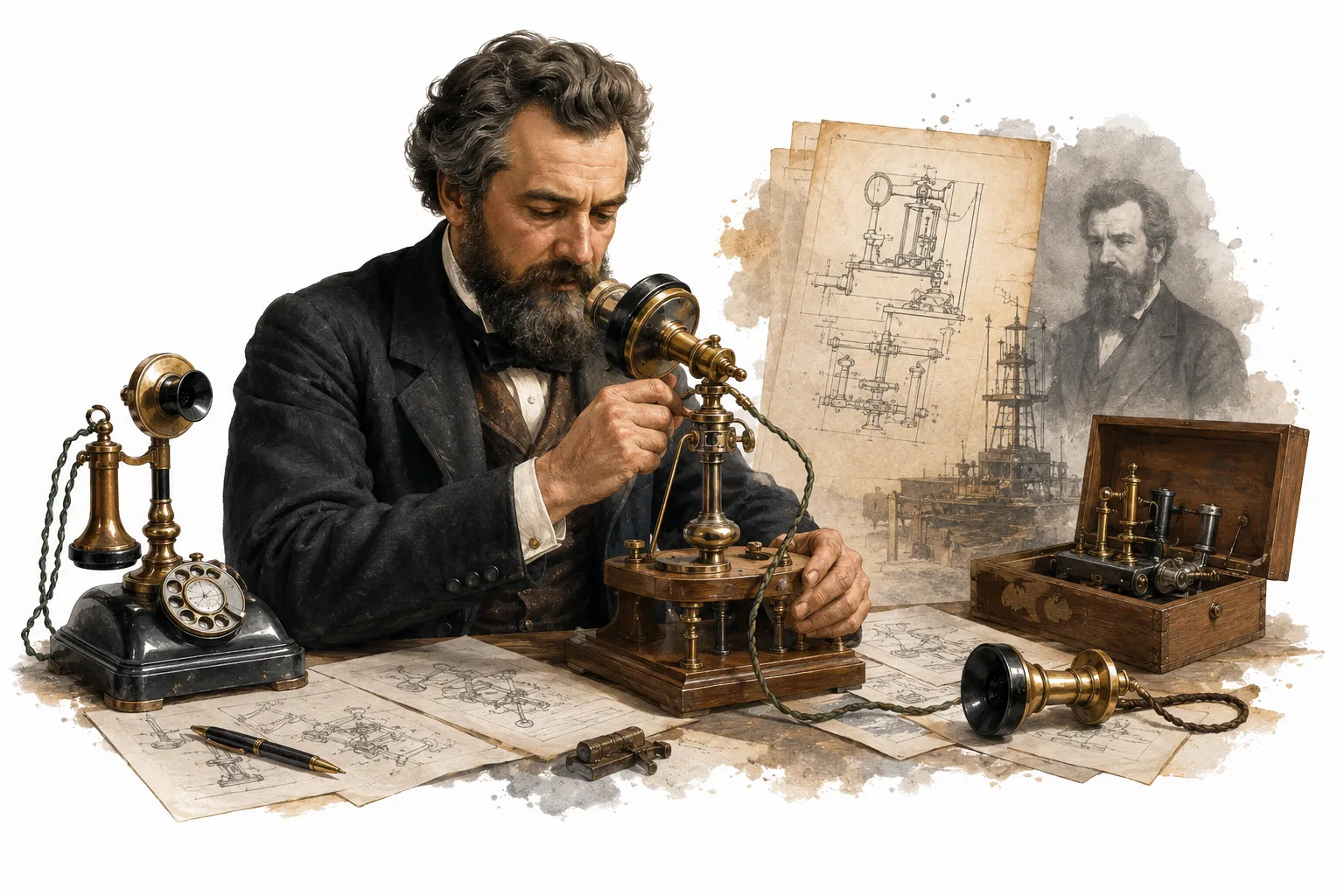
Quick Facts
Quick Facts
Bell's first successful telephone call was to his assistant, Thomas Watson: 'Mr. Watson, come here. I want to see you.'
The Bell Telephone Company was founded in 1877. It later became AT&T.
Elisha Gray's caveat was filed on the same day as Bell's patent application. Bell's was filed first in the morning. Gray's was filed in the afternoon.
Antonio Meucci demonstrated a working telephone in 1860 but could not afford the $250 patent fee.
The US government formally recognized Meucci's contributions in 2002.
Visual answer
The Race for the Telephone
Who did what, and when.
1860
Antonio Meucci demonstrates a working 'telectrophone' in New York. He cannot afford to patent it.
1870
Elisha Gray begins work on a telephone. He becomes a successful inventor.
1876, March 7
Bell files his patent application. Gray files a caveat on the same day. Bell is awarded the patent.
1876, March 10
Bell makes his famous call: 'Mr. Watson, come here. I want to see you.'
1877
Bell Telephone Company is founded. Bell becomes wealthy.
Story in brief
Story in Brief
1860
Antonio Meucci demonstrates a working telephone in New York. He calls it the 'telectrophone.'
Meucci was first. But he could not afford a patent. His work was forgotten.
1876, March 7
Bell files his patent application. Elisha Gray files a caveat for a similar device on the same day.
The patent office awards the patent to Bell. Gray sues.
1876, March 10
Bell makes his first successful call: 'Mr. Watson, come here. I want to see you.'
1887
The US government sues Bell, claiming the patent was obtained fraudulently.
The case drags on for years. Bell's patent is upheld.
2002
The US Congress passes a resolution recognizing Antonio Meucci's contributions to the invention of the telephone.
Meucci is formally acknowledged, 113 years after his death.
The Story
Who Really Invented the Telephone
The story of the telephone is a story of patents, not inventions. Antonio Meucci built a working telephone in 1860. He called it the 'telectrophone.' He demonstrated it to investors. Then he could not afford the $250 patent fee. His work was forgotten.
In 1876, Alexander Graham Bell and Elisha Gray both filed for patents on the same day. Bell's application was filed first in the morning. Gray's caveat was filed in the afternoon. The patent office awarded the patent to Bell. Gray sued, claiming that Bell had stolen his ideas.
The case went to the Supreme Court. Bell won. The Bell Telephone Company became a monopoly. Bell became one of the richest men in America. Gray received nothing. Meucci died in poverty. The telephone was 'invented' by the man who won the patent race, not necessarily the man who had the idea first.
Famous Quote
"Mr. Watson, come here. I want to see you."
, Alexander Graham Bell, March 10, 1876
These were the first intelligible words transmitted by telephone. Watson heard them clearly and ran to Bell's room.
Evidence
Who Did What
Antonio Meucci demonstrated a working telephone in 1860.
StrongBell and Gray both filed on the same day in 1876.
StrongBell's patent was upheld by the Supreme Court.
StrongMeucci was recognized by Congress in 2002.
StrongKey Points
Key Points So Far
Antonio Meucci demonstrated a working telephone in 1860 but could not afford a patent.
Bell and Gray both filed for patents on the same day in 1876.
Bell was awarded the patent. Gray sued. Bell won.
Bell became wealthy and famous. Meucci died poor.
Congress recognized Meucci's contributions in 2002.
Analogy
Like Winning a Race by a Photo Finish
The familiar part
Imagine a footrace where two runners cross the finish line at almost the same time. The judges declare a winner by a fraction of a second.
How it applies
The patent race was like that. Bell and Gray filed on the same day. Bell's paperwork was processed first. He won. If Gray's had been processed first, we might be calling it the 'Gray telephone.'
Where the analogy breaks
In a footrace, the winner is clearly faster. In the patent race, the winner was luckier.
Curiosity Notes
Details Most People Miss
Why this still matters
Why This Still Matters
The story of the telephone is a lesson in how invention really works. It is not about a single genius having a single idea. It is about multiple people working on similar problems, racing to be first. Bell won the race. But he was not alone. The telephone was born from competition, collaboration, and luck. That is how most inventions happen. The lone genius is a myth. The telephone is proof.
Key Findings
- ✓Core findingBell was the first to patent the telephone, but not necessarily the first to invent it.
- ✓Strong evidenceAntonio Meucci demonstrated a working telephone in 1860 but could not afford a patent.
- ⚠Main consequenceElisha Gray filed a caveat on the same day as Bell's patent application. Bell's was processed first.
- ✓Wider legacyBell's patent was upheld by the Supreme Court.
- ★Bottom lineThe US Congress recognized Meucci's contributions in 2002.
Final insight
A Last Thought
Alexander Graham Bell invented the telephone the way a runner wins a race: by being first to the finish line. But the finish line was the patent office. Meucci was faster in the laboratory. Gray was faster on paper. Bell was faster at the filing window. In the race for credit, the filing window matters more than the laboratory. That is not fair. But that is how the system works. Bell is remembered. Meucci is a footnote. The telephone is Bell's invention. But it could have been someone else's.
Quick answers
Common questions
Did Bell steal the telephone from Gray? +
There is no conclusive evidence. Bell's patent was upheld in court. But the timing is suspicious. Both men filed on the same day. Bell's lawyer may have seen Gray's caveat. We will never know for sure.
Who invented the telephone? +
The answer depends on your definition of 'invented.' Meucci built the first working model. Bell built the first commercially successful one and won the patent race. Both deserve credit.