Quick Facts
Quick Facts
Shakespeare's will mentions specific bequests to fellow actors.
Ben Jonson, a contemporary playwright, wrote a poem praising Shakespeare.
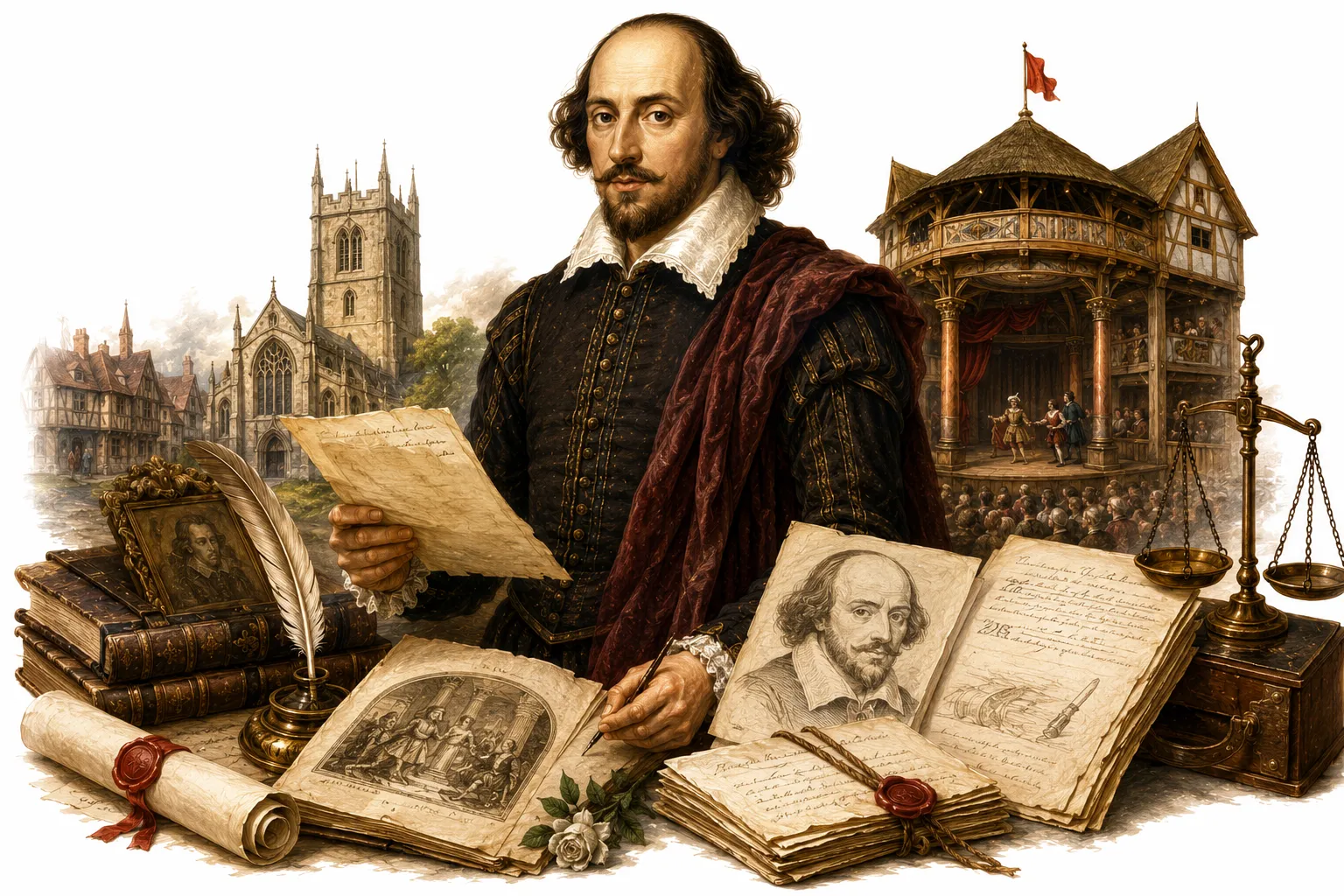
The First Folio (1623) includes a portrait and testimonials from other writers.
Shakespeare's name appears on the title pages of his plays during his lifetime.
No contemporary ever questioned that he wrote the plays.
Visual answer
The Evidence That Shakespeare Wrote Shakespeare
What we know about the man from Stratford.
Contemporary References
Other writers, including Ben Jonson and Robert Greene, refer to Shakespeare as a playwright during his lifetime.
The First Folio
Published in 1623 by his friends and fellow actors. It includes a portrait and testimonials.
His Will
Shakespeare leaves money to fellow actors Richard Burbage and John Heminges, who later edited the First Folio.
Title Pages
His name appears on the title pages of his plays during his lifetime. No one disputed it.
No Alternative
No contemporary document suggests anyone else wrote the plays. The conspiracy theories started in the 19th century.
Story in brief
Story in Brief
1592
Robert Greene attacks Shakespeare as an 'upstart crow.'
This is the first contemporary reference to Shakespeare as a playwright.
1594-1613
Shakespeare's name appears on title pages of his plays, including Romeo and Juliet, Hamlet, and King Lear.
1616
Shakespeare dies. His will mentions his fellow actors.
1623
The First Folio is published by his friends. It contains 36 plays and a portrait of Shakespeare.
Without the First Folio, half his plays would have been lost.
1850s
Delia Bacon publishes a book arguing that Francis Bacon wrote the plays.
The authorship question begins as a 19th century conspiracy theory.
1920s
The Earl of Oxford becomes the leading candidate. The theory persists today despite no evidence.
The Story
Why Some People Refuse to Believe
The idea that Shakespeare did not write Shakespeare is a 19th century invention. The first 'anti-Stratfordian' was Delia Bacon, an American writer who believed that Francis Bacon (no relation) wrote the plays. Her evidence? She said the plays were too sophisticated for a glover's son.
Since then, dozens of candidates have been proposed: the Earl of Oxford, Christopher Marlowe, Queen Elizabeth, even a group of writers. The theories change. The underlying snobbery does not. The argument is always the same: a man without a university education could not have written such brilliant works.
The problem is that the evidence is against them. Shakespeare's contemporaries named him as the author. His plays were published under his name. His will mentions fellow actors. No one in the 17th century doubted that Shakespeare wrote Shakespeare. The doubt started 200 years after his death, driven by class prejudice, not evidence.
Famous Quote
"He was not of an age, but for all time!"
, Ben Jonson, on Shakespeare
Jonson was a rival playwright. He praised Shakespeare in the First Folio. If anyone had a reason to deny Shakespeare's authorship, it was Jonson. He did not.
Evidence
Why Scholars Are Certain
Contemporary documents name Shakespeare as the author.
StrongNo contemporary ever questioned his authorship.
StrongThe First Folio was published by his friends and fellow actors.
StrongThe authorship question began in the 1850s, driven by snobbery, not evidence.
StrongKey Points
Key Points So Far
William Shakespeare of Stratford really existed and really wrote the plays.
Contemporary documents, including his will and references by other writers, confirm his authorship.
The authorship question began in the 19th century, driven by class prejudice.
No reputable scholar doubts Shakespeare's authorship.
Analogy
Like Believing the Moon Landing Was Faked
The familiar part
Imagine someone tells you the moon landing was faked. You ask for evidence. They say, 'It just seems too hard.'
How it applies
That is the authorship question. There is no evidence. Only incredulity. 'A glover's son could not have written Hamlet.' That is not evidence. That is prejudice.
Where the analogy breaks
Moon landing deniers have videos. Shakespeare deniers have nothing.
Curiosity Notes
Details Most People Miss
Why this still matters
Why This Still Matters
The authorship question matters because it reveals our biases. We want genius to look a certain way: educated, wealthy, aristocratic. When a glover's son becomes the greatest writer in history, we invent conspiracies to explain it away. That is not about Shakespeare. That is about us. We need to believe that genius is predictable. It is not. Genius comes from anywhere. Even Stratford.
Key Findings
- ✓Core findingYes, William Shakespeare of Stratford really existed and really wrote the plays.
- ✓Strong evidenceContemporary documents, including his will and references by other writers, confirm his authorship.
- ⚠Main consequenceThe authorship question began in the 19th century, driven by class prejudice.
- ✓Wider legacyNo reputable scholar doubts Shakespeare's authorship.
- ★Bottom lineThe conspiracy theories say more about the believers than about Shakespeare.
Final insight
A Last Thought
William Shakespeare really existed. He really wrote the plays. The evidence is clear. The doubters have nothing. But the doubters persist because they cannot accept the truth: genius is not predictable. It does not require a pedigree. It does not require a university education. It requires talent, work, and luck. Shakespeare had all three. He was a glover's son from a small town. That is not a problem. That is the point.
Quick answers
Common questions
Why do people think Shakespeare did not write his plays? +
Class prejudice. They cannot believe that a glover's son with a grammar school education could write such brilliant works. The evidence is overwhelming that he did. The doubt comes from snobbery, not scholarship.
Who is the most popular alternative candidate? +
The Earl of Oxford (Edward de Vere). He died in 1604. Shakespeare wrote plays until 1613. Oxfordians claim the plays were written earlier and 'released' after his death. There is no evidence for this.