Quick Facts
Quick Facts
Verne's submarine, the Nautilus, was electric. Real submarines at the time were hand-cranked or steam powered.
His moon spacecraft was launched from a giant cannon. Real spacecraft use rockets.
He predicted a global news network that would transmit information instantly.
He predicted the rise of electric vehicles as a clean alternative to fossil fuels.
He did not predict airplanes. He thought heavier-than-air flight was impossible.
Visual answer
What Verne Got Right and Wrong
A scorecard of his predictions.
Right: Electric Submarine
Verne's Nautilus was electric. Modern submarines are nuclear or diesel-electric.
Right: Lunar Module Size
His moon spacecraft's dimensions were close to the Apollo command module.
Right: News Networks
He predicted global real-time news. We have CNN, BBC, and the internet.
Wrong: Moon Cannon
A cannon cannot launch a spacecraft. The acceleration would kill the crew.
Wrong: Airplanes
Verne thought heavier-than-air flight was impossible. The Wright brothers proved him wrong in 1903.
Story in brief
Story in Brief
1865
From the Earth to the Moon is published. Verne describes a spacecraft launched by a giant cannon.
The dimensions of his spacecraft were close to the Apollo command module. But the launch method was impossible.
1870
Twenty Thousand Leagues Under the Sea is published. The Nautilus is an electric submarine.
Electric submarines became a reality decades later.
1873
Around the World in 80 Days is published. It celebrates the speed of modern travel.
1903
The Wright brothers fly the first airplane. Verne had said it was impossible.
Even geniuses can be wrong.
1954
The first nuclear submarine, USS Nautilus, is launched. It is named after Verne's fictional vessel.
Verne's name lives on in the real submarine.
The Story
Research, Not Revelation
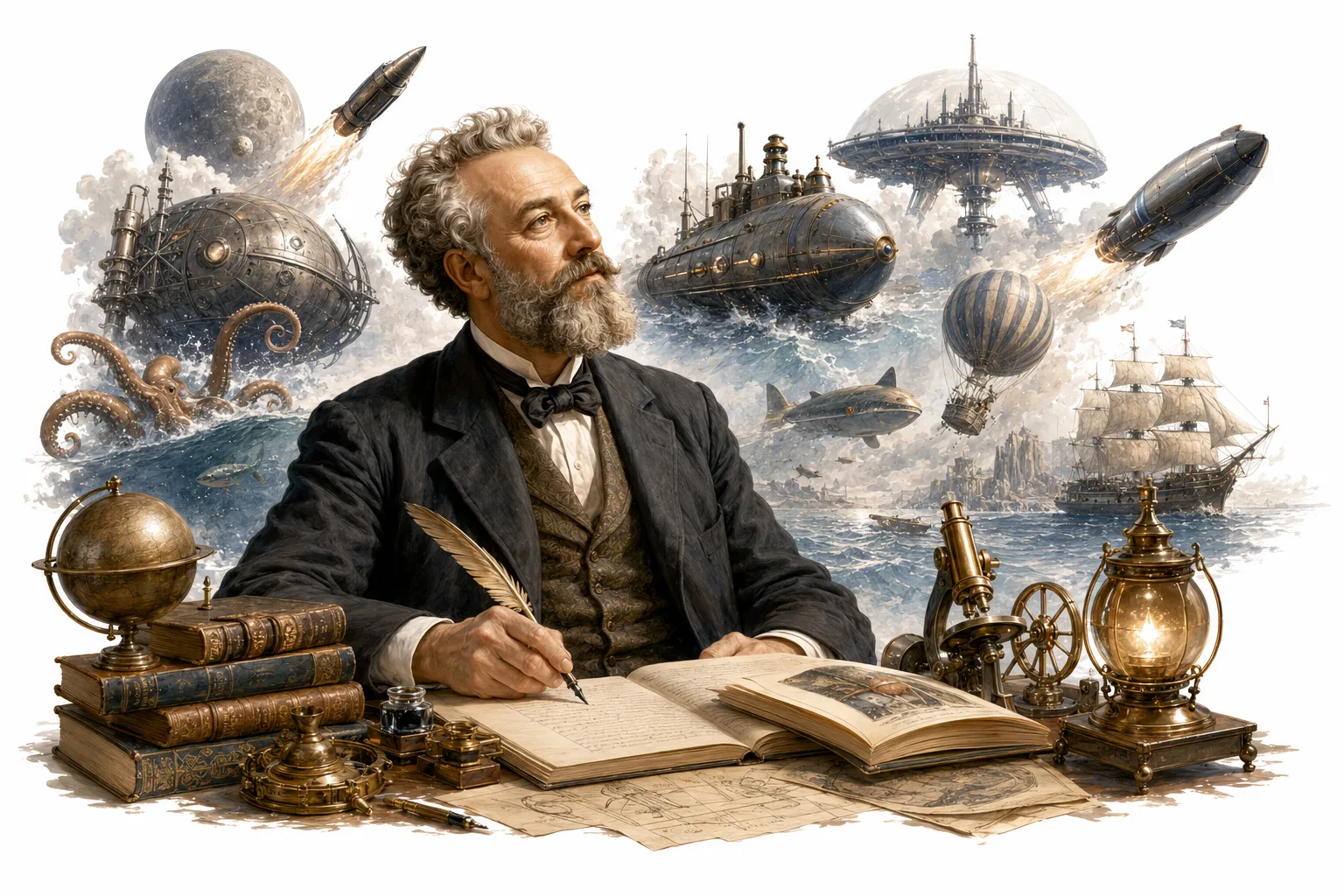
Jules Verne was not a psychic. He was a voracious reader. He subscribed to scientific journals. He visited factories and shipyards. He interviewed engineers. His 'predictions' were educated guesses based on the best available information.
His submarine, the Nautilus, was electric. At the time, submarines were powered by hand cranks or steam engines. But Verne knew that batteries were improving. He extrapolated. He imagined a submarine that could stay underwater for weeks. He was right.
His moon spacecraft was launched by a giant cannon. That was a mistake. Verne knew about rockets (fireworks had existed for centuries). But he thought rockets were too weak. He chose a cannon. He was wrong. The Apollo spacecraft used rockets. A cannon would have killed the crew.
Verne got some things right and some things wrong. That is not prophecy. That is science fiction.
Famous Quote
"Anything one man can imagine, other men can make real."
, Jules Verne
This quote captures his philosophy. He imagined. Others built. He was the idea man. They were the engineers.
Evidence
Verne's Track Record
He predicted electric submarines. They exist.
StrongHe predicted global news networks. They exist.
StrongHe predicted a moon landing. It happened. But his method (cannon) was wrong.
ModerateHe predicted electric vehicles. They exist.
StrongHe said heavier-than-air flight was impossible. It is possible.
StrongKey Points
Key Points So Far
Verne's 'predictions' were based on research and extrapolation, not magic.
He correctly imagined electric submarines, global news networks, and a moon landing.
He was wrong about using a cannon to launch spacecraft and about the impossibility of airplanes.
His accuracy is a testament to his intelligence, not supernatural powers.
Analogy
Like a Weather Forecaster
The familiar part
A weather forecaster predicts rain. They are not psychic. They look at data and make an educated guess.
How it applies
Verne was a forecaster of technology. He looked at the data (scientific journals, engineering trends) and made educated guesses. Sometimes he was right. Sometimes he was wrong. That is not prophecy. That is analysis.
Where the analogy breaks
Weather forecasters have computer models. Verne had a library.
Curiosity Notes
Details Most People Miss
Why this still matters
Why This Still Matters
Jules Verne is still read because he captured the excitement of technology. He imagined a world of machines and progress. Some of his imaginings came true. Others did not. But the spirit of his work, the sense that anything is possible, is still inspiring. We still dream of submarines, space travel, and electric cars. Verne dreamed them first. That is why we remember him.
Key Findings
- ✓Core findingJules Verne did not literally predict the future. He extrapolated from existing technology.
- ✓Strong evidenceHe correctly imagined electric submarines, global news networks, and a moon landing.
- ⚠Main consequenceHe was wrong about using a cannon to launch spacecraft and about the impossibility of airplanes.
- ✓Wider legacyHis accuracy is a testament to his intelligence, not supernatural powers.
- ★Bottom lineHe is still read because his stories capture the excitement of technological possibility.
Final insight
A Last Thought
Jules Verne did not predict the future. He imagined it. There is a difference. Prediction requires knowledge of the future. Imagination requires knowledge of the present and the courage to speculate. Verne had the courage. He read the science of his day. He extrapolated. He guessed. Some guesses were right. Some were wrong. The right ones make him look like a prophet. The wrong ones make him look human. He was both: a brilliant speculator and a man of his time. That is enough.
Quick answers
Common questions
Did Jules Verne predict the internet? +
Sort of. In Paris in the Twentieth Century, he predicted a global network that would transmit information electrically. He called it the 'phonographic telegraph.' It was similar to the internet in concept, though not in implementation.
What was Verne's biggest mistake? +
He thought heavier-than-air flight was impossible. The Wright brothers flew in 1903, two years before Verne's death. He lived long enough to be proven wrong.