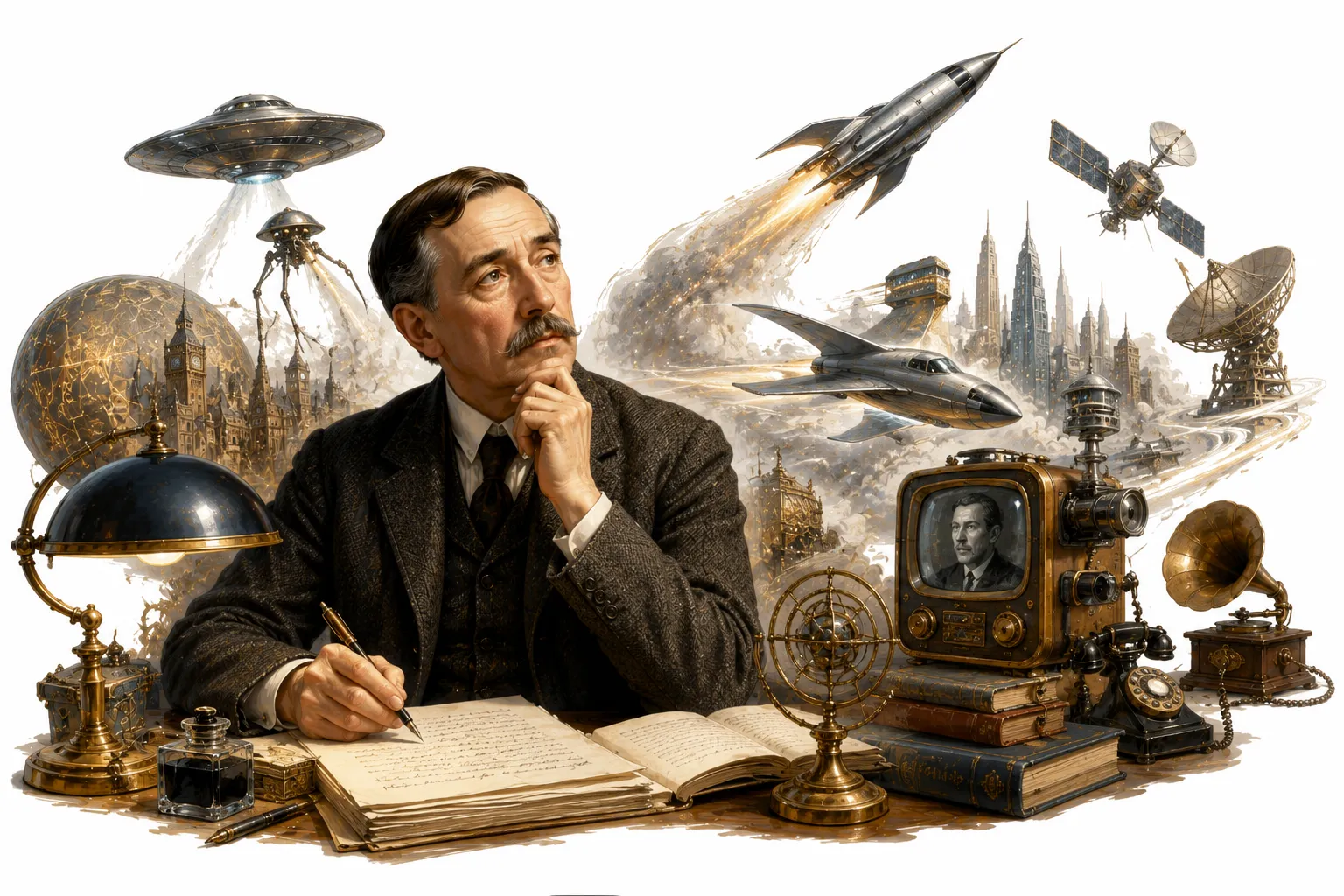
Quick Facts
Quick Facts
Wells studied biology under Thomas Henry Huxley, known as 'Darwin's Bulldog.'
He wrote over 100 books, including science fiction, history, and politics.
He was a socialist and a member of the Fabian Society.
He coined the term 'atomic bomb' in 1914, decades before it existed.
He predicted the internet in a 1938 book called 'World Brain.'
Visual answer
Wells's Predictions
What he got right and what he got wrong.
Atomic Bomb
The World Set Free (1914) describes 'atomic bombs' and nuclear chain reactions. Predicted by 31 years.
Laser
The War of the Worlds (1898) describes a 'heat ray' that kills instantly. Predicted by 62 years.
The Internet
World Brain (1938) describes a global information network accessible to all. Predicted by 50 years.
Wrong: Time Travel
The Time Machine (1895) imagined travel to the past. Physics says it is impossible.
Wrong: Invisible Man
The Invisible Man (1897) imagined invisibility. Still not possible.
Story in brief
Story in Brief
1895
Wells publishes 'The Time Machine.' He invents the concept of time travel.
1898
He publishes 'The War of the Worlds.' He describes a heat ray that anticipates lasers.
The novel becomes famous. Orson Welles's radio adaptation in 1938 causes a panic.
1901
He publishes 'The First Men in the Moon.' He predicts space travel.
1914
He publishes 'The World Set Free.' He coins the term 'atomic bomb.'
The book predicts nuclear war. Wells lives to see Hiroshima in 1945.
1938
He publishes 'World Brain.' He predicts a global information network.
The concept anticipates the internet.
1946
Wells dies. He has seen many of his predictions come true. He is not happy about it.
He wrote that humanity had failed to learn from his warnings.
The Story
How a Writer Predicted the 20th Century
In 1914, H. G. Wells published 'The World Set Free.' The novel described a future war fought with 'atomic bombs.' The bombs were small, portable, and devastating. They caused nuclear explosions. Cities were destroyed. The world was transformed.
Wells was not a physicist. He had studied biology. But he had read about radioactivity. He knew that scientists had discovered that atoms contained enormous energy. He imagined what would happen if that energy could be released. He was right.
When the first atomic bomb exploded in 1945, Wells was still alive. He was 79 years old. He had coined the term 'atomic bomb' 31 years earlier. He saw his prediction come true. He was horrified. He had warned humanity. Humanity had not listened.
Famous Quote
"The atomic bomb is the answer to the prayers of the militarist. It is the final weapon."
, H. G. Wells, 1914
He was right. The atomic bomb ended World War II. It also started the Cold War. It has not been used since. Wells hoped it would never be used again.
Evidence
Wells's Track Record
Predicted atomic bomb in 1914. Came true in 1945.
StrongPredicted laser in 1898. Came true in 1960.
StrongPredicted global information network in 1938. Came true with the internet.
StrongPredicted space travel. Came true in 1961 (Gagarin) and 1969 (Armstrong).
StrongPredicted biological weapons. Came true in the 20th century.
StrongKey Points
Key Points So Far
Wells predicted atomic bombs in 1914, 31 years before Hiroshima.
He predicted lasers in 1898.
He predicted a global information network (the internet) in 1938.
He predicted space travel and biological weapons.
He was not always right. Time travel and invisibility remain impossible.
Analogy
Like a Weather Forecaster
The familiar part
A weather forecaster looks at data and predicts rain. Sometimes they are right. Sometimes they are wrong.
How it applies
Wells was a weather forecaster for technology. He read the science of his day. He made predictions. Some were right. Some were wrong. He was right often enough to be impressive.
Where the analogy breaks
Weather forecasters have satellites. Wells had books. His accuracy is more impressive.
Curiosity Notes
Details Most People Miss
Why this still matters
Why This Still Matters
H. G. Wells is still famous because he saw the future. He did not see it because he was psychic. He saw it because he paid attention. He read science. He thought about consequences. He used his imagination. That is what science fiction is for. It is not prediction. It is warning. Wells warned us. We did not listen. But we still read him. That is his legacy.
Key Findings
- ✓Core findingWells predicted atomic bombs in 1914, 31 years before they were used.
- ✓Strong evidenceHe predicted lasers, space travel, and biological weapons.
- ⚠Main consequenceHe predicted a global information network that resembles the internet.
- ✓Wider legacyHe was not always right. Time travel and invisibility remain impossible.
- ★Bottom lineHe lived to see the atomic bomb used. He was horrified.
Final insight
A Last Thought
H. G. Wells predicted modern technology because he paid attention. He read the science of his day. He imagined where it might lead. He was right often enough to be called a prophet. But he was not a prophet. He was a writer. He used his imagination. He saw the atomic bomb coming. He wrote about it. No one stopped it. The bomb came anyway. That is the tragedy of prediction. You can see the future. You cannot change it.
Quick answers
Common questions
Did H. G. Wells invent the term 'atomic bomb'? +
Yes. He coined the term in his 1914 novel 'The World Set Free.' The term was adopted by scientists and the military.
Was Wells a scientist? +
He studied biology under Thomas Henry Huxley. He was trained as a scientist. He worked as a teacher before becoming a full-time writer.