
COGNITIVE BIAS

What Is the Availability Heuristic? Why You Overestimate What You Remember

You think plane crashes are more common than car crashes. You remember plane crashes. You forget car crashes. The availability heuristic explains why.

Editorial illustration of a brain with easily recalled memories overshadowing forgotten ones
Creator Amos Tversky, Daniel KahnemanOrigin PsychologyYear 1970sCategory Psychology, Cognitive Bias

QUICK ANSWER

Here is the idea in plain English.

The availability heuristic is a mental shortcut where people overestimate the likelihood of events based on how easily they come to mind. It was identified by Amos Tversky and Daniel Kahneman in the 1970s. The bias explains why vivid, dramatic, and recent events seem more common than they actually are. It is why you fear plane crashes more than car accidents, and why you overestimate the danger of things you see on the news.

If you remember only a few things, remember these.

The basic move

The availability heuristic is simple: you judge the likelihood of something by how easily you can remember it. If you can easily remember examples, you think it is common. If you cannot remember examples, you think it is rare.

Why it matters

This is not about facts. It is about memory. Dramatic events are easy to remember. Routine events are easy to forget. The easy-to-remember events seem more common than they are.

Use it deliberately

Recognize that your memory is biased. Easy-to-remember events are not more common. They are just more memorable.

CORE IDEA

The concept in its simplest useful form.

What Does the Availability Heuristic Mean in Simple Terms?

The availability heuristic is simple: you judge the likelihood of something by how easily you can remember it. If you can easily remember examples, you think it is common. If you cannot remember examples, you think it is rare.

This is not about facts. It is about memory. Dramatic events are easy to remember. Routine events are easy to forget. The easy-to-remember events seem more common than they are.

The bias explains why you fear plane crashes more than car accidents. You remember plane crashes. You forget car accidents. The heuristic is the cause.
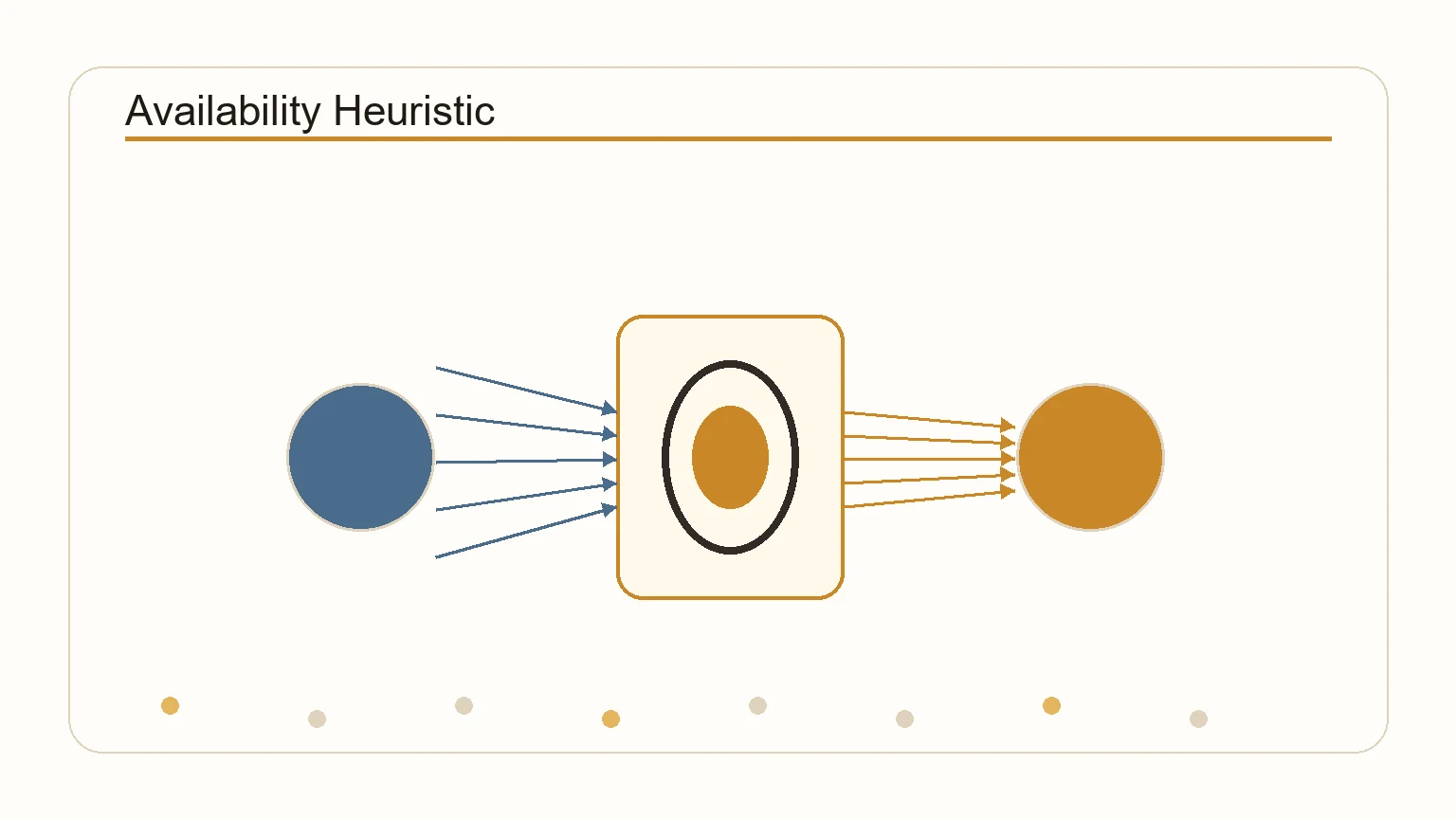

The small mechanism underneath the big idea.

01

The Story Behind the Availability Heuristic

In the 1970s, psychologists Amos Tversky and Daniel Kahneman were studying how people make judgments under uncertainty. They found that people do not reason about probabilities. They rely on mental shortcuts.

One of these shortcuts is the availability heuristic. People judge the likelihood of an event by how easily they can recall examples. If you can remember a plane crash, you think plane crashes are common. If you cannot remember a car crash, you think car crashes are rare.

The discovery was groundbreaking. It showed that human judgment is biased by memory. It explained why people overestimate rare risks and underestimate common ones.

02

Why the Availability Heuristic Became Famous

The availability heuristic became famous because it explains so many common errors. Why do people fear terrorism more than car accidents? Why do people overestimate the risk of rare diseases? The availability heuristic is the answer.

The concept was popularized by Tversky and Kahneman's research. Kahneman won the Nobel Prize in Economics for this work. The concept has been applied to everything from public policy to personal decision making.

Today, the availability heuristic is one of the most famous cognitive biases. It is a reminder that memory is not a reliable guide to probability.

Diagram showing how easily recalled events are judged as more common than equally frequent but less memorable events
A diagram showing the relationship between memory and perceived likelihood. Easily recalled events are judged as more common.

Where this idea shows up outside the textbook.

History

Tversky and Kahneman's research is the classic example. They found that people overestimate the frequency of dramatic events and underestimate the frequency of routine events.

Risk Perception

Plane crashes are easy to remember. Car accidents are easy to forget. People overestimate the risk of flying and underestimate the risk of driving.

News

The news covers dramatic events. It does not cover routine events. People overestimate the likelihood of the dramatic events.

Everyday Life

You are more likely to remember a shark attack than a drowning. You overestimate the risk of sharks and underestimate the risk of drowning.

CONCEPT MAP

Every idea has neighbors. This is where the current concept sits in the TinyThat knowledge graph.

Current concept

Availability Heuristic

What comes easily to mind feels more common or important.

What people often get wrong about this idea.

The availability heuristic is the same as the recency effect.

No. The recency effect is about recent events. The availability heuristic is about ease of recall. They are related but different.

You can eliminate the availability heuristic.

You cannot eliminate it. You can only recognize it. Awareness is the first step.

The availability heuristic only applies to risk perception.

No. It applies to everything: judgments, decisions, and evaluations. It is a general bias.

Useful ideas become dangerous when they are stretched too far.

Criticisms and Limitations of the Availability Heuristic

The availability heuristic is a powerful concept, but it has limitations. The effect varies across contexts and individuals. It is not universal.

The concept can be overused. Not every judgment is biased by memory. Sometimes people are rational.

The concept is a heuristic, not a law. It is a guide, not a rule.

Three simple ways to apply the idea without turning it into a slogan.

1

Recognize that your memory is biased

Recognize that your memory is biased. Easy-to-remember events are not more common. They are just more memorable.

2

When evaluating risk, look at the data

When evaluating risk, look at the data. Do not rely on your memory. The data is more reliable.

3

Be skeptical of vivid examples

Be skeptical of vivid examples. They are memorable, but they are not representative.

EXPLORE NEXT

The best next ideas to read after this one.

Quick answers to common questions.

What is the availability heuristic in simple terms?

You judge the likelihood of something by how easily you can remember it. Easy-to-remember events seem more common than they are.

What is an example of the availability heuristic?

You think plane crashes are more common than car accidents because you remember plane crashes more easily. You are wrong.

How do you avoid the availability heuristic?

Recognize that your memory is biased. Look at the data. Do not rely on your memory.

Why is the availability heuristic a problem?

It leads to distorted judgments. You overestimate rare risks and underestimate common ones.