STATISTICAL BIAS

What Is the Base Rate Fallacy? Why You Ignore the Numbers

You test positive for a rare disease. The test is 95% accurate. The disease affects 1 in 10,000 people. What is the chance you have the disease? Most people say 95%. They are wrong. That is the base rate fallacy.

Editorial illustration of a person ignoring statistical data in favor of vivid information
Creator Amos Tversky, Daniel KahnemanOrigin PsychologyYear 1970sCategory Psychology, Statistics

QUICK ANSWER

Here is the idea in plain English.

The base rate fallacy is a cognitive bias where people ignore general statistical information (base rates) in favor of specific, vivid information. It was identified by Daniel Kahneman and Amos Tversky in the 1970s. The bias explains why people overestimate rare risks and underestimate common ones. It is a common error in medical diagnosis, legal judgment, and everyday decision making.

If you remember only a few things, remember these.

The basic move

The base rate fallacy is simple: you ignore the general numbers. You focus on the specific case. You think the specific case is more important than the base rate.

Why it matters

A disease affects 1 in 10,000 people. A test is 95% accurate. You test positive. The chance you have the disease is not 95%. It is much lower. The base rate matters.

Use it deliberately

When making a judgment, ask: what is the base rate? What is the general probability?

CORE IDEA

The concept in its simplest useful form.

What Does the Base Rate Fallacy Mean in Simple Terms?

The base rate fallacy is simple: you ignore the general numbers. You focus on the specific case. You think the specific case is more important than the base rate.

A disease affects 1 in 10,000 people. A test is 95% accurate. You test positive. The chance you have the disease is not 95%. It is much lower. The base rate matters.

The bias is common. It affects doctors, judges, and everyday people. The solution is to remember the base rate.

The small mechanism underneath the big idea.

01

The Story Behind the Base Rate Fallacy

In the 1970s, Daniel Kahneman and Amos Tversky were studying how people make judgments under uncertainty. They found that people ignore general statistical information in favor of specific, vivid information.

Their classic example was the medical diagnosis problem. People were given a test for a rare disease. They were told the test was 95% accurate. They were not told the base rate. They overestimated the chance they had the disease.

The discovery was groundbreaking. It showed that people are not rational statisticians. They are influenced by vivid information and ignore the numbers.

02

Why the Base Rate Fallacy Became Famous

The base rate fallacy became famous because it explains a common error: ignoring the numbers. The bias is pervasive in medicine, law, and everyday life.

The concept was popularized by Kahneman and Tversky's research. It became a cornerstone of behavioral economics.

Today, the base rate fallacy is one of the most recognized cognitive biases. It is a reminder to think about the numbers.

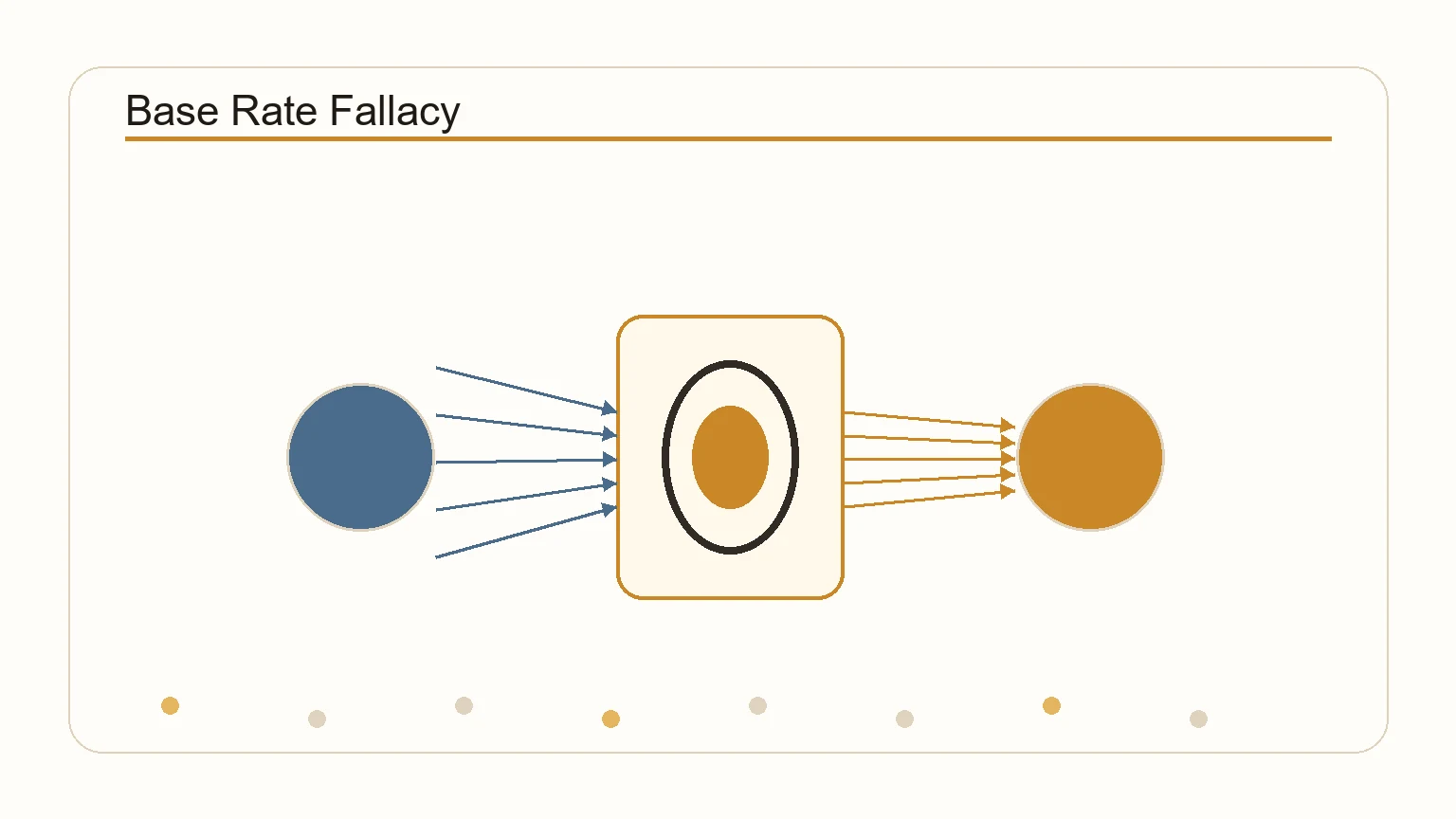
Diagram showing how base rates are ignored in favor of specific information
A diagram showing the difference between base rate and specific information, and why the base rate is often ignored.

Where this idea shows up outside the textbook.

Medicine

Doctors overestimate the chance of rare diseases because they focus on test results and ignore base rates.

Law

Juries overestimate the chance of rare events because they focus on vivid evidence and ignore base rates.

Finance

Investors overestimate the chance of rare market events because they focus on recent trends and ignore base rates.

Everyday Life

You overestimate the chance of a plane crash because you remember vivid stories and ignore the base rate.

CONCEPT MAP

Every idea has neighbors. This is where the current concept sits in the TinyThat knowledge graph.

Current concept

Base Rate Fallacy

People ignore general probabilities when judging a specific case.

What people often get wrong about this idea.

The base rate fallacy means you should ignore specific information.

No. It means you should not ignore the base rate. Both matter. The base rate is the starting point.

The base rate fallacy only applies to medicine.

No. It applies to law, finance, and everyday life. Anywhere there is probability.

You can eliminate the base rate fallacy.

You cannot eliminate it. You can only recognize it. The solution is to think about the numbers.

Useful ideas become dangerous when they are stretched too far.

Criticisms and Limitations of the Base Rate Fallacy

The base rate fallacy is a powerful concept, but it has limitations. Sometimes the base rate is not available. Then you must rely on specific information.

The concept can be overused. Not every case is about base rates. Sometimes the specific information is more important.

The concept is a heuristic, not a law. It is a guide, not a rule.

Three simple ways to apply the idea without turning it into a slogan.

1

When making a judgment, ask: what is the base rate? What is the general probability?

When making a judgment, ask: what is the base rate? What is the general probability?

2

Do not ignore the numbers

Do not ignore the numbers. Specific information is vivid. The base rate is the starting point.

3

Remember: the base rate is the prior probability

Remember: the base rate is the prior probability. It should be your starting point.

EXPLORE NEXT

The best next ideas to read after this one.

Quick answers to common questions.

What is the base rate fallacy in simple terms?

You ignore general probabilities in favor of specific information. The numbers matter, but you forget them.

What is an example of the base rate fallacy?

You test positive for a rare disease. You think you have it. You ignore the base rate. The chance is much lower than you think.

How do you avoid the base rate fallacy?

When making a judgment, ask: what is the base rate? What is the general probability? Remember the numbers.

Why is the base rate fallacy a problem?

It leads to overestimating rare risks and underestimating common ones. You make bad decisions because you ignore the numbers.