
COGNITIVE BIAS

What Is Survivorship Bias? Why Success Stories Are Misleading

You only see the winners. The losers are invisible. Survivorship bias explains why your view of success, business, and history is probably wrong.

Editorial illustration showing a survivor walking through a graveyard of failures
Creator Abraham Wald (statistical formulation)Origin World War IIYear 1940sCategory Cognitive Bias, Statistics

QUICK ANSWER

Here is the idea in plain English.

Survivorship bias is the logical error of focusing on the people or things that 'survived' a selection process while overlooking those that did not. This creates a distorted view of success because failures are invisible. The classic example is World War II planes: the military wanted to reinforce the areas with bullet holes. A statistician named Abraham Wald pointed out that they should reinforce the areas without bullet holes, because planes hit there never came back.

If you remember only a few things, remember these.

The basic move

Survivorship bias is the tendency to focus on winners and ignore losers. You look at successful people, successful companies, or successful strategies. You think you see a pattern. But you are only seeing the ones that succeeded. The ones that failed are invisible.

Why it matters

This is a problem because the successful survivors often share traits with the failures. The difference between success and failure is often invisible or random. If you only study the winners, you will build a flawed model of success.

Use it deliberately

Always ask: what am I not seeing? What are the invisible failures? Who tried this and failed?

CORE IDEA

The concept in its simplest useful form.

What Does Survivorship Bias Mean in Simple Terms?

Survivorship bias is the tendency to focus on winners and ignore losers. You look at successful people, successful companies, or successful strategies. You think you see a pattern. But you are only seeing the ones that succeeded. The ones that failed are invisible.

This is a problem because the successful survivors often share traits with the failures. The difference between success and failure is often invisible or random. If you only study the winners, you will build a flawed model of success.

The bias is everywhere. You see it in business, investing, history, and personal development. Once you understand it, you start noticing the invisible failures everywhere.

The small mechanism underneath the big idea.

01

The Story Behind Survivorship Bias

During World War II, the US military wanted to protect bombers from enemy fire. They studied the planes that returned from missions. They mapped the bullet holes and wanted to add armor to the areas that were hit most often.

Then Abraham Wald, a statistician, pointed out the fatal flaw: they were only studying the planes that survived. The planes that were hit in the most vulnerable areas never made it back. Those planes were invisible.

Wald recommended adding armor to the areas where the returning planes had no bullet holes. The logic was simple: if a plane returned with bullet holes in the wings, the wings could survive damage. If a plane was hit in the engine, it crashed. The engines had no bullet holes because planes with damaged engines did not return.

This insight transformed military strategy. It also gave us one of the most powerful mental models in history: survivorship bias.

02

Why Survivorship Bias Became Famous

Survivorship bias became famous because it explains the most common mistake in business and investing: copying the winners. People look at successful entrepreneurs and try to imitate them. They ignore the thousands who tried the same thing and failed.

The concept became widely known through books like 'Fooled by Randomness' by Nassim Nicholas Taleb. Taleb showed that success is often luck disguised as skill. Survivorship bias is a key part of that argument.

Today, survivorship bias is one of the most important mental models in decision making. It helps you see the invisible failures that others ignore.

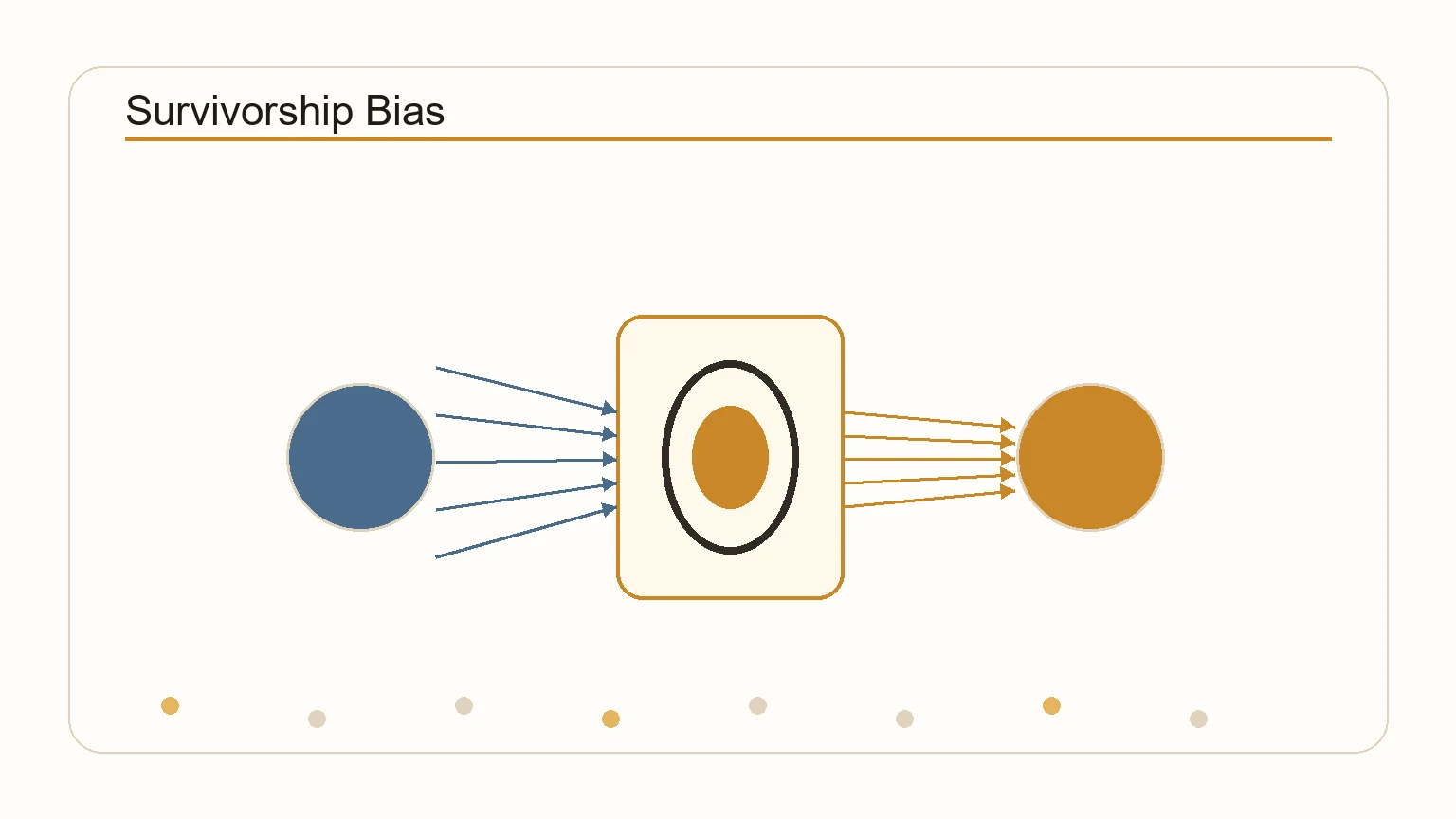
Diagram showing survivors vs. failures, illustrating the invisibility of failures
A diagram showing a group of people starting a journey. Some succeed and become visible. Others fail and disappear. The observer only sees the survivors.

Where this idea shows up outside the textbook.

History

The WWII bomber example is the classic case. The military wanted to reinforce the areas with bullet holes. Wald pointed out that they should reinforce the areas without bullet holes because those planes never returned.

Business

You look at successful startups. They all took risks, worked hard, and had great ideas. You conclude that risk, hard work, and ideas lead to success. You ignore the thousands of startups that took risks, worked hard, and had great ideas and still failed.

Everyday Life

You think about successful people. They all dropped out of college or took unconventional paths. You conclude that dropping out of college is a good idea. You ignore the millions who dropped out and failed.

Internet Culture

You see viral influencers. They all have a certain look or style. You conclude that look is the key to success. You ignore the millions with the same look who never went viral.

CONCEPT MAP

Every idea has neighbors. This is where the current concept sits in the TinyThat knowledge graph.

Current concept

Survivorship Bias

You see the winners while the failures disappear from view.

Commonly confused with

Selection BiasConfirmation Bias

What people often get wrong about this idea.

Survivorship bias only applies to business and investing.

It applies everywhere: history, medicine, evolution, architecture, and personal development. Anywhere there is selection, there is survivorship bias.

You can avoid survivorship bias by studying failures.

You cannot study failures that are invisible. You can only study the failures that are visible. The invisible failures are the problem.

Survivorship bias is a form of confirmation bias.

They are different. Confirmation bias is about seeking evidence that confirms your beliefs. Survivorship bias is about missing evidence because it is invisible.

Useful ideas become dangerous when they are stretched too far.

Criticisms and Limitations of Survivorship Bias

Survivorship bias is a powerful mental model, but it has limitations. It does not tell you what to do. It only tells you what to avoid.

The bias can be overstated. Sometimes the survivors really do share traits that the failures do not. The challenge is distinguishing between causal traits and coincidental traits.

The invisible failures are not always invisible. Sometimes the data exists. It is just ignored. Survivorship bias is as much about attention as it is about data.

Three simple ways to apply the idea without turning it into a slogan.

1

Always ask: what am I not seeing? What are the invisible failures? Who tried this and failed?

Always ask: what am I not seeing? What are the invisible failures? Who tried this and failed?

2

Be skeptical of success stories

Be skeptical of success stories. They are selected for success. Look for the failures.

3

When evaluating a strategy, look at the base rate

When evaluating a strategy, look at the base rate. How many people tried this and failed?

EXPLORE NEXT

The best next ideas to read after this one.

Quick answers to common questions.

What is survivorship bias in simple terms?

You only see the winners. You do not see the losers. This makes you think success is more common or more predictable than it actually is.

What is an example of survivorship bias?

You look at successful companies and copy their strategies. You do not look at the companies that tried the same strategies and failed.

How do you avoid survivorship bias?

Look for the invisible failures. Ask: who is missing from this picture? What data is not being shown?

Why is survivorship bias a problem?

It leads to false conclusions about success. You think you know what works, but you are only looking at the winners. The failures are invisible.