BEHAVIORAL ECONOMICS

What Is Loss Aversion? Why Losing Hurts More Than Winning Feels Good

Losing $100 hurts more than winning $100 feels good. The pain is about twice as powerful. Loss aversion explains why we hate losing more than we love winning.

Editorial illustration of a balance scale with loss weighing heavier than gain
Creator Daniel Kahneman, Amos TverskyOrigin Behavioral EconomicsYear 1979Category Psychology, Economics

QUICK ANSWER

Here is the idea in plain English.

Loss aversion is a cognitive bias where the pain of losing is psychologically twice as powerful as the pleasure of gaining. It was identified by Daniel Kahneman and Amos Tversky in their work on prospect theory. Loss aversion explains why people avoid risks, hold onto losing investments, and irrationally prefer the status quo. It is one of the most powerful biases in decision making.

If you remember only a few things, remember these.

The basic move

Loss aversion is simple: losing hurts more than winning feels good. The pain of a $100 loss is about twice as powerful as the joy of a $100 gain.

Why it matters

This bias affects everything. It makes you avoid risks. It makes you hold onto losing investments. It makes you prefer the status quo. The fear of loss is more powerful than the hope of gain.

Use it deliberately

Recognize when loss aversion is driving your decisions. Ask: am I avoiding loss or seeking gain?

CORE IDEA

The concept in its simplest useful form.

What Does Loss Aversion Mean in Simple Terms?

Loss aversion is simple: losing hurts more than winning feels good. The pain of a $100 loss is about twice as powerful as the joy of a $100 gain.

This bias affects everything. It makes you avoid risks. It makes you hold onto losing investments. It makes you prefer the status quo. The fear of loss is more powerful than the hope of gain.

Loss aversion is not rational. But it is human. We are wired to avoid loss. Evolution favored survival over optimization. The bias is a feature, not a bug.
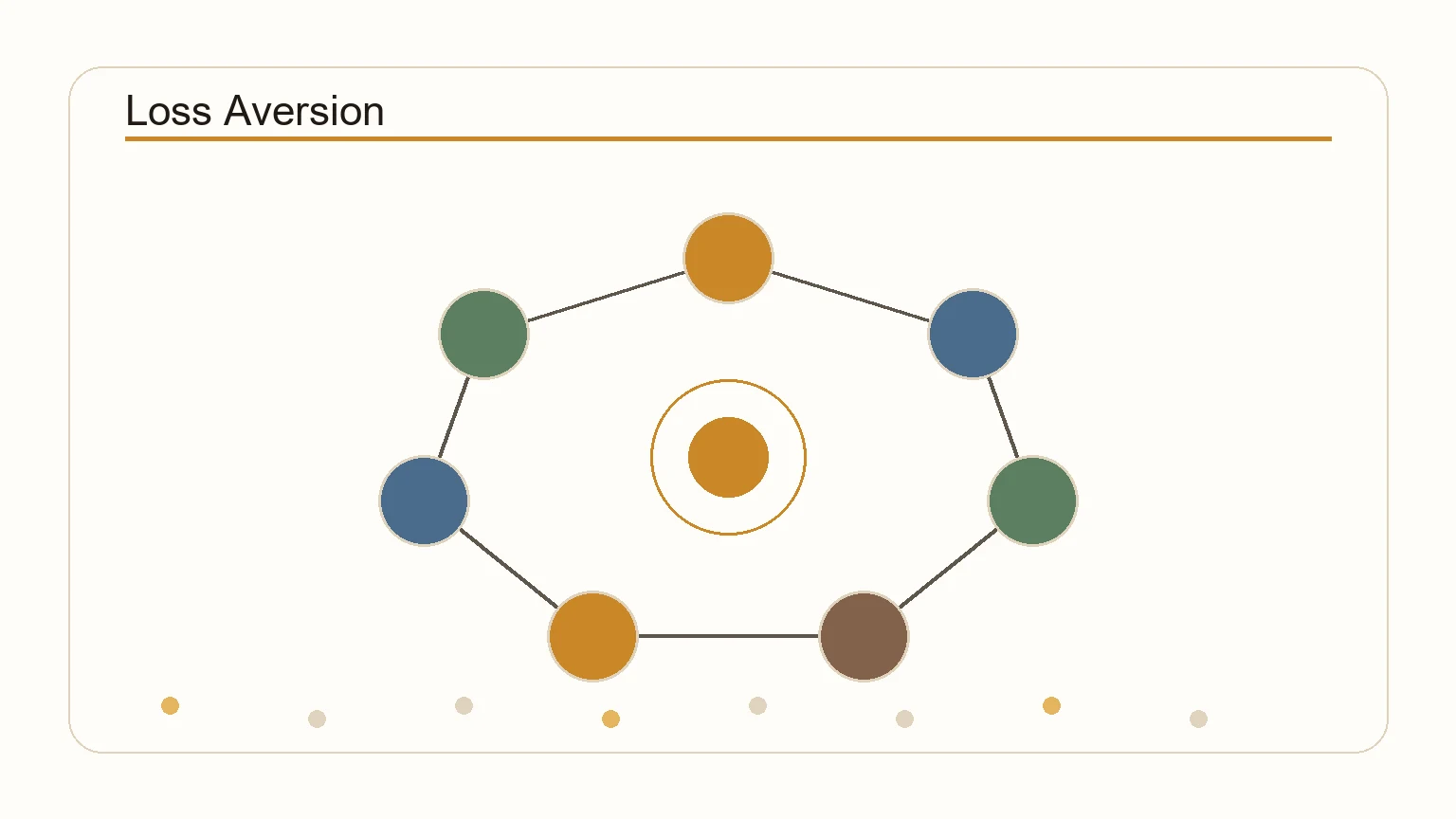

The small mechanism underneath the big idea.

01

The Story Behind Loss Aversion

In 1979, psychologists Daniel Kahneman and Amos Tversky published their groundbreaking work on prospect theory. They were studying how people make decisions under uncertainty. They found something surprising: people are not rational.

Kahneman and Tversky discovered that the pain of losing is about twice as powerful as the pleasure of winning. Losing $100 hurts twice as much as winning $100 feels good. This is loss aversion.

The discovery changed economics. It showed that people are not rational actors. They are emotional. They are biased. They are human. Loss aversion is one of the most important findings in behavioral economics.

02

Why Loss Aversion Became Famous

Loss aversion became famous because it explains so many irrational behaviors. Why do people hold onto losing stocks? Why do they avoid risks? Why do they prefer the status quo? Loss aversion is the answer.

The concept was popularized by Kahneman and Tversky's research. Kahneman won the Nobel Prize in Economics for this work. The concept has been applied to finance, marketing, and public policy.

Today, loss aversion is one of the most important concepts in behavioral economics. It is a reminder that humans are not rational. We are emotional. We are biased. We are human.

Diagram showing the asymmetry between loss and gain in prospect theory
A diagram showing the asymmetry between the pain of loss and the pleasure of gain. Loss is about twice as powerful.

Where this idea shows up outside the textbook.

Finance

Investors hold onto losing stocks. They do not want to realize the loss. They hope the stock will recover. Loss aversion is the cause.

Marketing

Companies offer free trials. Once you have something, you do not want to lose it. The fear of loss keeps you subscribing.

Everyday Life

You prefer to keep what you have rather than trade it for something better. The risk of loss is more powerful than the hope of gain.

Internet Culture

You stay in a bad relationship because you fear losing what you have. The fear of loss is more powerful than the hope of something better.

CONCEPT MAP

Every idea has neighbors. This is where the current concept sits in the TinyThat knowledge graph.

Current concept

Loss Aversion

Losses feel more painful than equivalent gains feel good.

What people often get wrong about this idea.

Loss aversion means people are afraid of all losses.

No. It is a tendency, not a rule. People are more sensitive to losses than gains. But the degree varies.

Loss aversion is the same as risk aversion.

No. They are related but different. Risk aversion is about uncertainty. Loss aversion is about the asymmetry of loss and gain.

Loss aversion can be eliminated.

No. It is a fundamental part of human psychology. You can manage it. You cannot eliminate it.

Useful ideas become dangerous when they are stretched too far.

Criticisms and Limitations of Loss Aversion

Loss aversion has been criticized for being context-dependent. The degree of loss aversion varies across cultures, contexts, and individuals. It is not universal.

The concept can be overused. Not every decision is driven by loss aversion. Sometimes people are just cautious.

The theory has been challenged by some researchers. The original 2:1 ratio may not hold in all circumstances. The concept is still useful, but it is not a fixed law.

Three simple ways to apply the idea without turning it into a slogan.

1

Recognize when loss aversion is driving your decisions

Recognize when loss aversion is driving your decisions. Ask: am I avoiding loss or seeking gain?

2

Use loss aversion to your advantage

Use loss aversion to your advantage. Frame decisions in terms of avoiding loss. It is a powerful motivator.

3

Be skeptical of the status quo

Be skeptical of the status quo. Loss aversion makes you prefer the familiar. Sometimes the unfamiliar is better.

EXPLORE NEXT

The best next ideas to read after this one.

Quick answers to common questions.

What is loss aversion in simple terms?

Losing hurts more than winning feels good. The pain of a $100 loss is about twice as powerful as the joy of a $100 gain.

What is an example of loss aversion?

You hold onto a losing stock because you do not want to realize the loss. The fear of loss is more powerful than the hope of gain.

How do you use loss aversion?

Recognize when it is driving your decisions. Frame decisions in terms of avoiding loss. Be skeptical of the status quo.

Why is loss aversion a problem?

It leads to irrational decisions. You hold onto losses. You avoid risks. You prefer the status quo. The fear of loss is often irrational.