Visual answer
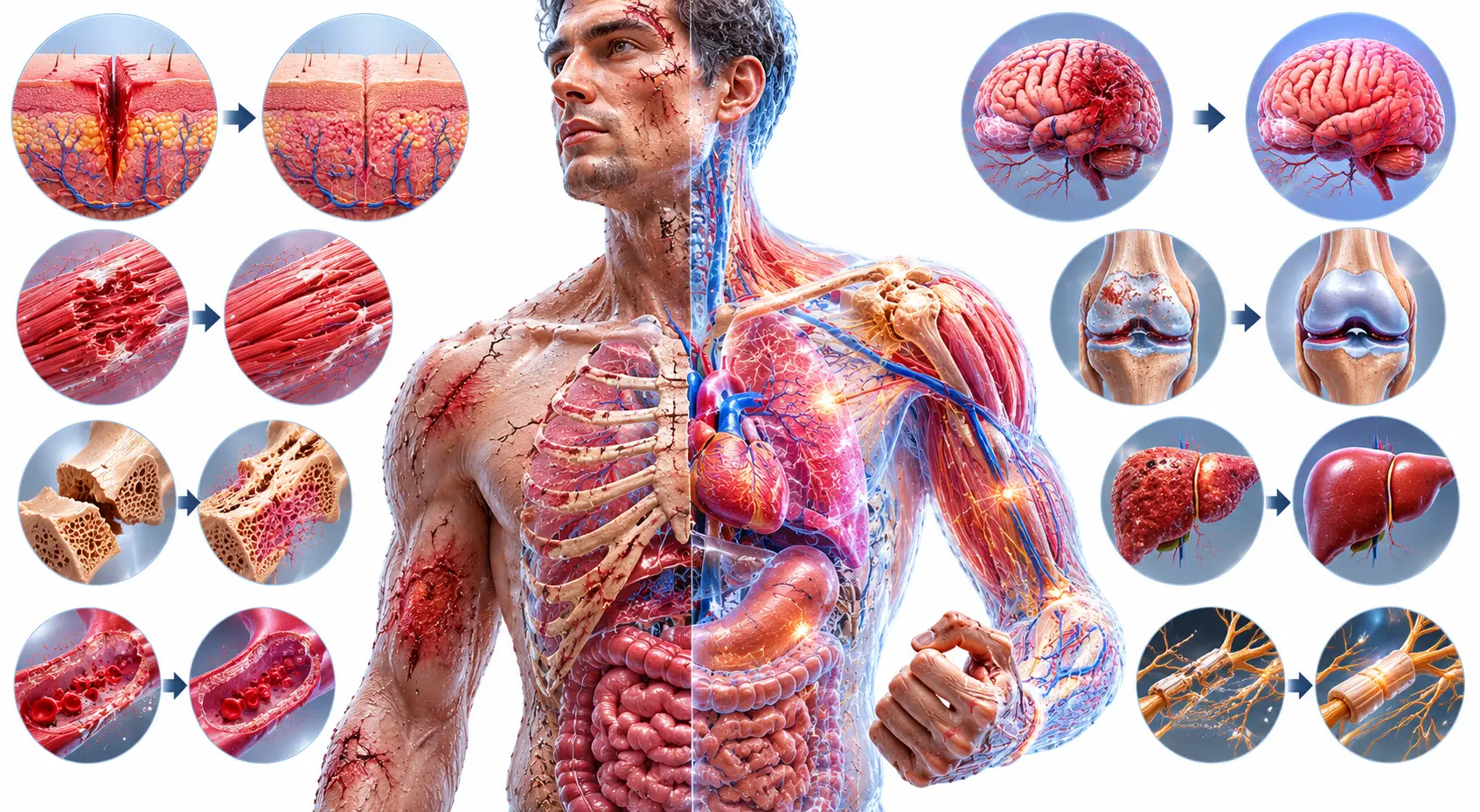
The Stages of Wound Healing
A simple cut healing is actually a coordinated biological repair operation.
Hemostasis
Blood vessels constrict, platelets clump, and a clot forms to stop bleeding.
Inflammation
Immune cells enter the area, kill bacteria, and clear damaged material.
Proliferation
New tissue forms, collagen is laid down, and blood vessels grow into the wound.
Remodeling
Collagen reorganizes over time and the repaired tissue gradually strengthens.
What heals well
What the Body Does Brilliantly
Skin is one of the body's great repair surfaces.
A small cut can trigger clotting, immune cleanup, new tissue growth, and sealing, all without a single conscious instruction from you.
Bone is even more impressive. A fracture does not simply get glued back together. The body builds a temporary scaffold, replaces it with new bone, then reshapes that bone over time.
The liver is the body's regeneration champion. Remove a large portion of a healthy liver, and the remaining tissue can grow back toward its original size.
Even the immune system has memory. After fighting an infection, it keeps specialized cells ready so the next attack can be answered faster.
The body is not passive matter waiting to be repaired. It is constantly repairing itself.
Why healing evolved
Healing Is One of Life's Oldest Technologies
Long before humans existed, living organisms faced a simple problem.
The world causes damage.
Cells break. Tissues tear. Infections invade.
Any organism that could repair itself had a better chance of surviving long enough to reproduce.
Over hundreds of millions of years, natural selection turned healing into one of life's most sophisticated abilities.
Every scar, every recovered illness, and every healed bone is the result of biological systems refined over evolutionary time.
Hard limits
The Limits the Body Cannot Cross
The body is brilliant at sealing damage. It is much less brilliant at rebuilding everything perfectly.
Heart muscle is one of the clearest examples. After a major heart attack, dead muscle is mostly replaced by scar tissue. The scar can hold the structure together, but it cannot pump blood like living heart muscle.
The spinal cord is even less forgiving. Severed nerve fibers in the central nervous system do not simply grow back across the injury.
Cartilage is another weak point. Because it has little blood supply, it cannot launch the same kind of repair response that skin or bone can.
The brain has plasticity, meaning it can sometimes reroute functions and adapt after injury.
But most lost neurons are not replaced in any meaningful way. Compensation is not the same as regeneration.
Why scars form
Why the Body Often Chooses Scars Over Perfect Repair
When the body is damaged, speed matters.
A wound left open for too long invites infection, bleeding, and further injury.
So the body often chooses a fast patch over a perfect rebuild.
Scar tissue is the biological version of emergency construction.
It closes the gap, strengthens the area, and keeps the body alive.
But scar tissue is usually not identical to the original tissue. It may be stiffer, less flexible, less specialized, or unable to perform the old job.
That is why healing can save you and still leave a permanent mark.
What helps
What Actually Helps the Body Heal
Healing needs materials and conditions.
Sleep matters because many repair processes become more active during deep rest.
Protein matters because new tissue has to be built from something.
Vitamin C helps the body make collagen, the structural protein used in wound repair.
Zinc supports immune activity and tissue repair.
Blood flow matters because oxygen and nutrients must reach the damaged area.
Stress, poor sleep, poor nutrition, smoking, uncontrolled diabetes, and infection can all slow the repair system down.
The body can do remarkable work, but it does not do it well when starved, inflamed, exhausted, or deprived of circulation.
Can you heal anything?
Myth vs Reality
What people think
Given enough time and the right mindset, the body can heal anything
This belief is appealing because it makes healing feel unlimited and controllable.
What actually happens
The body is remarkable, but it has biological limits
Some injuries exceed natural repair capacity. Destroyed heart muscle, severe spinal cord injury, advanced organ failure, and major cartilage loss cannot be fixed by time or mindset alone. Medical care matters because biology has boundaries.
Frontier science
Where Science Is Trying to Push the Limits
Scientists are trying to teach the body tricks it once lost.
Stem cell research asks whether damaged tissue can be given new cells capable of becoming muscle, cartilage, nerve, or other specialized tissue.
Researchers studying salamanders and zebrafish are asking an even stranger question: why can they regenerate limbs and heart tissue when humans cannot?
Some of the molecular pathways for regeneration exist in nature. The challenge is understanding why mammals use them so poorly.
Gene therapy is also being explored as a way to change the repair environment, reduce scarring, or activate growth signals.
The body's limits are real. But increasingly, they look like puzzles rather than permanent walls.
What heals vs what does not
Healing Capacity by Tissue Type
Skin
High repair capacity. Minor to moderate damage usually heals reliably.
Liver
Exceptional regeneration. Can regrow toward original size after major tissue loss.
Bone
Strong repair capacity when properly aligned and stabilized.
Blood vessels
Can grow and remodel during healing, especially around damaged tissue.
Heart muscle
Very limited regeneration. Major damage is mostly replaced by scar tissue.
Cartilage
Poor repair capacity because it has little blood supply.
Spinal cord
Severely limited repair. Damaged central nerve connections usually do not regrow properly.
Brain neurons
Limited replacement. The brain can adapt, but most lost neurons are not fully regenerated.
Quick answers
Common questions
Can the human body heal itself from anything? +
No. The body can heal many injuries and illnesses, but it cannot repair all damage. Some tissues regenerate well, while others have very limited repair capacity.
Why can't humans regrow limbs? +
Humans heal major injuries by rapidly sealing wounds and forming scar tissue. Animals that regrow limbs use a different regenerative strategy that keeps tissues more flexible and growth-capable. Scientists are studying why mammals lost much of this ability.
Why does the liver regenerate so well? +
Liver cells can re-enter the cell cycle and divide when tissue is lost. This allows the remaining liver to grow back toward its original mass.
Why does the heart not heal like the liver? +
Heart muscle cells divide very poorly after birth. After major damage, the body usually forms scar tissue instead of new working heart muscle.
Can the body heal from cancer on its own? +
Very rarely, spontaneous remission can occur, likely involving immune activity. But it is unpredictable and cannot be relied on as a treatment strategy.
Why do children heal faster than adults? +
Children generally have more active growth and repair systems, faster cell turnover, and stronger regenerative capacity in many tissues. Healing slows with age.
Does fasting help the body heal? +
Short-term fasting may stimulate autophagy, a cellular cleanup process. But extended fasting or poor nutrition can impair healing because the body needs protein, vitamins, minerals, and energy to repair tissue.