Quick Facts
Quick Facts
Einstein failed his first university entrance exam. He passed on the second try.
He could not find a teaching job after graduation. He worked at the Swiss patent office instead.
In 1905, his 'miracle year,' he published four papers that changed physics forever.
He did not win the Nobel Prize for relativity. He won it for the photoelectric effect.
His brain was stolen after his death and preserved for study.
Visual answer
How a Patent Clerk Changed the Universe
The key ideas from Einstein's miracle year, 1905.
Photoelectric Effect
Light behaves as particles (photons). Won the Nobel Prize. Led to quantum theory.
Brownian Motion
Proved atoms actually exist. Before this, some scientists doubted atoms were real.
Special Relativity
Time and space are relative. E=mc² comes from this.
General Relativity
Gravity is the warping of space and time. His masterpiece.
Story in brief
Story in Brief
1895
Einstein fails his university entrance exam. He is 16.
1900
He graduates but cannot find a teaching job.
Rejection pushed him to the patent office, where he had time to think.
1905
The miracle year. Four papers published. Physics will never be the same.
1915
General theory of relativity completed.
It predicted that gravity bends light, which was confirmed in 1919.
1919
Solar eclipse confirms Einstein's theory. He becomes a worldwide celebrity overnight.
1921
He wins the Nobel Prize.
1933
Flees Nazi Germany and settles in the United States.
The Story
The Year Everything Changed
In 1905, Albert Einstein was a nobody. He was 26 years old, working at the Swiss patent office, evaluating other people's inventions for a modest salary. He had no PhD, no university position, and no research budget. What he had was time and a very active imagination.
That year, he published four papers. Any one of them would have guaranteed a place in the history of physics. Together, they rewrote the rules. He proved that atoms exist, explained how light works, and introduced the theory of special relativity, which contained the most famous equation in history: E=mc².
It took a few years for the world to notice. But when a 1919 solar eclipse confirmed his prediction that gravity bends light, the newspapers went wild. A German Jew had overturned Newton, the greatest scientist in British history. The headlines screamed. Einstein, the patent clerk, became Einstein, the global icon.
Famous Quote
"Imagination is more important than knowledge. For knowledge is limited, whereas imagination embraces the entire world."
, Albert Einstein
This quote explains everything about his career. He did not memorize more facts than other physicists. He asked better questions.
Evidence
Why Einstein Matters
E=mc² explained how stars produce energy and led to nuclear power.
StrongGeneral relativity is essential for GPS. Without it, your phone would lose accuracy by miles each day.
StrongThe photoelectric effect led to quantum mechanics, which gave us computers, lasers, and smartphones.
StrongKey Points
Key Points So Far
Einstein's miracle year (1905) changed physics forever.
Special relativity showed that time and space are relative, not fixed.
E=mc² shows that mass and energy are the same thing.
General relativity showed that gravity is the warping of space and time.
He became famous after a 1919 eclipse confirmed his predictions.
Analogy
Understanding General Relativity
The familiar part
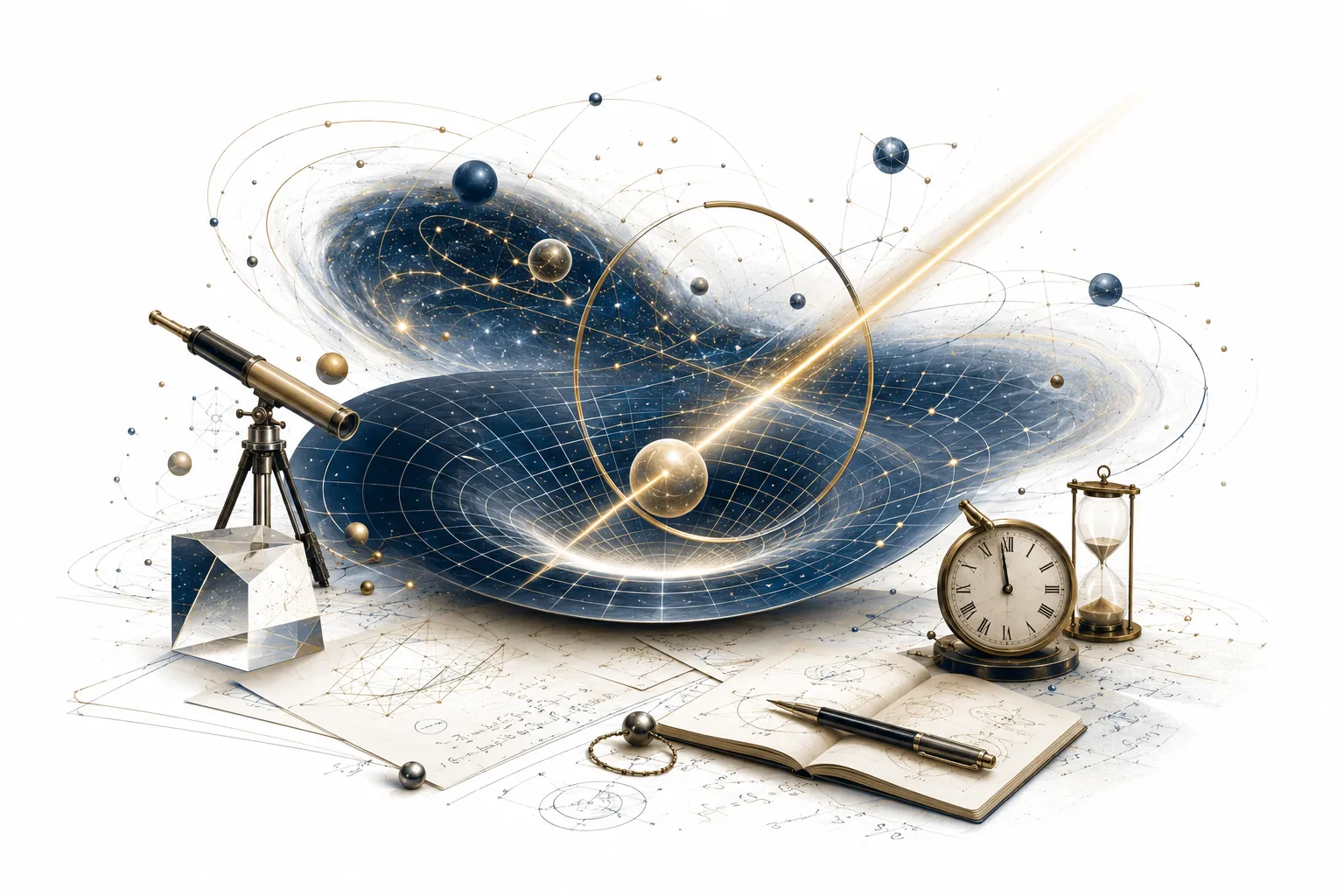
Imagine a trampoline. Place a heavy bowling ball in the center. The trampoline fabric stretches and dips.
How it applies
That dip is gravity. The Sun creates a dip in space. The planets roll around the edge of that dip. That is general relativity. No mysterious force. Just curves in space.
Where the analogy breaks
On a trampoline, you can see the dip. In space, the dip is invisible. Einstein had to imagine it. And he did.
Curiosity Notes
Details Most People Miss
Why this still matters
Why This Still Matters
Einstein is still famous because he changed how we see reality. Before Einstein, space and time were a stage where events happened. After Einstein, space and time were part of the action. Without his theories, GPS would not work, nuclear energy would not exist, and our understanding of the universe would be stuck in the 19th century. He is the father of modern physics. And his hair is still a meme.
Key Findings
- ✓Core findingEinstein is famous for the theory of relativity and E=mc².
- ✓Strong evidenceHe won the Nobel Prize for the photoelectric effect, not relativity.
- ⚠Main consequenceHe made his major discoveries while working as a patent clerk.
- ✓Wider legacyA 1919 solar eclipse made him a global celebrity.
- ★Bottom lineHis work is essential for GPS, nuclear power, and modern physics.
Final insight
A Last Thought
Einstein's real genius was not being right about everything. He was famously wrong about quantum mechanics, saying 'God does not play dice with the universe.' He turned out to be wrong. Quantum mechanics does involve dice. But his willingness to be wrong, to ask embarrassing questions, and to imagine impossible scenarios is what made him great. The universe does not care if you are a patent clerk. It only cares if you are paying attention.
Quick answers
Common questions
What does E=mc² mean? +
Energy equals mass times the speed of light squared. It means mass and energy are two forms of the same thing. A tiny amount of mass contains an enormous amount of energy.
Was Einstein a genius? +
Yes, but not in the way people imagine. He was not a superhuman calculator. He was a visionary who asked profound questions and thought in pictures, not just equations.