Quick Facts
Quick Facts
A magnet creates an invisible magnetic field around itself.
Iron sticks because its magnetic domains can line up with that field.
Copper, aluminum, and gold are not strongly attracted to ordinary magnets.
A paperclip becomes a tiny temporary magnet when it sticks.
Visual answer
How magnets attract metal
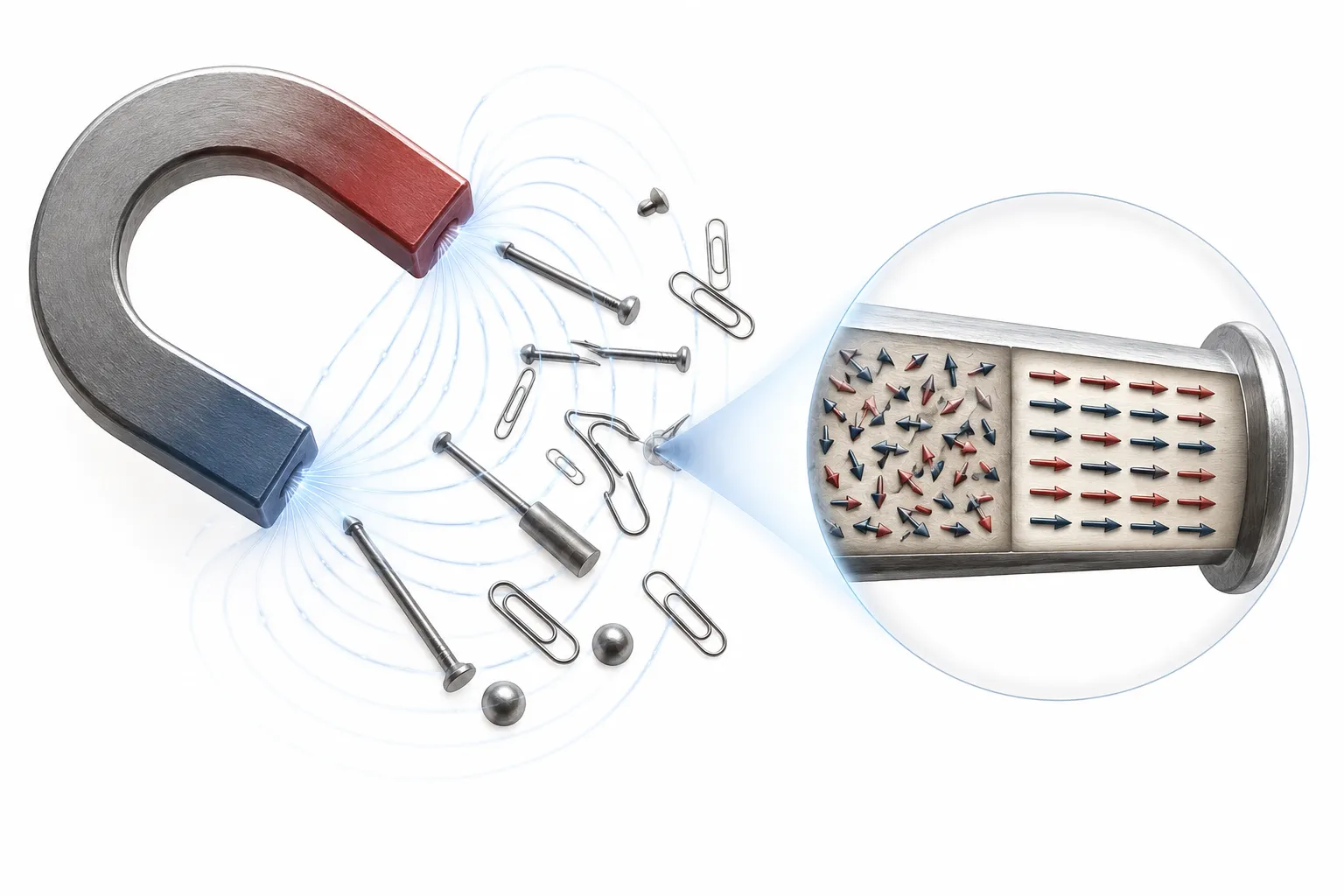
The diagram shows how a magnet's field lines up magnetic domains inside certain metals, turning the nearby metal into a temporary magnet.
Magnetic field
The magnet creates a field around itself.
Domains align
Tiny magnetic regions inside iron or steel start pointing the same way.
Attraction
The metal acts like a temporary magnet and is pulled toward the original magnet.
Tiny Domains
The Metal Has Tiny Compass Needles Inside It
Inside iron are little regions called magnetic domains. Each one behaves a bit like a tiny magnet.
In ordinary iron, these domains point in many different directions, so their effects mostly cancel out.
Bring a magnet close, and many domains swing into alignment. Suddenly the iron has a north and south magnetic personality of its own.
Analogy
The Crowd That Lines Up
The familiar part
A crowd in a train station is chaotic until someone announces a platform change. Then everyone turns and moves in the same direction.
How it applies
Iron’s magnetic domains are like that crowd. A magnet gives the announcement, and the domains line up.
Where the analogy breaks
People complain about platform changes. Magnetic domains are more obedient.
Curiosity Notes
Details Most People Miss
Why this still matters
Why This Still Matters
Magnetism powers motors, speakers, hard drives, MRI machines, compasses, generators, and the small miracle of not losing the takeaway menu on your refrigerator.
Key Findings
- ✓Core findingMagnets attract only certain metals strongly.
- ✓Strong evidenceIron, nickel, and cobalt are the classic magnetic metals.
- ⚠Main consequenceMagnetic domains inside the metal line up with the magnet’s field.
- ✓Wider legacyThe metal can become temporarily magnetized.
Final insight
A Last Thought
A magnet does not bully metal from a distance by magic. It persuades the tiny magnetic citizens inside iron to face the same way. Once they do, the paperclip is doomed.
Quick answers
Common questions
Why don't magnets stick to aluminum? +
Aluminum is not ferromagnetic. It interacts weakly with magnetic fields, but not enough for an ordinary magnet to stick.
Is a paperclip a magnet? +
Not usually. But when it touches a magnet, its domains can line up and make it temporarily magnetic.