Quick Facts
Quick Facts
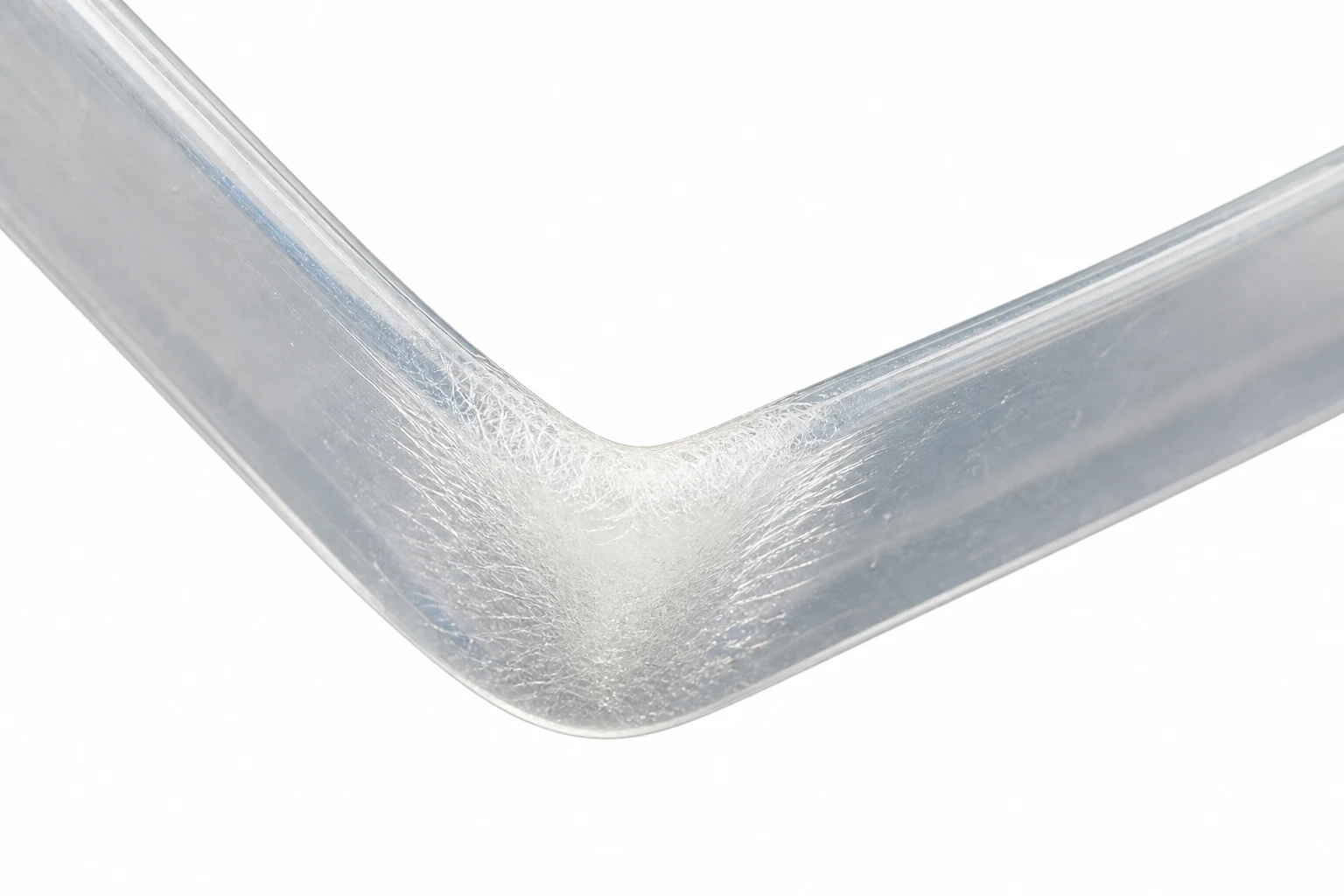
The technical term is stress whitening, and materials scientists also call it crazing.
It happens because plastic is made of long molecular chains that don't all stretch evenly.
The whiter the mark, the more microscopic damage has occurred underneath it.
It's often an early warning sign that the plastic is close to actually cracking.
Visual answer
How a fold turns pale
As plastic bends, its internal structure stretches unevenly until tiny gaps open up along the crease, scattering light in every direction.
The fold
Force concentrates along a single line as the plastic bends.
Microscopic tearing
Polymer chains separate slightly, opening tiny voids too small to see individually.
Light scatters
Those voids bounce light around instead of letting it pass through, producing a pale streak.
What Happens
A Fold Is a Tiny Act of Violence
Plastic looks solid and uniform, but it's really a tangle of long molecular chains, coiled together like spaghetti left too long in the pot. When you bend it, the outer curve of that bend has to stretch further than the inner curve.
Most of the time the chains cope admirably, sliding and flexing to absorb the strain. But push past a certain point, and some of them start to pull apart from their neighbors, leaving behind microscopic gaps—voids invisible to the eye on their own, but numbering in the thousands along a single crease.
Light passing through a normal stretch of plastic goes straight through, or reflects cleanly. Light hitting those thousands of tiny voids scatters in every direction at once, and scattered light reads to our eyes as white—which is, incidentally, the same basic reason clouds and snow look white rather than the blue of the sky or the clear of ice.
Is It Broken?
Not Broken Yet. But Warned.
A whitened crease doesn't mean the plastic has failed—it means the plastic has been pushed close to failing, and has the microscopic scars to prove it.
Bend it again in the same spot, and it's markedly weaker there than everywhere else, which is why a container that's been folded once often cracks cleanly along that exact line the second time round.
Analogy
The Paperclip That Never Forgets
The familiar part
Bend a paperclip back and forth enough times and it eventually snaps, even though nothing about it looked different right up until the moment it did.
How it applies
Plastic's white crease is that same story, made visible early. It's the material keeping a private record of every insult you've inflicted on it, and finally showing you the receipt.
Where the analogy breaks
Metal fatigues invisibly; plastic, rather more considerately, tells you exactly where it's hurting.
Curiosity Notes
Details Most People Miss
Why this still matters
Why This Still Matters
That pale line on a bent bottle is a small, visible reminder that even the most ordinary materials are built from structures too small to see, and that damage often announces itself long before anything visibly breaks.
Key Findings
- ✓Core findingBending plastic beyond its limit creates thousands of microscopic voids.
- ✓Strong evidenceThose voids scatter light instead of letting it pass through, which looks white.
- ⚠Main consequenceThe technical terms are stress whitening or crazing.
- ✓Wider legacyA whitened crease is usually weaker and more likely to crack in the future.
Final insight
A Last Thought
Next time you catch a pale crease on a folded bottle, you're not looking at a smudge—you're looking at thousands of tiny wounds, all opened at once, quietly scattering the light and telling you exactly where you bent things too far.
Quick answers
Common questions
Will the white mark go away? +
Rarely. Once those microscopic voids have opened up, most plastics don't heal, so the pale streak is usually permanent.
Does all plastic turn white when bent? +
No—it depends on the type. Rigid plastics like polypropylene and PET are prone to it, while soft, flexible plastics like silicone rarely show it at all.