Quick Facts
Quick Facts
Newborns blink only about two to three times per minute, far less than adults. Blink rate increases throughout childhood and stabilizes in adulthood.
People in conversation blink significantly more than the same people reading or watching something alone.
During intense concentration, such as reading or playing video games, blink rate drops dramatically, sometimes to fewer than four blinks per minute.
The brain suppresses visual awareness during each blink through a mechanism called blink suppression.
Blinks tend to cluster at grammatically natural pauses in speech and text processing.
Visual answer
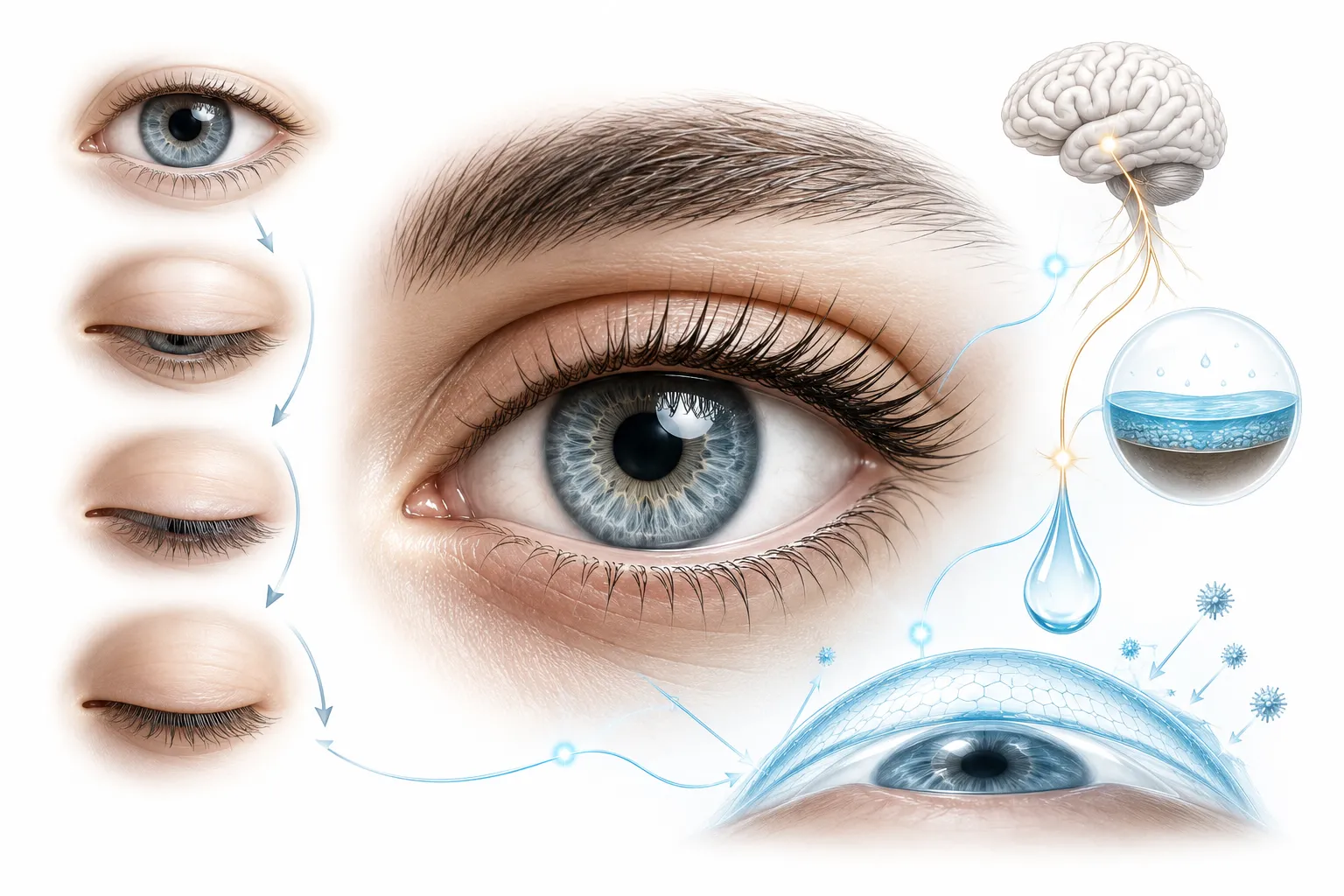
The Anatomy of a Blink
What happens when you blink.
Tear Film
The blink spreads a fresh layer of tears across the cornea, preventing drying.
Meibomian Glands
Oily layer that reduces tear evaporation and keeps the eyes lubricated.
Blink Suppression
The brain deactivates visual cortex briefly before the eyelid closes, hiding the blackout from awareness.
Dopamine Link
Blink rate is controlled by dopamine levels in the brain, making it a window into neurological function.
Story in brief
Story in Brief
Ancient Times
People noticed blinking but assumed it was purely for lubrication.
The protective function was obvious. The cognitive function was invisible.
1990s
Neurophysiologists demonstrated that visual cortex activity is actively suppressed during blinks.
It showed blinking is a brain function, coordinated by neural systems that manage attention and sensory input.
2009-2013
Nakano and colleagues showed that audience members watching the same film blinked at nearly identical moments.
Spontaneous blinking turned out to be entrained to the information structure of experience.
Present
Research continues to explore blinking as a non-invasive proxy for dopaminergic function.
Blink rate may help diagnose and monitor several neurological conditions.
Why We Blink
What the Blink Actually Does
The primary function of blinking is to maintain the tear film on the surface of the eye. Each blink spreads a fresh layer of tears across the cornea, preventing drying and maintaining the smooth optical surface needed for clear vision.
The meibomian glands in the eyelids contribute an oily layer that reduces tear evaporation. Without blinking, the cornea would dry out within minutes, leading to discomfort, blurred vision, and eventually damage.
But the protective function only explains part of the story. Humans blink far more often than necessary for lubrication. The excess blinking serves cognitive and neurological functions beyond keeping the eye moist.
Cognitive Function
How Blinking Serves the Mind
Research by Tamami Nakano and colleagues found that blinks in conversation cluster at natural pauses in the other person's speech, at phrase endings and between sentences. The pattern was consistent across speakers and languages.
The brain appears to time blinks to natural information boundaries, using them as processing windows between units of communication. The blink is a neural punctuation mark.
When audiences in a movie theater watch the same film, they tend to blink at the same moments. Different people in different seats make the same unconscious decision to close their eyes at the same frames.
Evidence
What Science Has Discovered
Blink rate is strongly modulated by dopamine levels in the striatum.
StrongThe visual cortex briefly deactivates during each blink.
StrongBlinks cluster at natural pauses in speech and narrative.
StrongScreen use suppresses blink rate to dangerously low levels.
StrongKey Points
Key Points So Far
You blink about 15,000 to 20,000 times per day, spending roughly 90 minutes with your eyes closed.
The brain suppresses visual awareness during each blink before the eyelid even closes.
Blinks cluster at natural pauses in speech and narrative, suggesting a cognitive processing function.
Dopamine levels directly control blink rate, making it a measurable neurological signal.
Screen use suppresses blinking to dangerously low rates, causing widespread dry eye problems.
From the Research
"Spontaneous blinking is not random. It is timed to natural pauses in information flow, suggesting a role in cognitive processing beyond simple eye maintenance."
, Tamami Nakano, Blink Synchrony Researcher
Her research revealed that blinks coordinate with narrative structure, not just eye dryness.
Analogy
Like a Page Turn in a Book
The familiar part
Imagine reading a book. At the end of a page, you turn it. The turn is a moment of transition. You do not think about it. It just happens.
How it applies
A blink is to the brain what a page turn is to a reader: a natural break point that the mind uses to consolidate and transition between units of information.
Where the analogy breaks
Page turns happen at the end of a page. Blinks happen at the end of a sentence. The timing is different. The function is similar.
Curiosity Notes
Details Most People Miss
Why this still matters
Why This Still Matters
Every blink is a tiny blackout the brain organizes and conceals. The continuity of your visual life is an edited performance. Understanding blinking helps us understand attention, cognition, and neurological health. It also helps us prevent computer vision syndrome, a condition affecting millions of people who spend hours staring at screens, suppressing their blink rate, and drying out their eyes.
Key Findings
- ✓Core findingYou blink about 15,000 to 20,000 times per day, spending roughly 90 minutes with your eyes closed.
- ✓Strong evidenceThe brain suppresses visual awareness during each blink before the eyelid even closes.
- ⚠Main consequenceBlinks cluster at natural pauses in speech and narrative, suggesting a cognitive processing function.
- ✓Wider legacyDopamine levels directly control blink rate, making it a measurable neurological signal.
- ★Bottom lineScreen use suppresses blinking to dangerously low rates, causing widespread dry eye problems.
Final insight
A Last Thought
You have been blind approximately 15,000 times today, each blackout lasting a third of a second, each one timed by a brain that decided the interruption was worth more than the seeing. And every single time, you were convinced the lights never went out. That is the hidden architecture of perception. The blink is not a gap in seeing. It is a punctuation mark in experience. And you never even notice it.
Quick answers
Common questions
Why do people blink more in conversation than when reading? +
Research found that blinks in conversation cluster at natural pauses in the other person's speech, at phrase endings and between sentences. The pattern was consistent across speakers and languages, suggesting the brain times blinks to natural information boundaries.
Does dopamine affect how often you blink? +
Yes. Blink rate is strongly modulated by dopamine levels in the striatum. Parkinson's disease dramatically reduces blink rate, while schizophrenia produces elevated rates. Blink rate is a non-invasive marker of dopaminergic function.
What happens in the brain during a blink? +
The visual cortex briefly deactivates during each blink, and simultaneously the brain activates the default mode network, the system associated with internal thought. Blinks function as micro-transitions between external attention and internal processing.