Visual answer
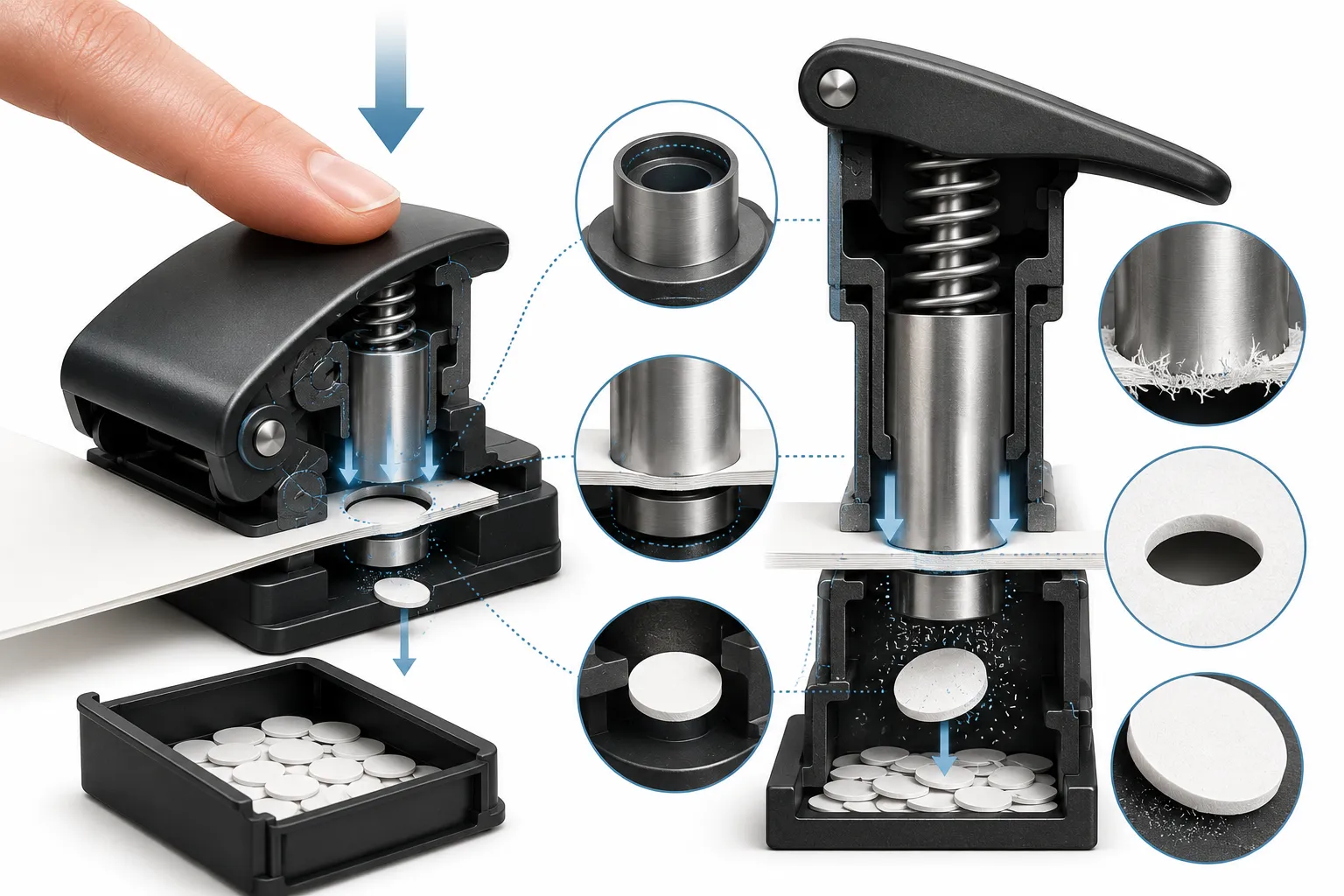
The Punch and Die Shear Cycle
How pressing a tube into a slot creates a perfect circle.
Paper Loaded
The paper sits between the sharp-edged hollow punch tube and the matching die slot below.
Force Applied
The lever pushes the punch tube straight down into the paper.
Shear Fracture
The paper trapped in the microscopic gap between the tube and slot snaps under shear stress.
Slug Separation
The disk inside the tube is completely severed from the sheet and falls away as confetti.
Where We Stand
Precision Shearing on a Desktop
Current state
The hole puncher is a miniature version of heavy industrial machinery used in metalworking and sheet metal fabrication. It uses one of the most efficient methods for creating clean holes in thin materials without generating excessive heat or leaving ragged edges.
What supports this
In industry, the waste piece is called a 'slug' and is usually collected or recycled. On your desk, it's an inadvertent party supply. The mechanism has barely changed since the 19th century because the physics of shearing thin, flat materials hasn't changed.
What could change this
Laser cutters can vaporize the material, leaving no slug, but they are expensive, dangerous, and overkill for a piece of paper. Mechanical shearing remains the fastest, cheapest, and most reliable method.
The Core Idea
Think of It Like a Cookie Cutter
The familiar part
When you use a cookie cutter on dough, you press the sharp edge down. The dough inside the cutter is completely separated from the dough on the baking sheet. You lift the cutter, and out pops a perfect shape.
How it applies
A hole puncher is a cookie cutter for paper. The 'cutter' is a hollow steel tube with a sharpened edge (the punch). The 'baking sheet' is a metal plate with a hole exactly the same size (the die). When you squeeze the lever, the punch pushes the paper into the die. The paper trapped inside the tube is cleanly sheared away from the paper trapped outside the tube. The paper inside the tube is the cookie, your confetti.
Where the analogy breaks
Unlike cookie dough, which is soft and yields easily, paper is a matted web of tough wood fibers. To separate it cleanly without tearing, the edges of the punch and die must be incredibly close together (the 'clearance') and razor-sharp.
The Physics
The Snap of the Shear
There are two main ways to separate materials: cutting and shearing. Cutting uses a wedge (like scissors or a knife) to gradually push material apart. This works great for soft things, but on paper, a wedge can distort the fibers and leave a fuzzy, frayed edge.
Shearing uses two straight edges passing incredibly close to each other. The punch tube pushes down. As it enters the die, the paper is trapped in the microscopic gap between the two. The force concentrates on this thin line of paper. Suddenly, the internal bonds of the paper fibers can't take the strain anymore, and they snap. It happens almost instantaneously across the whole circle.
This snapping action is why hole punchers make that deeply satisfying *chunk-chunk* sound. It’s the sound of thousands of cellulose fibers breaking simultaneously. And because the material inside the tube is completely surrounded by this break, it has no choice but to fall away as a discrete, intact disk.
The Evidence
Why It Has to Be Confetti
Shearing requires the punch to pass into a matching die, isolating a solid slug.
StrongThe 'chunk' sound is the sound of sudden, brittle fracture of paper fibers.
ModerateIf the punch just sliced, the hole would be jagged and the paper would warp.
StrongThe confetti could be avoided if the punch just crushed the paper to dust.
WeakThe Big Myth
The Most Common Misconception
What people think
"The hole puncher cuts a circle out of the paper."
We use the word 'cut' for almost everything, so it's natural to imagine a tiny circular blade slicing its way around the perimeter.
What actually happens
It punches through, it doesn't cut around
There is no circular blade. It's a straight-edged tube pressing straight down. It doesn't travel around the circumference of the circle; it travels straight through the z-axis (depth) of the paper. The circle is formed by the shape of the tube and the die, not by a cutting motion.
What If It's True?
What If We Stopped Making Slugs?
Imagine this
Imagine a hole puncher that somehow vaporized the paper inside the hole, leaving no confetti.
What would happen
You'd lose one of the greatest simple pleasures in the modern office. But practically, vaporizing it would require heat or lasers, which would scorch the edges of the hole and melt the plastic base of the puncher. The 'waste' is the unavoidable physical evidence of the laws of conservation of mass.
Why this matters
You cannot make a hole out of nothing. A hole is defined by the material that surrounds it. The confetti is the physical proof that the hole exists. It is the exact, undeniable counterpart to the absence you just created.
Final insight
The Matter of Absence
A hole puncher is a philosopher's tool. It forces you to confront the physical reality of nothingness. You cannot have a hole without a heap of something else. Every time you click the lever, you trade a solid little disk of reality for an empty space, and somehow, the paperwork is better for it.
Quick answers
Common questions
What happens to industrial metal slugs? +
Just like paper confetti, metal stamping and punching operations create tons of metal slugs every year. Because they are pure, clean metal, they are highly valued by recyclers and are usually melted down to make new sheet metal.
Why do hole punchers sometimes leave a jagged edge or a half-torn hole? +
This happens when the clearance between the punch and die is too large, or when the cutting edges have become dull. Instead of a clean snap (shear), the paper stretches and tears (rupture) before finally breaking, leaving a fuzzy, ugly edge.
Why is standard hole punch paper size so specific? +
The standard two-hole punch in the US creates holes 0.25 inches apart, optimized for standard file folders. The standard three-hole punch (for binders) follows the ISO 838 standard, with holes 80mm apart, designed to allow pages to turn easily without tearing out.