Visual answer
Permanent vs. Dry Erase at a Microscopic Level
How the binder polymer dictates the fate of the ink.
Permanent Ink (Acrylic)
The acrylic polymer binder forms strong bonds with the surface, sinking into microscopic pores and locking the dye in place.
Dry Erase Ink (Silicone)
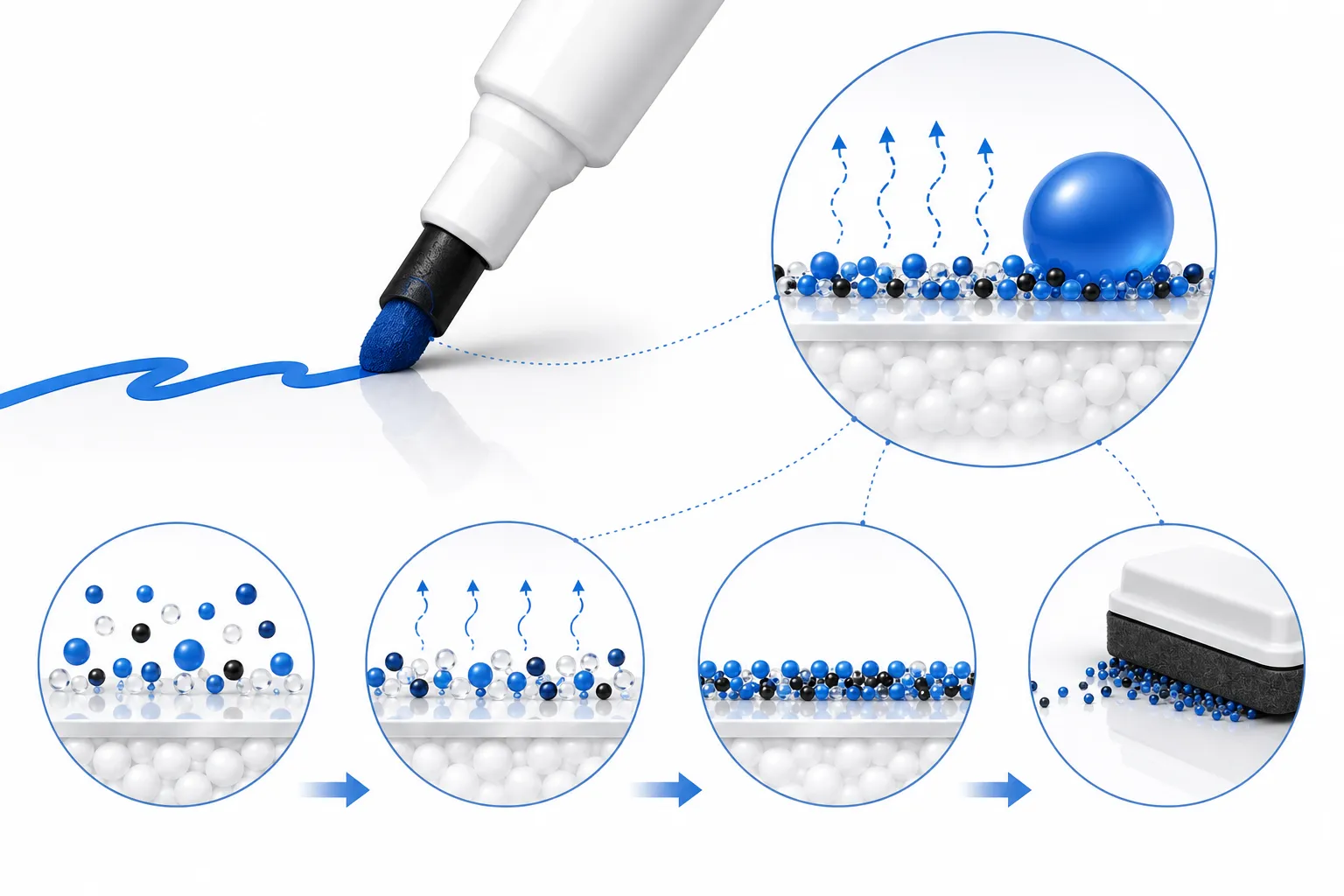
The oily silicone polymer binder is non-polar. It cannot grip the non-porous, poreless whiteboard surface.
Mechanical Removal
Because the ink is only resting on the surface in a fragile film, the mild abrasive friction of an eraser easily pushes it off.
Where We Stand
A Delicate Chemical Balancing Act
Current state
Dry erase technology is a triumph of matching ink chemistry to surface chemistry. The system only works because the ink, the solvent, and the board are perfectly tuned to repel each other just enough to allow writing, but not enough to prevent erasing.
What supports this
The invention is generally credited to Jerry Woolf in the 1950s, but it took decades to perfect the inks. Early dry erase inks were notoriously smudgy or refused to write smoothly. Modern inks use carefully balanced surfactants and solvents to ensure the ink flows, sticks temporarily, and then releases under the mild abrasive action of a felt eraser.
What could change this
The rise of 'smart boards' and digital displays is slowly making the chemistry moot. But the underlying principle, using non-adhering polymers on non-porous surfaces, is used in industrial marking, surgical planning, and automotive design.
The Core Idea
Think of It Like Spray Paint vs. Crayon on Wax Paper
The familiar part
If you spray paint a wall, the paint contains solvents that evaporate, leaving behind an acrylic binder that chemically grips the surface. It's stuck forever. But if you draw on a piece of wax paper with a crayon, the wax just sits on the slick surface.
How it applies
A permanent marker is spray paint. It uses an acrylic polymer that forms strong bonds with whatever it touches. A dry erase marker is a crayon. It uses an oily silicone polymer. When the alcohol solvent evaporates, it leaves behind the dye suspended in this oily, slippery silicone. Because the whiteboard is also non-porous and slick, the silicone doesn't grip. It just rests there like a greasy fingerprint.
Where the analogy breaks
Unlike a crayon, dry erase ink has to be liquid enough to flow through a felt tip. If the silicone base is too slippery, the ink won't stick to the board *at all*, not even for a minute. If it sticks too well, it won't erase. It's a chemical tightrope walk.
The Chemistry
The Opposites Don't Attract
To understand why it wipes off, you have to look at the 'binder', the chemical that holds the color pigment together and attaches it to the world. In a permanent marker, this is usually an acrylic resin. Acrylics are polar molecules. They form strong intermolecular bonds with polar surfaces (like paper, wood, or skin), sinking into microscopic pores and locking tight.
Dry erase ink uses a silicone polymer. Silicones are highly non-polar. The whiteboard surface, whether it's melamine resin, baked enamel, or glass, is also non-polar and has virtually no microscopic pores. In chemistry, 'like dissolves like,' but non-polar things don't aggressively bond to other non-polar things without help. The ink just sits on top in a fragile, oily film.
The solvent in the marker, usually isopropanol (rubbing alcohol), helps the ink flow and temporarily 'wets' the surface to let you write. But once the alcohol evaporates (which is why markers dry out if left uncapped), the non-polar silicone is left high and dry, barely clinging to the non-polar board.
The Evidence
Proof in the Polymer
Dry erase ink uses an oily silicone polymer instead of an acrylic binder.
StrongThe whiteboard surface is deliberately non-porous to prevent ink absorption.
StrongErasing is a mechanical action (physical removal), not a chemical dissolution.
StrongUsing a dry erase marker on paper makes it act like a permanent marker.
StrongThe Big Myth
The Most Common Misconception
What people think
"The ink is water-soluble, so erasing just dissolves it."
It seems logical that the dampness of an eraser cloth or the liquid in spray cleaners is dissolving the ink away.
What actually happens
Water actually makes it worse
The silicone polymer in the ink is hydrophobic, it actively repels water. If you try to wipe a whiteboard with a wet paper towel, the ink will likely smear into a horrific, streaky mess. Dry erase ink is removed by the mild abrasive friction of a dry felt eraser physically pushing the oily silicone layer off the slick surface. Cleaners work because they contain specific solvents, not water.
What If It's True?
What If You Mix Up the Markers?
Imagine this
You accidentally use a permanent Sharpie on a whiteboard. Panic sets in.
What would happen
The acrylic binder in the Sharpie grips the non-porous surface surprisingly well (it doesn't sink in, but it forms a strong film). But here is the спасение (salvation): because the dry erase marker contains a strong solvent (alcohol) and an oily silicone base, you can actually draw over the permanent ink with a dry erase marker. The fresh solvent breaks down the acrylic bond of the permanent ink, and the whole messy mixture can then be wiped away together.
Why this matters
The fact that the 'cure' for a permanent marker is a dry erase marker is the ultimate proof that the difference between them isn't the color or the smell, but just a single molecular chain in the binder. It's a beautiful bit of chemical irony.
Final insight
The Power of Not Sticking
We spend a lot of time inventing glues, adhesives, and permanent bonds. But the dry erase marker is a masterpiece of *un*-sticking. It relies on a profound chemical indifference, the ink doesn't hate the board, it just doesn't care about it at all. And in that lack of attachment lies the ability to think, erase, and think again.
Quick answers
Common questions
Are dry erase markers toxic? +
The solvents (alcohols) can be irritating in large, poorly ventilated amounts, and the dyes aren't meant for ingestion. But in normal classroom or office use, they are considered very low risk. The shift away from harsher solvents in early markers was a major part of making them safe for schools.
Why do whiteboards eventually get 'ghosting' (faint stains)? +
Over time, microscopic abrasions on the board surface from erasing, or the buildup of oily silicone residue that isn't fully lifted, creates areas where the ink can cling slightly better. The board is no longer perfectly smooth and non-porous.
Why do some dry erase markers leave ink on your hands, but the board stays clean? +
Your skin is porous and has natural oils that the silicone polymer in the ink actually bonds to quite well. The board is slick and non-porous. So the ink transfers to you, but won't stick to the board!