Visual answer
The Stick-Slip Cycle
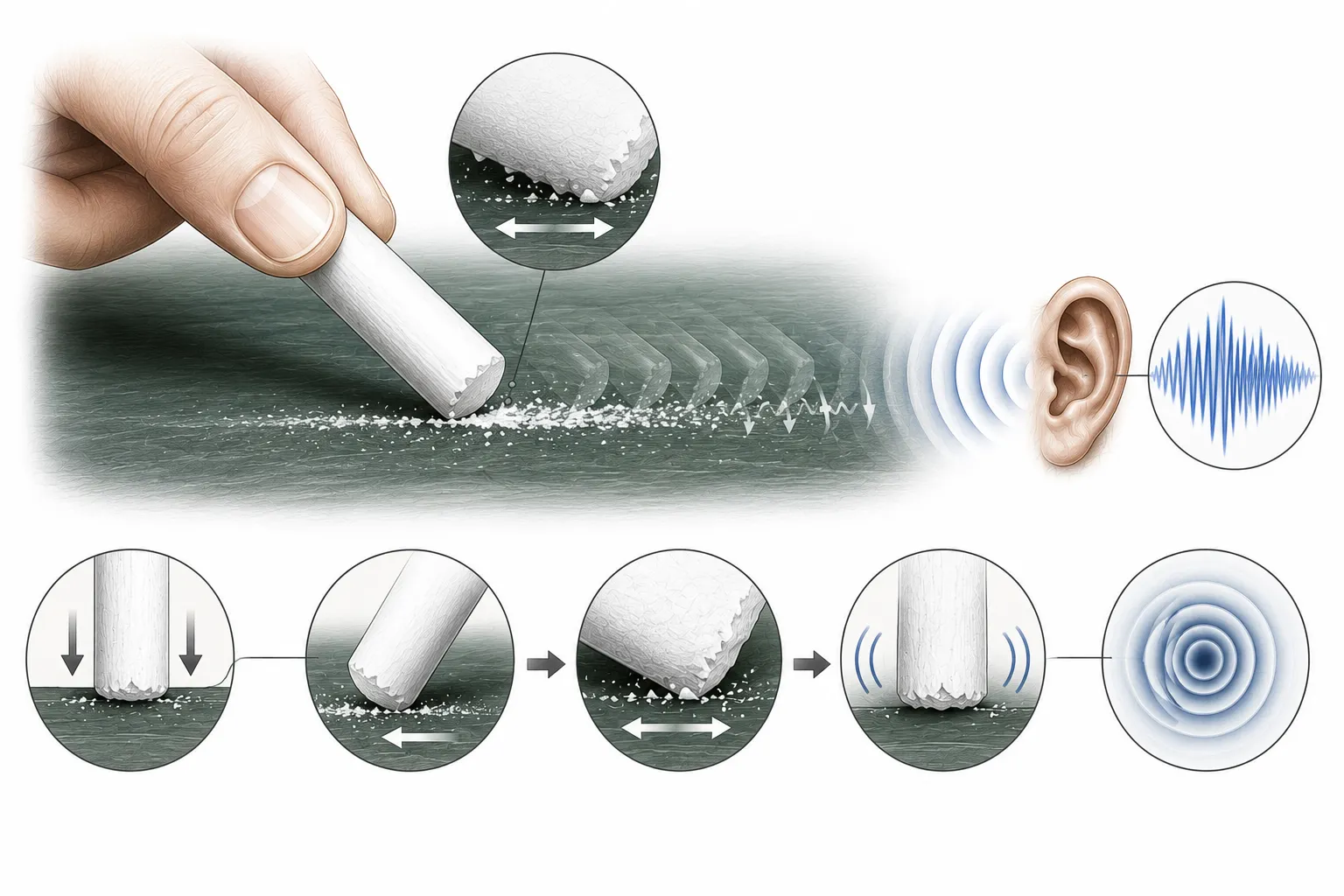
How holding a chalk at a low angle creates a microscopic earthquake.
The Stick
Held at a low angle, the chalk's surface grips the board. Static friction locks it in place.
The Flex
Your hand keeps pushing forward. The chalk stick bends like a spring, storing potential energy.
The Slip
The bending force overcomes the static friction. The chalk violently snaps forward, vibrating.
The Squeal
This snap happens hundreds of times a second. The vibrating chalk and board amplify the sound.
Where We Stand
A Demonstration in Tribology
Current state
The chalk squeak is a well-documented, classic example of 'stick-slip' friction, a subfield of physics called tribology (the study of interacting surfaces in relative motion). It is entirely predictable and entirely preventable once you understand the mechanics.
What supports this
Physicists have studied this exact phenomenon because it models larger, more violent events, like tectonic plates slipping along fault lines to cause earthquakes, or the agonizing squeal of car brakes. The chalkboard is just a very small, very audible earthquake.
What could change this
The shift to whiteboards and digital screens has largely eradicated the chalk squeak from modern life, saving millions of students from involuntary shudders. But the physics remains vital in industrial design and seismology.
The Core Idea
Think of It Like a Bow on a Violin String
The familiar part
When a violinist drags the bow across a string, the rosin on the bow hair grips the string. The string bends, then slips, then grips again. This rapid stick-slip cycle vibrates the string, producing a musical note.
How it applies
Your finger is the violinist, the chalk is the bow, and the blackboard is the string. When you hold the chalk at a shallow angle, the friction is high. The chalk 'sticks' to the board. As you push, the chalk flexes like a tiny spring. When the flexing force overcomes the friction, the chalk 'slips' forward suddenly. It immediately sticks again, flexes, and slips. This happens hundreds of times per second, vibrating the chalk and the board to produce that dreadful, high-pitched squeal.
Where the analogy breaks
A violin string is tuned to vibrate at a pleasing, harmonious frequency. The chalk and board, unfortunately, are not tuned. They vibrate at whatever chaotic frequency their specific materials and geometry dictate, which usually falls right into the most sensitive, grating range of human hearing.
The Mechanics
The Anatomy of a Squeak
Chalk is made of calcium sulfate or magnesium carbonate. It's porous and slightly soft. The blackboard, whether slate or a synthetic porcelain, is hard and has a microscopic texture. When you press chalk against the board at a low, oblique angle, you maximize the surface area in contact, which maximizes static friction.
As you drag the chalk, it doesn't slide smoothly. It grabs the board. The chalk stick itself is slightly flexible, so it bends backward under the force of your hand. The tension builds until the static friction is broken. The chalk violently snaps forward. This snap is the 'slip'.
Because you are maintaining forward pressure, it instantly grabs again (the 'stick'). This grab-slip-grab-slip cycle can happen 200 to 500 times a second. This rapid oscillation is sound. The hard, flat board behind the chalk acts exactly like the wooden body of an acoustic guitar, amplifying the tiny vibrations of the chalk into a room-filling shriek.
The Evidence
Why It Happens (And Why It Doesn't)
Holding the chalk at a low, shallow angle increases friction, triggering stick-slip.
StrongThe squeak frequency matches the resonant frequency of the chalk/board system.
StrongUsing a shorter piece of chalk changes its resonant frequency, often preventing the squeak.
ModerateThe squeak is caused by impurities or cheap chalk.
WeakThe Big Myth
The Most Common Misconception
What people think
"Cheap, low-quality chalk is what squeaks."
People often blame the brand or the composition of the chalk for the noise, assuming it's an impurity causing the sound.
What actually happens
Even the finest, most expensive chalk will squeak
The squeak is a mechanical inevitability of the angle and pressure applied, not a chemical flaw. In fact, premium, denser chalk can sometimes squeak *more* because it has a more uniform, predictable surface that grips the board more consistently. It's a physics problem, not a manufacturing defect.
What If It's True?
What If We Eradicated Stick-Slip Friction?
Imagine this
Imagine a world where surfaces never experienced stick-slip, only smooth, fluid friction.
What would happen
It would be a quieter world, no squeaky doors, no shrieking brakes, no chalk squeals. But it would also be a world without violins, cellos, or any bowed string instruments. It might even change how earthquakes happen, as tectonic fault lines rely heavily on stick-slip mechanics to build and release energy.
Why this matters
The things that annoy us most are often just fundamental laws of physics manifesting in our daily lives. The chalk squeak is a tiny, obnoxious reminder that the universe is governed by friction, tension, and sudden release.
Final insight
The Music of Friction
Next time that sound hits you, try to reframe it. You aren't just hearing a terrible noise; you are witnessing a violent, microscopic earthquake. You are hearing the exact same physics that makes a Stradivarius weep, reduced to a stick of calcium carbonate and a piece of slate. It doesn't make it less awful, but it does make it fascinating.
Quick answers
Common questions
Is the chalk actually skipping across the board? +
In a way, yes, microscopically. The 'slip' phase is a tiny, rapid skip forward. It's not a smooth slide. It's a series of microscopic jumps happening faster than the eye can see, but slow enough for the ear to catch as a sound wave.
How do you stop chalk from squeaking? +
The most reliable method is to break the chalk in half. A shorter piece has a different stiffness and resonant frequency, which usually moves it out of the squeak range. Alternatively, hold the chalk at a steeper, more upright angle (closer to 90 degrees), which reduces the surface area contact and prevents the 'stick' from happening in the first place.
Does this happen with dry erase markers? +
Rarely, but it can. Dry erase ink acts as a lubricant, drastically reducing friction, which usually prevents stick-slip. However, if a marker is almost completely dry, the plastic tip can occasionally stick-slip against the smooth board surface, producing a similar, though usually much quieter, squeak.