Visual answer
Why Cats May Eat Grass
Grass eating may serve several overlapping purposes, from hairball movement to instinctive enrichment.
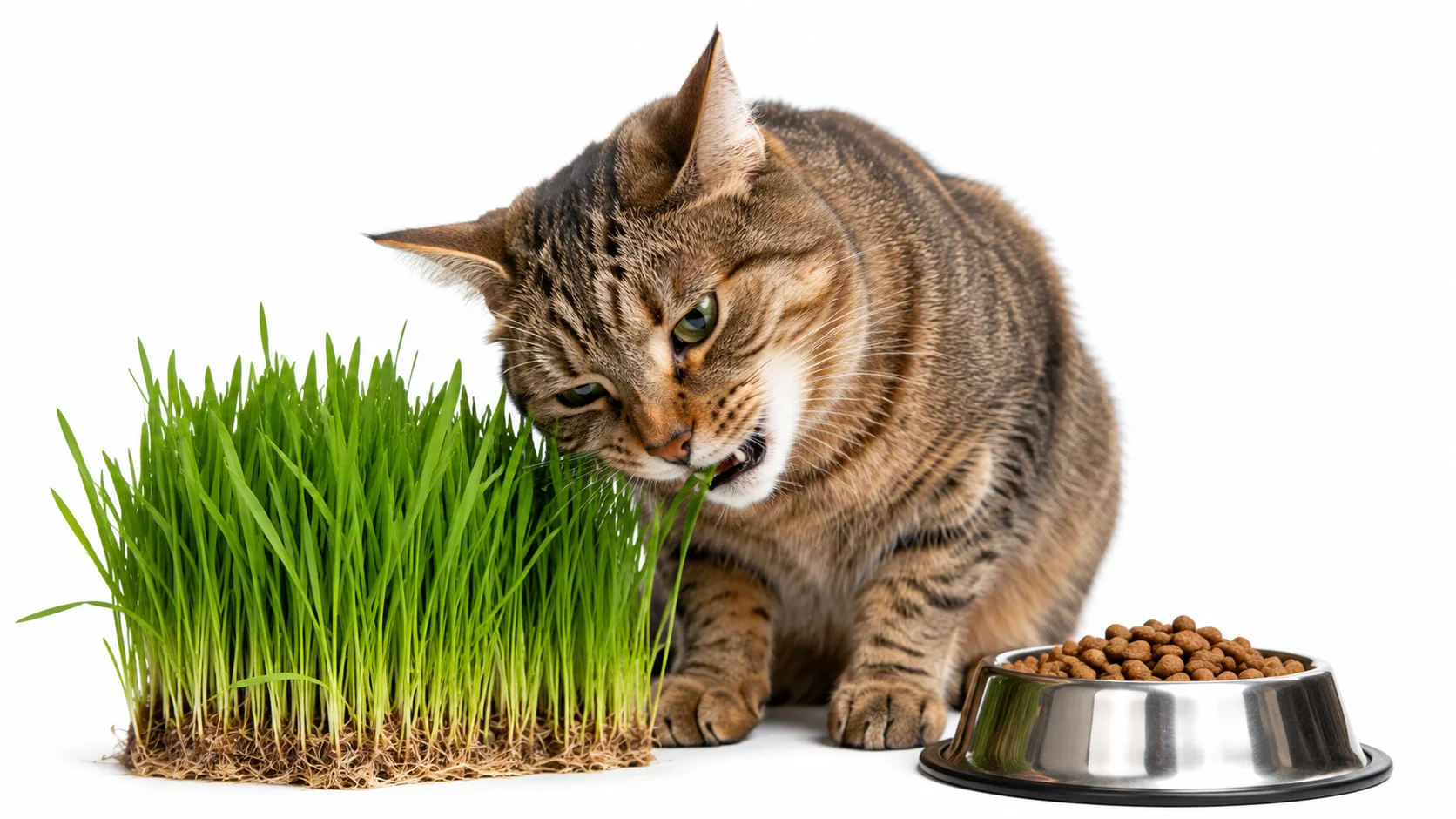
Chewing grass
The cat eats plant blades even though grass is not a normal major food source.
Stomach irritation
Grass may irritate the stomach enough to trigger vomiting in some cases.
Gut movement
Grass fiber may help move hair and other material through the intestines.
Old instinct
The behavior may come from wild ancestors that consumed prey, fur, feathers, and plant material.
Not a salad
Your Cat Is Not Suddenly Becoming a Vegetarian
Cats are obligate carnivores. Their bodies are built around meat.
They need nutrients that come most naturally from animal tissue, and their digestive system is not designed to live on plants.
So when a cat eats grass, it is not choosing a salad over dinner.
The grass is doing something else.
It may be adding roughage. It may be helping move swallowed fur. It may be triggering the stomach to reject something uncomfortable.
To a human, grass looks like food. To a cat's body, it may work more like a tool.
Vomiting
Why Grass Sometimes Makes Cats Vomit
The most obvious theory is the one every cat owner has seen on the carpet.
A cat eats grass, waits a short while, and vomits.
Grass blades can irritate the stomach lining, especially because cats do not digest them well. That irritation may trigger vomiting.
For a wild ancestor, this could have been useful. A cat that swallowed fur, feathers, small bones, or other indigestible prey parts might benefit from bringing some of it back up.
But vomiting cannot be the whole explanation.
Many cats eat grass and do not vomit afterward. That means the behavior probably has more than one purpose.
Hairballs
The Hairball Problem
Cats are excellent groomers, which also means they swallow a lot of hair.
Most swallowed hair passes through the digestive system without drama. Some collects in the stomach and becomes a hairball.
Grass may help in two ways. Sometimes it may help bring material back up. Other times, its fiber may help move material downward through the intestines.
That second path is less theatrical, but probably just as important.
A cat does not need to vomit for grass to have done something useful.
Wild instinct
An Instinct From a Messier Diet
Modern indoor cats often eat neat bowls of processed food.
Their ancestors did not.
A wild cat eating prey would swallow muscle, organs, fur, feathers, bones, stomach contents, and whatever plant material happened to be inside the prey.
Grass eating may be a leftover behavior from that rougher digestive world.
The modern cat may no longer need it in quite the same way, especially if it lives indoors and eats commercial food.
But instincts do not disappear just because the furniture improved.
Nutrients
Could Grass Offer Any Nutritional Benefit?
Grass is not a meaningful meal for a cat, but it is not completely empty either.
It can contain small amounts of nutrients such as folic acid, a B vitamin involved in blood and cell production.
That does not mean cats eat grass mainly as a vitamin supplement. The amounts are usually small, and cats get their essential nutrition elsewhere.
Still, evolution often keeps behaviors that offer several small benefits at once.
Grass eating may be partly mechanical, partly instinctive, and partly nutritional in a very minor way.
Safe grass
The Grass Itself Is Usually Not the Problem
For most cats, occasional grass eating is normal.
The danger comes from what may be on the grass.
Outdoor lawns can carry pesticides, herbicides, fertilizers, car fluids, parasites, or other contaminants.
Some houseplants are also toxic to cats, which makes random plant chewing risky indoors.
The safer option is cat grass grown specifically for pets, often from wheat, oat, barley, or rye seed.
It gives the cat a clean outlet for the behavior without turning your houseplants into a veterinary gamble.
Sick cat?
Myth vs Reality
What people think
A cat eating grass must be sick
Because grass sometimes leads to vomiting, many owners assume the cat must have felt ill before eating it.
What actually happens
Many healthy cats eat grass as a normal behavior
Grass eating can happen in cats that show no signs of illness. Occasional chewing is usually normal. Repeated vomiting, appetite loss, weight loss, or compulsive grass eating should be discussed with a vet.
Quick answers
Common questions
Is it normal for cats to eat grass? +
Yes. Occasional grass eating is common and usually normal, especially if the cat is otherwise eating well, active, and not vomiting repeatedly.
Why does my cat vomit after eating grass? +
Grass can irritate the stomach lining because cats do not digest it well. That irritation may trigger vomiting, sometimes bringing up hair or other material.
Should I stop my cat from eating grass? +
You usually do not need to stop safe grass eating. The bigger concern is grass treated with chemicals or toxic houseplants. Pet-safe cat grass is a better option.
Do indoor cats need cat grass? +
They do not strictly need it for nutrition, but cat grass can provide a safe outlet for a normal instinctive behavior.
When should grass eating worry me? +
Talk to a vet if your cat eats grass compulsively, vomits repeatedly, loses weight, stops eating, seems lethargic, or shows signs of digestive distress.