Visual answer
What Kneading Communicates
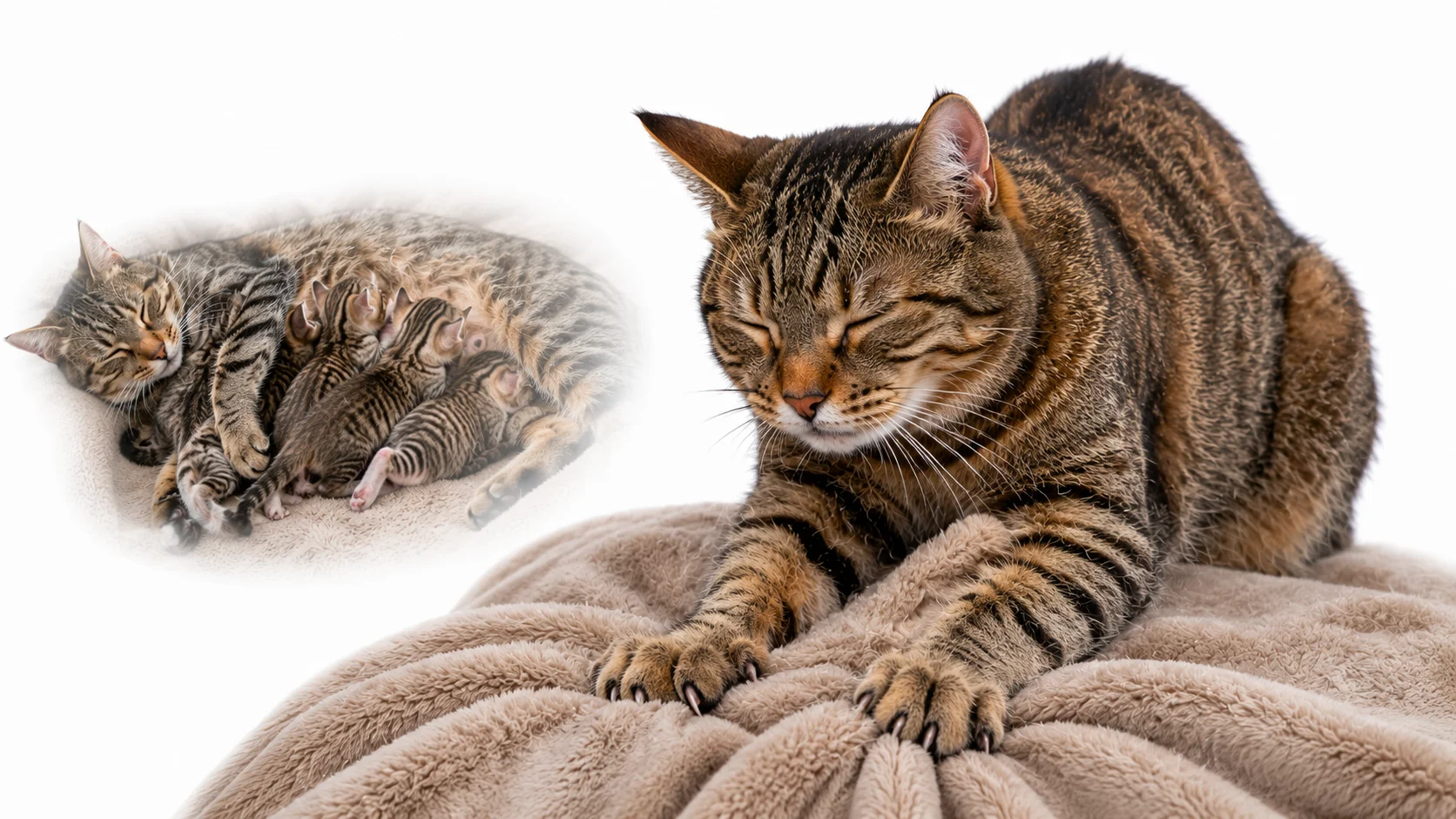
Kneading combines kitten instinct, comfort, scent marking, and bonding in one repeated paw movement.
Kitten origin
Nursing kittens press their paws against the mother to help stimulate milk flow.
Comfort memory
The rhythm becomes associated with warmth, feeding, safety, and being close to a trusted body.
Scent marking
Paw pad scent glands leave a familiar chemical signal on the surface being kneaded.
Bonding signal
When a cat kneads a person, it often means that person belongs inside the cat's comfort zone.
Kitten origin
It Starts Before a Kitten Can See
A newborn kitten enters the world almost helpless. It cannot see properly, cannot walk well, and depends completely on warmth and milk.
But it can knead.
Those tiny paws press rhythmically against the mother's belly while the kitten nurses. The pressure helps stimulate milk flow, so the movement is not decorative. It is part of survival.
At the same time, the kitten is surrounded by the safest things it knows: warmth, food, scent, touch, and the mother's body.
The brain links that paw rhythm with comfort very early. Later in life, when the adult cat feels safe and settled, the old movement can reappear as if the body remembers what the mind does not.
Adult cats
Why Adult Cats Keep a Kitten Behavior
In many wild cats, kneading fades after kittenhood. The job is done once nursing is over.
Domestic cats are different. They carry many kitten-like behaviors into adulthood, partly because domestication favored animals that stayed more social, playful, vocal, and tolerant around humans.
That is why adult cats still meow at people, play like juveniles, seek soft contact, and often knead when they feel secure.
A cat kneading your lap is not literally mistaking you for its mother. It is entering a familiar emotional state, one linked with safety and care.
The behavior may look silly, but it comes from one of the deepest comfort circuits in the animal's life.
Scent marking
The Message Hidden in the Paws
Cats do not experience the world the way we do. To them, scent is a map, a diary, and a security system.
Their paws contain scent glands. When a cat kneads a blanket, bed, or person, it can leave behind a faint chemical signature.
You cannot smell it, but the cat can.
This does not mean the cat is claiming you like property in a dramatic human sense. It is more subtle than that. The cat is making the surface familiar.
A kneaded blanket smells more like home. A kneaded lap smells more like a trusted place. In the cat's world, that matters.
What it means
What Your Cat May Be Feeling
Most kneading happens when a cat is relaxed.
Look at the rest of the body. A kneading cat often purrs, softens its eyes, lowers its guard, and settles its weight into the surface beneath it.
That combination usually means comfort, not demand.
Some cats knead people. Some knead blankets. Some knead their beds before sleeping, as if preparing a small private nest.
When a cat chooses your lap for this ritual, it is usually a compliment. In cat language, you have become part of the furniture of safety.
Different cats
Why Some Cats Knead More Than Others
Not every cat kneads in the same way.
Some cats do it every evening. Some do it only on one favorite blanket. Some barely do it at all.
Early life may play a role. Cats separated from their mothers very young may knead more intensely, sometimes as a self-soothing behavior. Personality also matters. Some cats are simply more physically expressive than others.
Texture matters too. Soft fleece, wool, pillows, and human laps can all trigger the behavior because they resemble the warm, yielding surfaces linked with early comfort.
The absence of kneading does not mean a cat dislikes you. It only means this particular comfort behavior is not one of its favorite tools.
Myth vs reality
Myth vs Reality
What people think
Kneading always means the cat loves you
It is tempting to treat every biscuit-making session as a clear declaration of love.
What actually happens
Kneading usually means comfort, and sometimes that includes you
Cats knead blankets, beds, pillows, other cats, and people. The behavior signals safety and relaxation first. When your cat kneads you, it likely means you are part of that safe emotional space.
Quick answers
Common questions
Why does my cat knead only me? +
Your cat may associate you with safety, warmth, routine, or comfort. Cats often choose specific people for specific behaviors, especially the person they trust most or relax around most easily.
Should I stop my cat from kneading? +
Usually no. Kneading is normal and positive. If the claws hurt, place a blanket between you and the cat instead of punishing or abruptly stopping the behavior.
Why does my cat knead and purr at the same time? +
Kneading and purring often appear together because both are linked with comfort, bonding, and self-soothing.
Do male cats knead too? +
Yes. Male and female cats both knead. The behavior comes from kittenhood and is not limited to one sex.
Why does my cat knead before sleeping? +
Kneading before sleep may help the cat settle into a comfortable, familiar state. It may also be related to old nesting behavior and scent marking.