Quick Facts
Quick Facts
In ancient Egypt, headboards were made of gold, ebony, or ivory, but still served to keep the sleeper's head elevated away from the floor.
In medieval Europe, beds were often placed in the great hall, and the headboard acted as a tiny, private wall.
The invention of central heating in the 20th century is what allowed headboards to become thin and decorative.
Visual answer
Why beds have headboards
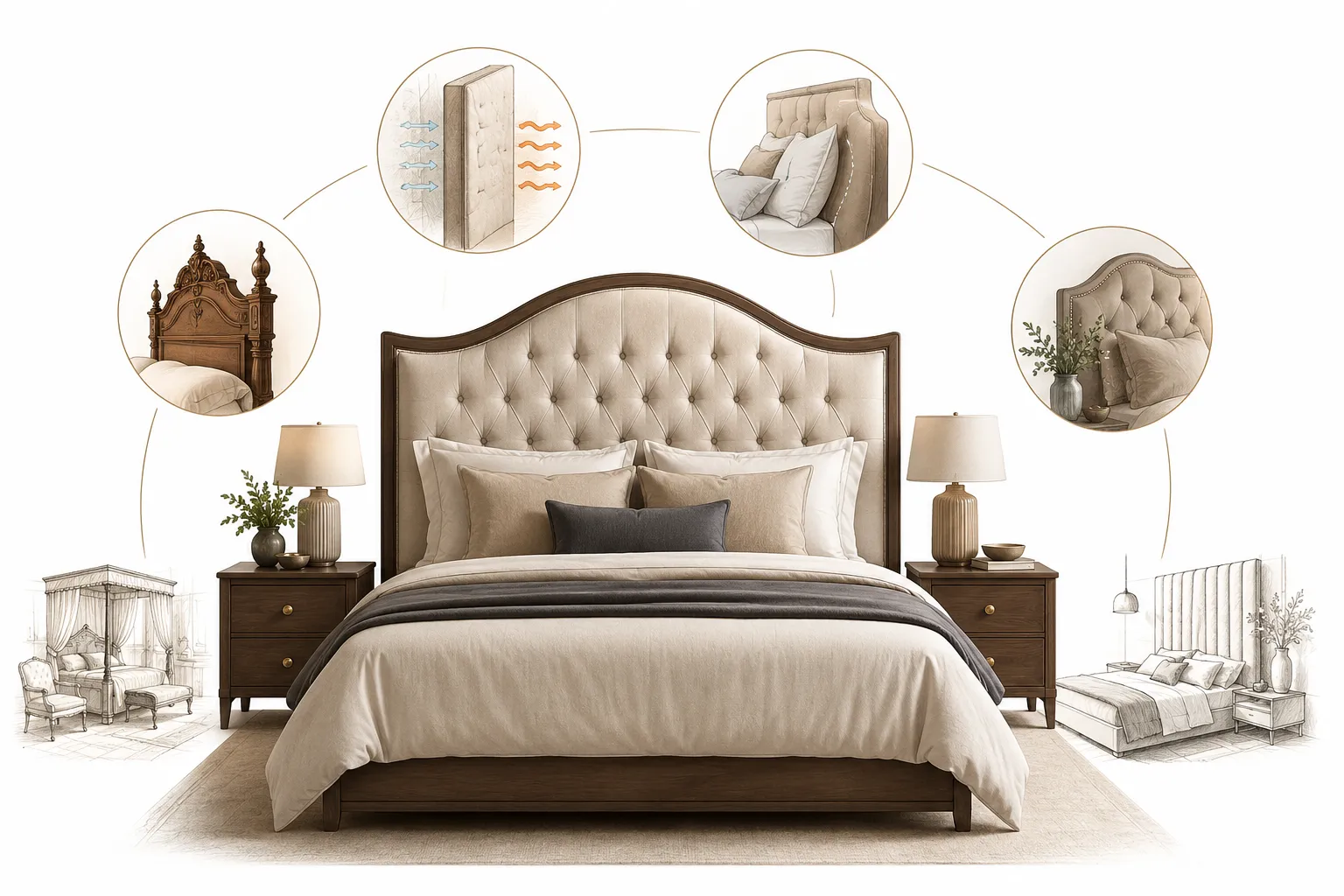
The diagram shows how headboards began as practical insulation and became a mix of comfort, protection, and design.
Block cold walls
Early headboards helped separate sleepers from cold, drafty walls.
Protect the wall
They reduce marks from pillows, heads, and bed movement.
Support comfort
Modern headboards also make sitting up in bed easier.
The Cold Wall Problem
A Shield Against the Stone
Imagine a house in 15th-century England. The walls are solid stone. There is no insulation. Outside, it is freezing rain. The cold seeps directly through the rock.
If you push your bed against that wall and lay your head on a pillow, you are essentially resting your brain against a block of ice. Furthermore, old houses had terrible drafts. Gaps in the masonry allowed freezing air to whistle down the wall and directly onto your face while you slept.
The headboard solved this. A thick slab of wood placed a few inches from the wall created a dead air space, an insulating pocket. It physically blocked the drafts from hitting your head, and kept your pillow from falling into the damp, cold gap between the bed frame and the wall.
Evolution
The Life Cycle of the Headboard
Headboards used to keep heads off the cold floor and away from insects.
Ancient EgyptEstablished the idea of a 'head barrier' for comfort and hygiene.
Massive, intricately carved oak headboards become common to block stone-wall drafts.
Medieval EuropeThey were essential for survival in poorly insulated homes.
Headboards become status symbols. The wealthy had them upholstered in silk or carved by masters.
18th/19th CenturyFunction began to take a back seat to fashion.
Central heating and better insulation arrive. Headboards shrink, get thinner, and become optional.
20th CenturyThe headboard's primary job was eliminated by modern engineering.
Curiosity Notes
Details Most People Miss
Why this still matters
Why This Still Matters
It’s a perfect example of how human design evolves. We invent something out of desperate necessity (freezing to death), it becomes a cultural staple, the necessity vanishes, but the object remains, disguised as 'style.'
Key Findings
- ✓Core findingHistorically, exterior walls were freezing cold and drafty.
- ✓Strong evidenceA thick wooden headboard insulated the head and blocked cold air.
- ⚠Main consequenceThey also stopped pillows from slipping down behind the bed.
- ✓Wider legacyToday, they are purely decorative and used for back support while reading.
Final insight
A Last Thought
The headboard is a triumph of inertia over logic. We invented it to save ourselves from freezing to death against a stone wall. Then we invented central heating. But we looked at the wooden plank and thought, 'You know what? This looks kind of nice.' And so we kept it. It is a piece of winter survival gear that is now mostly sold in beige linen.
Quick answers
Common questions
Can a bed look good without a headboard? +
Absolutely. Many modern minimalist designs use wall art or paneling behind the bed instead of a traditional headboard.
Why don't beds have footboards anymore? +
Footboards were originally to keep you from sliding out of bed (which was just a pile of straw). Modern mattresses have friction, so footboards just get in the way of making the bed.