Quick Facts
Quick Facts
Van Gogh had invited Gauguin to live with him in the 'Yellow House' in Arles.
The two artists had a volatile relationship. They argued constantly.
Gauguin threatened to leave. Van Gogh became distraught.
After cutting his ear, van Gogh was hospitalized. Gauguin left and never saw him again.
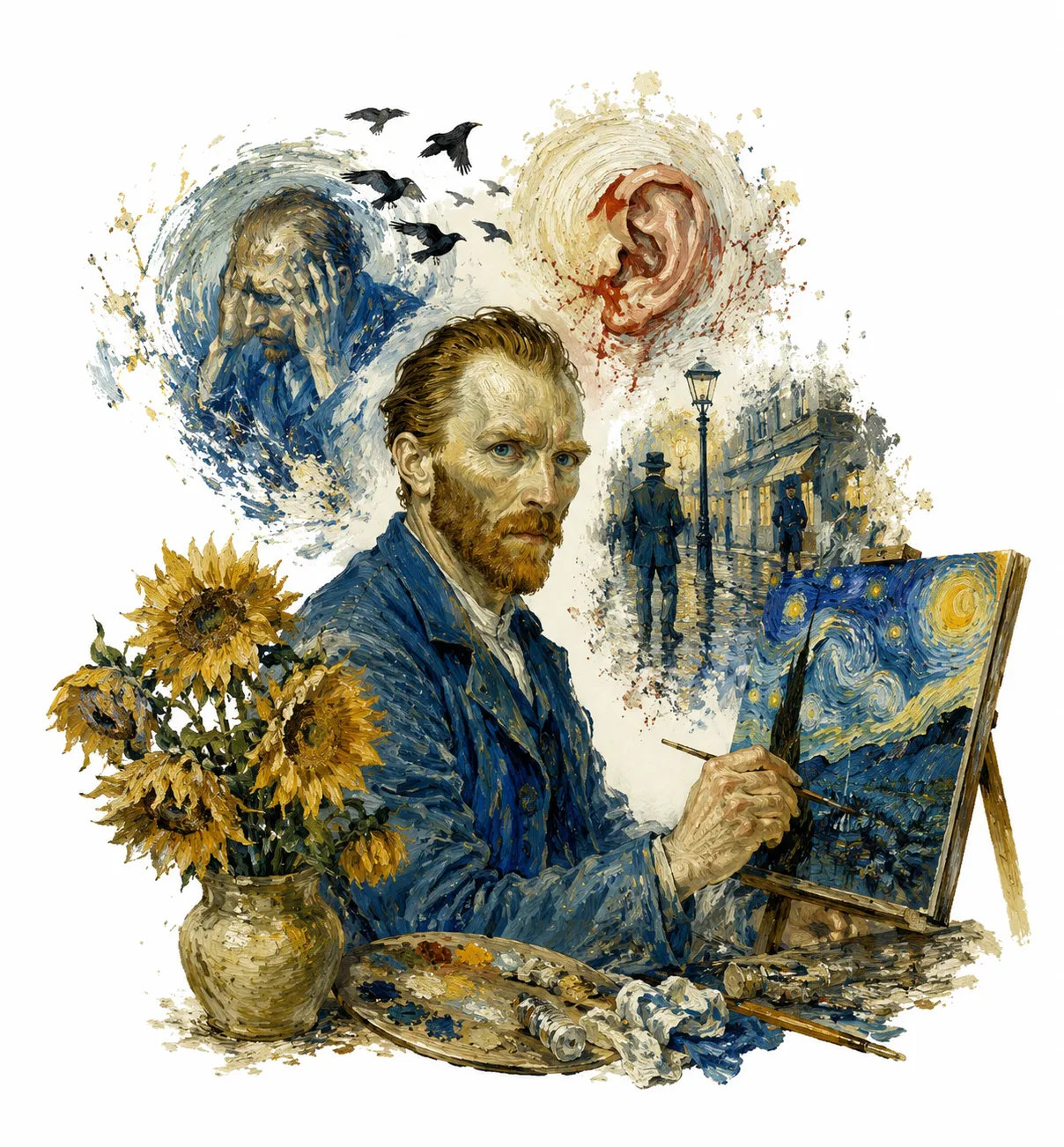
Van Gogh painted a self-portrait with a bandaged ear. It is one of his most famous works.
Visual answer
The Breakdown in Arles
The events leading to van Gogh's self-mutilation.
October 1888
Gauguin arrives in Arles to live with van Gogh. Van Gogh is overjoyed.
October-December 1888
The two artists work together but clash constantly. Their artistic differences become personal.
December 23, 1888
Gauguin announces he is leaving. Van Gogh suffers a breakdown.
Evening of December 23
Van Gogh cuts off his ear with a razor. He wraps it in newspaper and gives it to a prostitute.
December 24, 1888
Van Gogh is found bleeding in his bed. He is hospitalized. Gauguin leaves Arles. They never meet again.
Story in brief
Story in Brief
1886
Van Gogh moves to Paris. He meets Paul Gauguin.
1888
Van Gogh moves to Arles in the south of France. He dreams of starting an artists' colony.
October 1888
Gauguin joins van Gogh in Arles.
Van Gogh is thrilled. He has been lonely for years. He finally has a companion.
October-December 1888
The two artists argue constantly. Van Gogh's mental state deteriorates.
December 23, 1888
Gauguin says he is leaving. Van Gogh cuts off his ear.
The ear incident becomes legendary. Gauguin leaves immediately.
1889
Van Gogh voluntarily commits himself to an asylum in Saint-Rémy.
July 27, 1890
Van Gogh shoots himself in the chest. He dies two days later.
His brother Theo, who had supported him financially and emotionally, dies six months later.
The Story
A Fight, A Razor, and A Prostitute
Vincent van Gogh was lonely. He had always been lonely. He had tried to be a preacher, an art dealer, and a teacher. Nothing worked. His only real relationship was with his younger brother, Theo, who supported him financially and emotionally.
When van Gogh moved to Arles, he dreamed of creating an artists' colony. He invited Paul Gauguin, a brilliant and egotistical painter, to join him. Van Gogh decorated a room for Gauguin. He bought new furniture. He was desperate for companionship.
The two artists were a terrible match. Van Gogh was chaotic and emotional. Gauguin was cold and domineering. They argued about art, about money, about everything. On December 23, 1888, Gauguin announced he was leaving. Van Gogh snapped. He took a razor and followed Gauguin into the street. Gauguin turned around. Van Gogh turned back. He went home. And he cut off his ear.
Famous Quote
"I put my heart and my soul into my work, and I have lost my mind in the process."
, Vincent van Gogh (attributed)
Whether van Gogh actually said this is unclear. But it captures his tragedy perfectly.
Evidence
What Historians Believe
Van Gogh suffered from severe mental illness, possibly bipolar disorder or epilepsy.
StrongHis relationship with Gauguin was volatile and stressful.
StrongVan Gogh had a history of breakdowns and self-destructive behavior.
StrongAlcohol abuse, particularly absinthe, may have contributed.
ModerateKey Points
Key Points So Far
Van Gogh cut off his ear after Gauguin announced he was leaving.
He had a history of mental illness and breakdowns.
He gave the severed ear to a prostitute named Rachel.
He was hospitalized. Gauguin left and never returned.
Van Gogh died by suicide two years later.
Analogy
Like Drowning in a Room Full of People
The familiar part
Imagine being desperately lonely. You finally find a friend. Then that friend says they are leaving. You feel like you are drowning.
How it applies
Van Gogh was drowning. Gauguin was the lifeline. When Gauguin left, van Gogh panicked. He did not know how to ask for help. So he hurt himself instead.
Where the analogy breaks
Most people do not cut off their ears when they panic. Van Gogh was not most people.
Curiosity Notes
Details Most People Miss
Why this still matters
Why This Still Matters
Van Gogh's story is still told because it is the ultimate tale of the suffering artist. He created beauty out of pain. His sunflowers, his starry nights, his self-portraits are among the most beloved images in art. And he made them while fighting demons we can only imagine. The ear is a symbol of that struggle. But his art is a symbol of what struggle can produce.
Key Findings
- ✓Core findingVan Gogh cut off his ear after a fight with Paul Gauguin.
- ✓Strong evidenceHe had a history of mental illness, possibly bipolar disorder or epilepsy.
- ⚠Main consequenceHe gave the ear to a prostitute named Rachel.
- ✓Wider legacyHe died by suicide two years later, in 1890.
- ★Bottom lineHe sold only one painting in his lifetime.
Final insight
A Last Thought
Vincent van Gogh cut off his ear. That is the story everyone knows. But the story everyone forgets is that he painted over 2,000 artworks, including some of the most beautiful paintings ever made. The ear is a moment of madness. The art is a lifetime of genius. We remember the ear because it is shocking. We love the art because it is glorious. Van Gogh was both: a man in pain and a man of brilliance. The ear and the sunflowers come from the same person. That is the real tragedy. And the real triumph.
Quick answers
Common questions
Did van Gogh really give his ear to a prostitute? +
Yes. He wrapped it in newspaper and delivered it to a woman named Rachel at a brothel in Arles. She fainted. The police found van Gogh the next morning, bleeding in his bed.
What happened to the ear? +
No one knows. The prostitute likely threw it away. There is no record of what happened to it after that night.