Quick Facts
Quick Facts
Leonardo was left-handed and wrote backwards. His notebooks are mirror writing.
He was an illegitimate child, which barred him from many professions. Art was open to him.
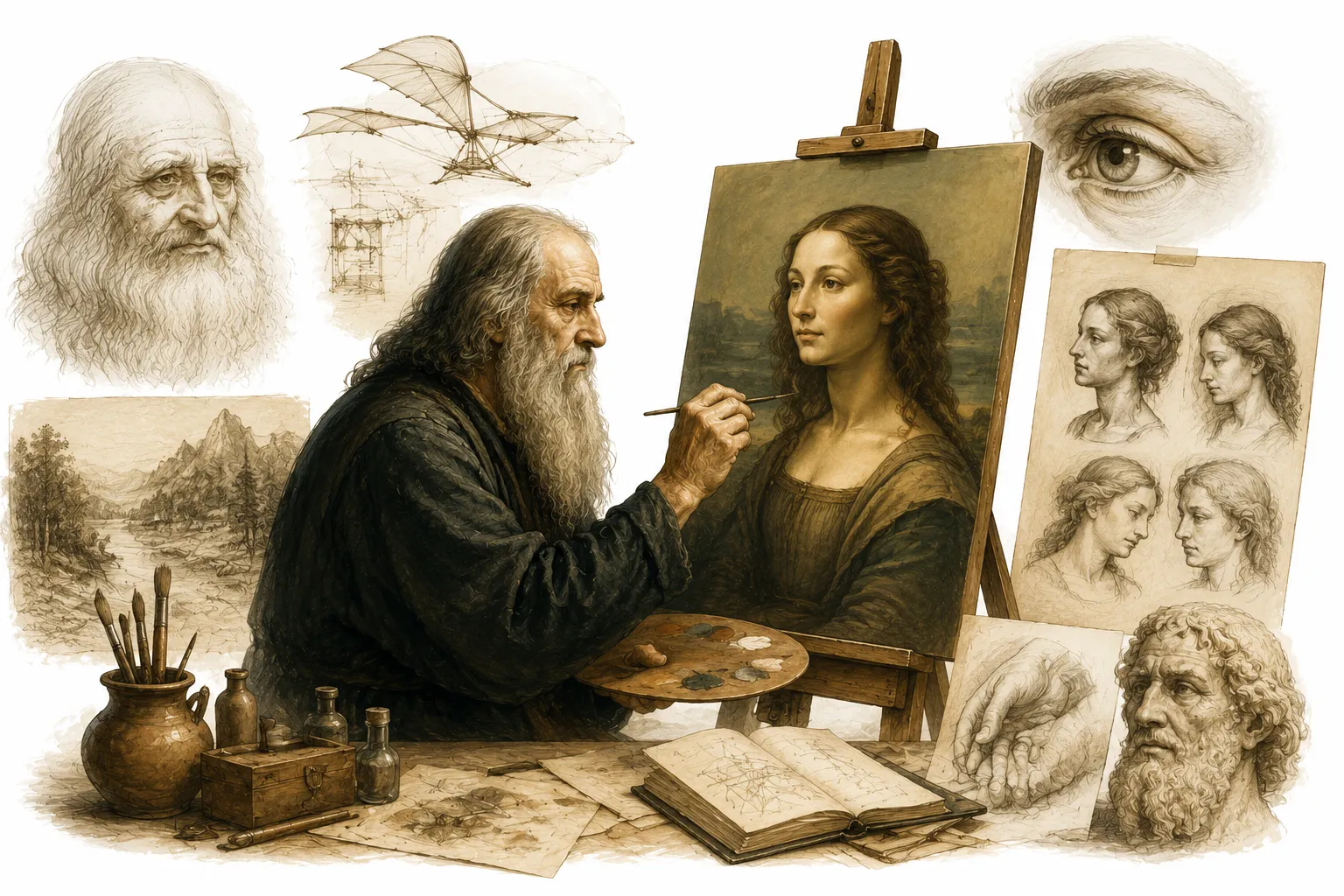
He spent years on the Mona Lisa and never considered it finished.
He designed a robot knight that could sit, move its arms, and open and close its jaw.
He dissected over 30 human bodies to understand anatomy.
Visual answer
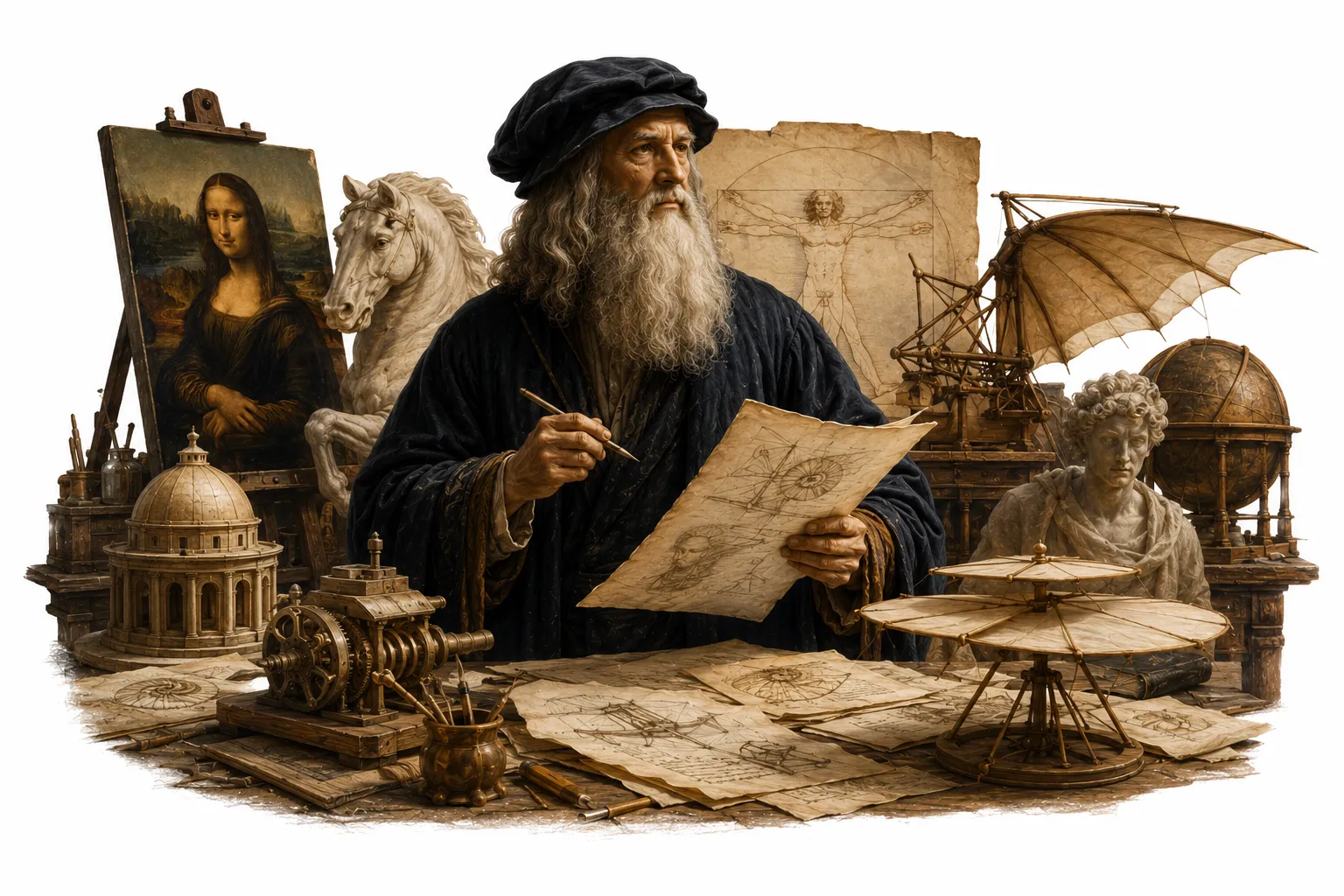
Leonardo's Many Talents
The Renaissance man's greatest achievements across different fields.
Art
Mona Lisa, The Last Supper. Only about 15 surviving paintings, but they are among the most famous in history.
Anatomy
Detailed drawings of the human body, including the fetus, heart, and muscles. Centuries ahead of medical illustration.
Engineering
Designs for bridges, canals, and fortifications. Many were too expensive to build in his time.
Invention
Flying machines, parachutes, tanks, diving suits, and even a robot. None were built in his lifetime.
Science
Studies of water flow, geology, optics, and botany. He observed nature like a modern scientist.
Story in brief
Story in Brief
1452
Leonardo is born in Vinci, Italy.
1466
He becomes an apprentice to the artist Verrocchio in Florence.
1482
He moves to Milan and begins filling notebooks with inventions.
The Milan period produced many of his most famous notebook sketches.
1495-1498
He paints The Last Supper in Milan.
1503
He begins the Mona Lisa. He will work on it for years, off and on.
The painting will become the most famous in the world.
1516
He moves to France at the invitation of King Francis I.
1519
He dies at age 67, reportedly in the arms of the king.
The Story
Curiosity Without Limits
Leonardo da Vinci had a problem. He was interested in everything. He wanted to know how the human body worked, so he dissected corpses. He wanted to know how birds flew, so he designed flying machines. He wanted to know how water flowed, so he spent years studying rivers and canals.
The result was thousands of pages of notebooks filled with observations, diagrams, and ideas. But there was a downside. He rarely finished anything. He took commissions for paintings and then abandoned them. He designed machines that could not be built with 15th century technology. He started books that went nowhere.
His employer, the Duke of Milan, once asked him to paint a mural of a famous battle. Leonardo became obsessed with painting horses. He painted detailed studies of horses. He never finished the mural. The unfinished work was eventually destroyed. That was Leonardo in a nutshell: brilliant, obsessed, and permanently distracted.
Famous Quote
"Learning never exhausts the mind."
, Leonardo da Vinci
He proved this by learning until the day he died. His last notebooks show him still asking questions about geometry and anatomy.
Evidence
Why Leonardo Still Matters
The Mona Lisa is the most visited painting in the world.
StrongHis anatomical drawings were so accurate that they were used by doctors for centuries.
StrongHis flying machine designs inspired later aviation pioneers.
ModerateHis notebooks are studied as masterpieces of observation and drawing.
StrongKey Points
Key Points So Far
Leonardo painted two of the most famous paintings in history: the Mona Lisa and The Last Supper.
He filled thousands of pages with inventions that were centuries ahead of his time.
He made detailed anatomical drawings based on dissecting human bodies.
He rarely finished anything. His curiosity always pulled him in new directions.
Analogy
Leonardo Was Like a YouTube Rabbit Hole
The familiar part
Imagine falling down a YouTube rabbit hole. You start watching a video about painting, then click on one about flying machines, then one about the human heart, then one about water physics.
How it applies
That was Leonardo's entire life. He never stopped falling down rabbit holes. Unlike most of us, he documented everything. The notebooks are the history of a mind that could not stop asking 'why' and 'how.'
Where the analogy breaks
YouTube videos end. Leonardo's curiosity did not.
Curiosity Notes
Details Most People Miss
Why this still matters
Why This Still Matters
Leonardo da Vinci is still famous because he represents something we all admire: boundless curiosity. In an age of specialization, he was a generalist. He wanted to know everything about everything. He could not, of course. No one can. But the trying was the point. His notebooks are a testament to the joy of asking questions, even when you cannot find the answers.
Key Findings
- ✓Core findingLeonardo painted the Mona Lisa and The Last Supper.
- ✓Strong evidenceHe filled thousands of notebook pages with inventions and observations.
- ⚠Main consequenceHe studied anatomy by dissecting human bodies.
- ✓Wider legacyHe was a classic Renaissance man: artist, scientist, engineer, and inventor.
- ★Bottom lineHe rarely finished anything, but what he finished changed art forever.
Final insight
A Last Thought
Leonardo da Vinci is famous because he tried to be everything. He was not the greatest painter of his time. Michelangelo might have been better. He was not the greatest inventor. Archimedes came before him. But no one combined art, science, and invention the way he did. He failed at many things. He finished almost nothing. But the attempt, recorded in 7,000 pages of notebooks, is what makes him immortal. He wanted to know everything. He did not succeed. But he tried harder than anyone else.
Quick answers
Common questions
How many paintings did Leonardo complete? +
Fewer than 20 surviving paintings can be reliably attributed to him. He was not a prolific painter. He was a thinker who sometimes painted.
Did Leonardo really invent the helicopter? +
He designed a machine with a spinning screw-like blade that he thought would lift into the air. It is often called an 'aerial screw' and resembles a modern helicopter. But he never built it, and it would not have worked with the materials available in his time.