Quick Facts
Quick Facts
The painting is also known as 'La Gioconda,' which means 'the happy woman.'
It is painted on a poplar wood panel, not canvas.
The painting measures 30 inches by 21 inches.
It has been stolen once, in 1911. It was recovered two years later.
The painting now lives behind bulletproof glass in the Louvre museum in Paris.
Visual answer
The Strange Journey of the Mona Lisa
From commission to the Louvre.
c. 1503
Francesco del Giocondo commissions Leonardo to paint a portrait of his wife, Lisa.
1503-1516
Leonardo works on the painting off and on. He never delivers it. He keeps it in his studio.
1516
Leonardo moves to France. He takes the painting with him. It is still unfinished.
1519
Leonardo dies. The painting is inherited by his assistant, Salai.
16th century
King Francis I acquires the painting. It enters the French royal collection.
1797
The painting is installed in the Louvre. It becomes world famous.
Story in brief
Story in Brief
c. 1503
Leonardo receives a commission from Francesco del Giocondo to paint his wife, Lisa.
The commission is ordinary. A merchant wants a portrait. Nothing special.
1503-1516
Leonardo works on the painting. He does not deliver it. He keeps it.
No one knows why. He was a perfectionist. He may have been distracted. He may have grown attached.
1516
Leonardo moves to France at the invitation of King Francis I. He takes the Mona Lisa with him.
The painting leaves Italy. It will never return.
1519
Leonardo dies. The Mona Lisa is in his possession. He never gave it to the merchant.
The painting passes to Leonardo's assistant, then to the king. The merchant never got his wife's portrait.
The Story
Why Leonardo Kept the World's Most Famous Painting
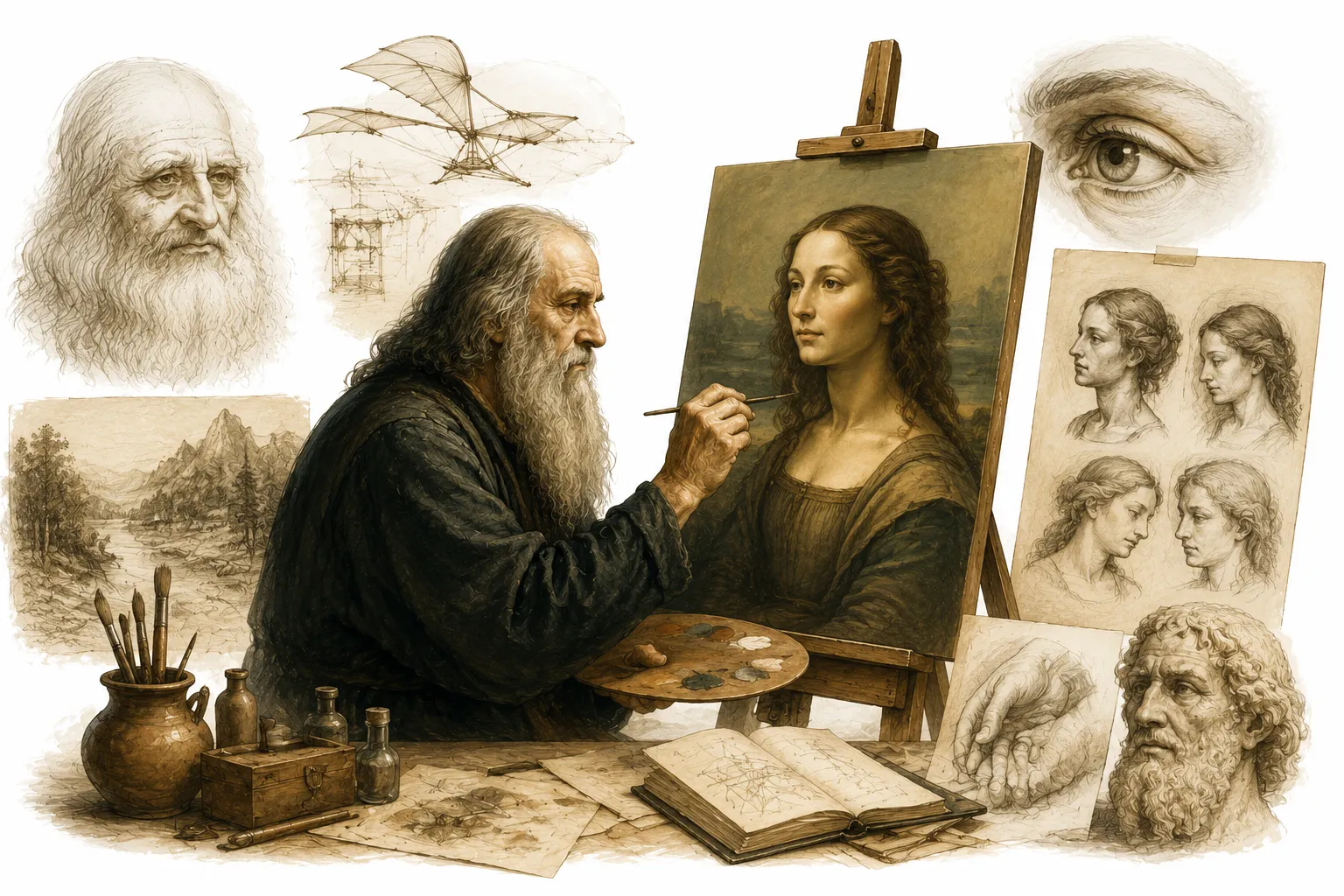
In 1503, a wealthy Florentine silk merchant named Francesco del Giocondo commissioned Leonardo da Vinci to paint a portrait of his wife, Lisa Gherardini. It was a routine commission. Every rich man wanted a portrait of his wife. Leonardo had done dozens of them.
But something went wrong. Or perhaps something went right. Leonardo never delivered the painting. He kept it. He worked on it for years, adding tiny touches, perfecting the smile, adjusting the background. He never considered it finished. He never let it go.
When Leonardo moved to France in 1516, the Mona Lisa went with him. When he died in 1519, it was still in his possession. He never explained why. The merchant never got his portrait. Leonardo's assistant inherited it. The king of France bought it. The painting entered the French royal collection. It became the most famous painting in the world. And Francesco del Giocondo? He probably died still waiting.
From Vasari
"He worked on it for four years, and then left it unfinished. It is the most beautiful painting in the world."
, Giorgio Vasari, Lives of the Artists
Vasari wrote this in 1550, 30 years after Leonardo's death. He claimed Leonardo worked on the painting for four years. Modern scholars think it was longer.
Evidence
What We Know About the Commission
The painting was commissioned by Francesco del Giocondo, a silk merchant.
StrongThe subject was his wife, Lisa Gherardini.
StrongLeonardo never delivered the painting. He kept it until his death.
StrongThe painting entered the French royal collection after Leonardo's death.
StrongThe merchant was never paid. Leonardo was never paid.
ModerateKey Points
Key Points So Far
The Mona Lisa was commissioned by a wealthy silk merchant as a portrait of his wife.
Leonardo never delivered the painting. He kept it for himself.
He worked on it for years, perhaps until his death.
He took it with him to France. It never returned to Italy.
The merchant never got the painting. Leonardo never got paid.
Analogy
Like a Novelist Who Cannot Finish the Book
The familiar part
Imagine a novelist who is hired to write a book. He takes the advance. He works on the book for years. He rewrites. He revises. He never finishes. The publisher gives up. The novelist keeps the manuscript. He works on it until he dies.
How it applies
That was Leonardo. The Mona Lisa was his manuscript. He could not finish it. He could not let it go. It was his obsession. He died with it in his hands.
Where the analogy breaks
Novelists usually have editors. Leonardo had only himself. He was his own worst critic.
Curiosity Notes
Details Most People Miss
Why this still matters
Why This Still Matters
The Mona Lisa is still famous because of its mystery. Why did Leonardo keep it? Why did he never finish it? What is she smiling about? The questions are more interesting than the answers. Leonardo took his secrets to the grave. The painting stayed. We are still asking. That is the power of art. It does not answer. It asks.
Key Findings
- ✓Core findingThe Mona Lisa was commissioned by a wealthy silk merchant as a portrait of his wife, Lisa Gherardini.
- ✓Strong evidenceLeonardo never delivered the painting. He kept it for himself.
- ⚠Main consequenceHe worked on it for years, perhaps until his death, and took it with him to France.
- ✓Wider legacyThe painting entered the French royal collection after Leonardo's death.
- ★Bottom lineIt became a global icon after being stolen from the Louvre in 1911.
Final insight
A Last Thought
Leonardo da Vinci painted the Mona Lisa for money. But he never collected. He kept the painting for himself. He carried it with him to France. He kept it in his studio. He added tiny touches. He never let it go. It was his companion for the last 16 years of his life. When he died, it was still in his hands. The merchant never got his portrait. The world got a masterpiece. That is the irony of the Mona Lisa. It was never meant to be famous. It was meant to be private. Leonardo could not share it. He could not finish it. He could not let it go.
Quick answers
Common questions
Is the Mona Lisa a real person? +
Yes. Her name was Lisa Gherardini. She was the wife of Francesco del Giocondo. She lived a normal life. She had children. She died in her 60s. She never knew her portrait would become famous.
Why did Leonardo never finish the painting? +
No one knows. He was a perfectionist. He may have been distracted by other projects. He may have grown attached to the painting. He never explained. The mystery is part of the legend.