1
01. The plug looks symmetrical to the human eye
Near-identical top and bottom surfaces make both orientations appear equally valid.
Everyday Technology
The connector that achieves failure 100% of the time, on the first two attempts. A USB plug has two sides. One of them is correct. You will, with near-mathematical certainty, try the wrong one first, correct yourself, then somehow try the wrong one again before finally succeeding. This is not incompetence. This is a design that managed to make a coin-flip feel like an impossible puzzle. The answer involves asymmetric internal design, an era before manufacturers cared much about user experience, and the reason the problem has now been definitively, if belatedly, solved.
Quick answer
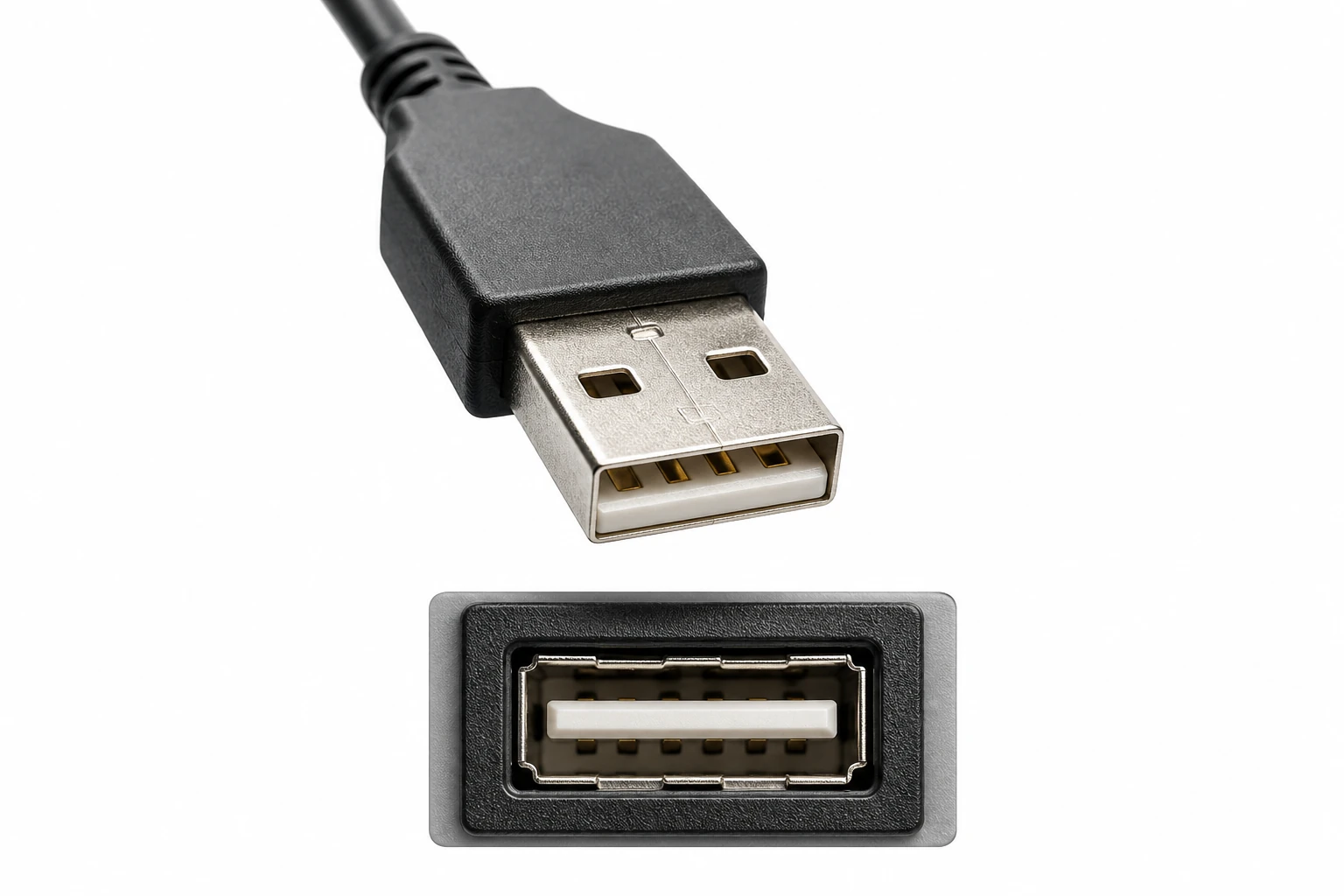
The original USB-A connector looks nearly identical on both sides but is internally asymmetrical, with contacts on one side only, meaning one orientation works and one does not, and without clear visible differentiation the user cannot reliably tell which is which without a marking they rarely see. USB-C, the modern standard, is fully reversible and works in both orientations - solving a problem that existed for nearly thirty years while the original USB specification was in use.
The mystery
The answer involves asymmetric internal design, an era before manufacturers cared much about user experience, and the reason the problem has now been definitively, if belatedly, solved.
The short answer
The original USB-A connector looks nearly identical on both sides but is internally asymmetrical, with contacts on one side only, meaning one orientation works and one does not, and without clear visible differentiation the user cannot reliably tell which is which without a marking they rarely see.
The twist
USB-C, the modern standard, is fully reversible and works in both orientations - solving a problem that existed for nearly thirty years while the original USB specification was in use.
Common mistake
Many people assume their failure rate is simply bad luck - an equal chance of right and wrong.
Everyday Technology
Cost, manufacturing complexity, and backward compatibility concerns delayed reversible design until the USB-C generation.
The designers who finally fixed it
The industry group that developed the USB-C specification introduced full reversibility as a core design requirement.
Related questions
Yes, Apple's Lightning connector is fully reversible, introduced in 2012 before USB-C standardized the approach.
Where similar design-versus-user conflicts appear
Early SIM card trays were similarly difficult to orient correctly, before notched or clearly marked designs became standard.
Where similar design-versus-user conflicts appear
The standard 3.5mm jack is fully rotationally symmetric and works in any orientation - a simple user-friendly design that predates USB by decades.
Is it random which orientation you pick?
Studies and informal experiments suggest people systematically choose the wrong orientation more than 50% of the time, possibly due to a consistent bias in how people orient objects for insertion.
Continue learning