Everyday Science

Why Does a Pendulum Swing?

A weight on a string that quietly helped humanity learn to keep time. Push a weight hanging from a string and it does something deceptively simple: it swings back and forth, again and again, in a rhythm so steady that clockmakers built entire industries around it. The motion looks effortless. Underneath it is a tireless, repeating negotiation between gravity and momentum. The answer involves gravity, inertia, and a discovery a teenage Galileo reportedly made while watching a chandelier sway in church.

Quick answer

A pendulum swings because gravity constantly pulls it back toward its lowest resting point, but its built-up momentum carries it past that point each time, creating a repeating back-and-forth motion that only gradually slows due to air resistance and friction. A pendulum's swing time depends almost entirely on its length, not its weight - a heavier bob swings at exactly the same rate as a lighter one of the same length.
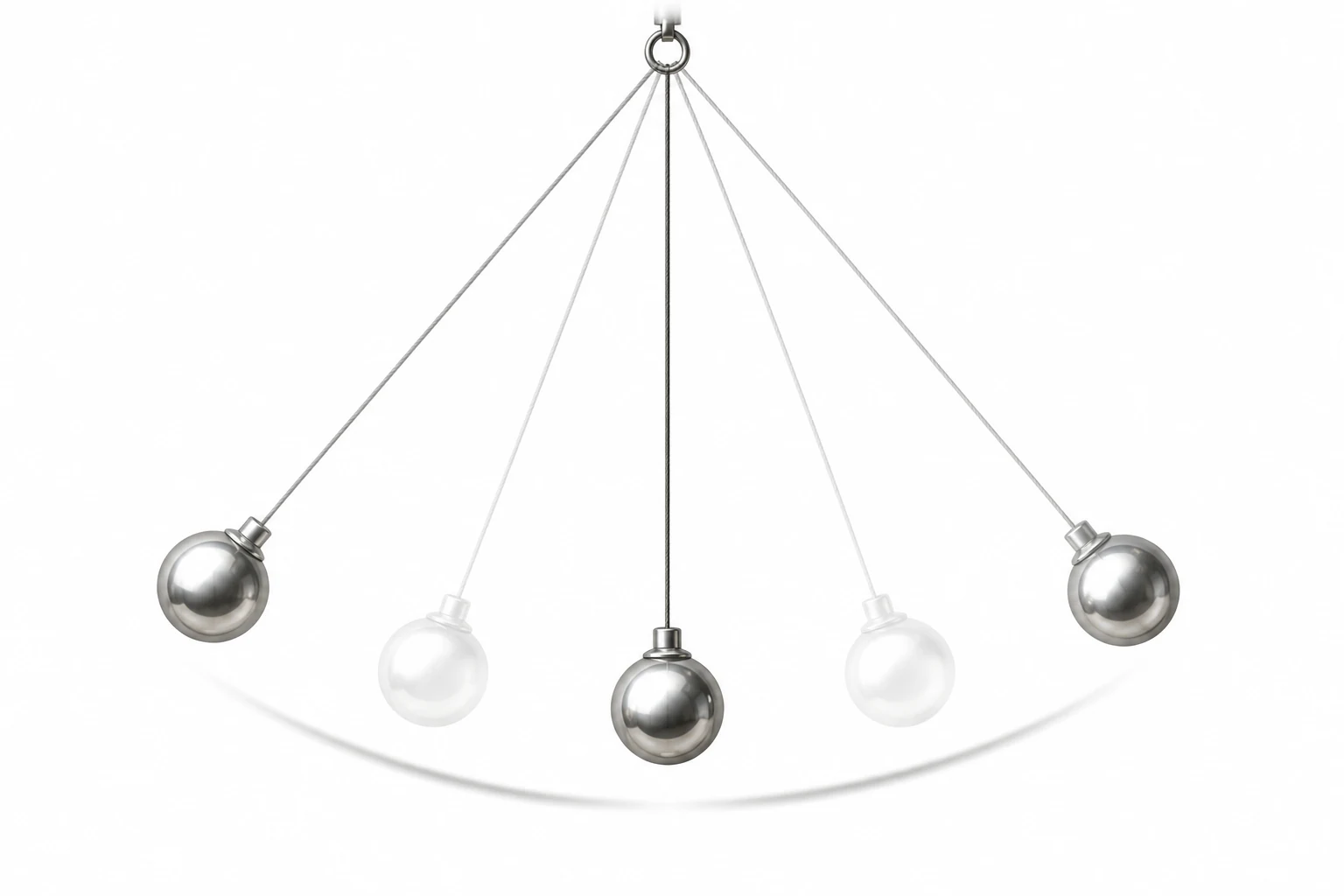
Why Does a Pendulum Swing? hero image

The mystery

The answer involves gravity, inertia, and a discovery a teenage Galileo reportedly made while watching a chandelier sway in church.

The short answer

A pendulum swings because gravity constantly pulls it back toward its lowest resting point, but its built-up momentum carries it past that point each time, creating a repeating back-and-forth motion that only gradually slows due to air resistance and friction.

The twist

A pendulum's swing time depends almost entirely on its length, not its weight - a heavier bob swings at exactly the same rate as a lighter one of the same length.

Common mistake

Many people assume a heavier weight on a pendulum will swing more slowly than a lighter one.

A tug-of-war between gravity and motion

A pendulum's swing is the visible result of two forces continuously trading the upper hand.

Gravity always pulls it back to center

At rest, a pendulum hangs straight down, the lowest point gravity can pull it to. Lifted to one side and released, gravity immediately begins pulling it back toward that resting position.

This constant pull toward center is what gives the pendulum its restoring force.

Gravity has one job in a pendulum's life, and it performs it with relentless consistency.

Momentum carries it past the bottom

As the pendulum swings downward, it builds speed and momentum, which carries it past the lowest point rather than letting it simply stop there.

This overshoot is essential - without it, the pendulum would just settle motionless at the bottom after one pass.

A pendulum never stops at the bottom because momentum insists on finishing what gravity started.

Why the swing eventually fades

Air resistance and friction at the pivot point gradually drain energy from the system with every swing, which is why a pendulum's arc slowly shrinks over time.

A pendulum clock solves this by using a small mechanical push, called an escapement, to top up the lost energy at each swing.

Left alone, every pendulum eventually loses its argument with friction - clockmakers simply gave it reinforcements.

The physics of one full swing

A complete pendulum cycle moves through a consistent, repeating sequence.

1

01. The pendulum is pulled to one side

Lifting the bob raises its potential energy relative to its resting position.

2

02. Gravity pulls it back down

Potential energy converts into kinetic energy as the bob accelerates toward the bottom.

3

03. Momentum carries it through and upward

The bob swings past center and rises on the opposite side, converting kinetic energy back into potential energy.

4

04. The cycle repeats in reverse

Gravity pulls it back again, continuing the oscillation until energy losses bring it to rest.

Why length matters more than weight

A pendulum's swing period depends on its length and the strength of gravity, but not on the mass of the bob - heavier and lighter weights of identical length swing in perfect sync.

This surprising fact, formalized mathematically, became the foundation of mechanical timekeeping for nearly three centuries before quartz and atomic clocks took over.

Surprising pendulum facts

Pendulum clocks helped define the meter
Early proposals for standardizing length were based on the length of a pendulum with a one-second swing.
Foucault's pendulum proves Earth spins
A large swinging pendulum slowly changes direction relative to the floor, visibly demonstrating Earth's rotation.
Pendulums work differently on other planets
Because gravity's strength varies, the same pendulum swings faster on a high-gravity world and slower on a low-gravity one.

Doesn't a heavier pendulum swing slower?

Myth

Many people assume a heavier weight on a pendulum will swing more slowly than a lighter one.

Heavier objects intuitively feel like they should move more sluggishly, even though gravity accelerates all masses equally.

Reality

Mass has essentially no effect on swing speed for an ideal pendulum; only the length of the pendulum and the strength of gravity determine its period.

Mass has essentially no effect on swing speed for an ideal pendulum; only the length of the pendulum and the strength of gravity determine its period.

Where pendulum physics shows up elsewhere

Playground swings
A swing set behaves like a simple pendulum, with its rhythm determined mainly by the length of its chains.
Seismographs
Some early seismographs used pendulum-based mechanisms to detect and record the motion of earthquakes.

Why pendulum physics still matters

The principles behind pendulum motion underpin centuries of timekeeping technology and remain a foundational example in physics education.

Pendulum clocks were, for hundreds of years, the most accurate timekeeping devices humanity had ever built.

Worth noting

A rhythm borrowed from gravity itself

A swinging pendulum is really just gravity and momentum taking turns, with such reliable timing that humans built centuries of clocks around their argument. Few simple objects have kept better time than a weight that simply refuses to stay still.

Quick answers

Common questions

Does air resistance affect pendulum accuracy?

Yes, which is why historically precise pendulum clocks were sometimes housed in sealed, low-pressure cases.

Why does a pendulum eventually stop?

Energy is gradually lost to friction at the pivot and air resistance, slowing the swing until it stops entirely.

Everyday Science

Related questions

Winding stores energy that compensates for the swing energy gradually lost to friction and air resistance.

The man who timed his own heartbeat

Galileo Galilei

Galileo is credited with first identifying the consistent timing of pendulum swings, reportedly while observing a swinging lamp in a cathedral.

Related questions

Why does a longer pendulum swing more slowly?

Longer pendulums have farther to travel per swing, increasing the time required for each oscillation.

Where pendulum physics shows up elsewhere

Playground swings

A swing set behaves like a simple pendulum, with its rhythm determined mainly by the length of its chains.

Where pendulum physics shows up elsewhere

Seismographs

Some early seismographs used pendulum-based mechanisms to detect and record the motion of earthquakes.

Doesn't a heavier pendulum swing slower?

Mass has essentially no effect on swing speed for an ideal pendulum; only the length of the pendulum and the strength of gravity determine its period.

Mass has essentially no effect on swing speed for an ideal pendulum; only the length of the pendulum and the strength of gravity determine its period.