1
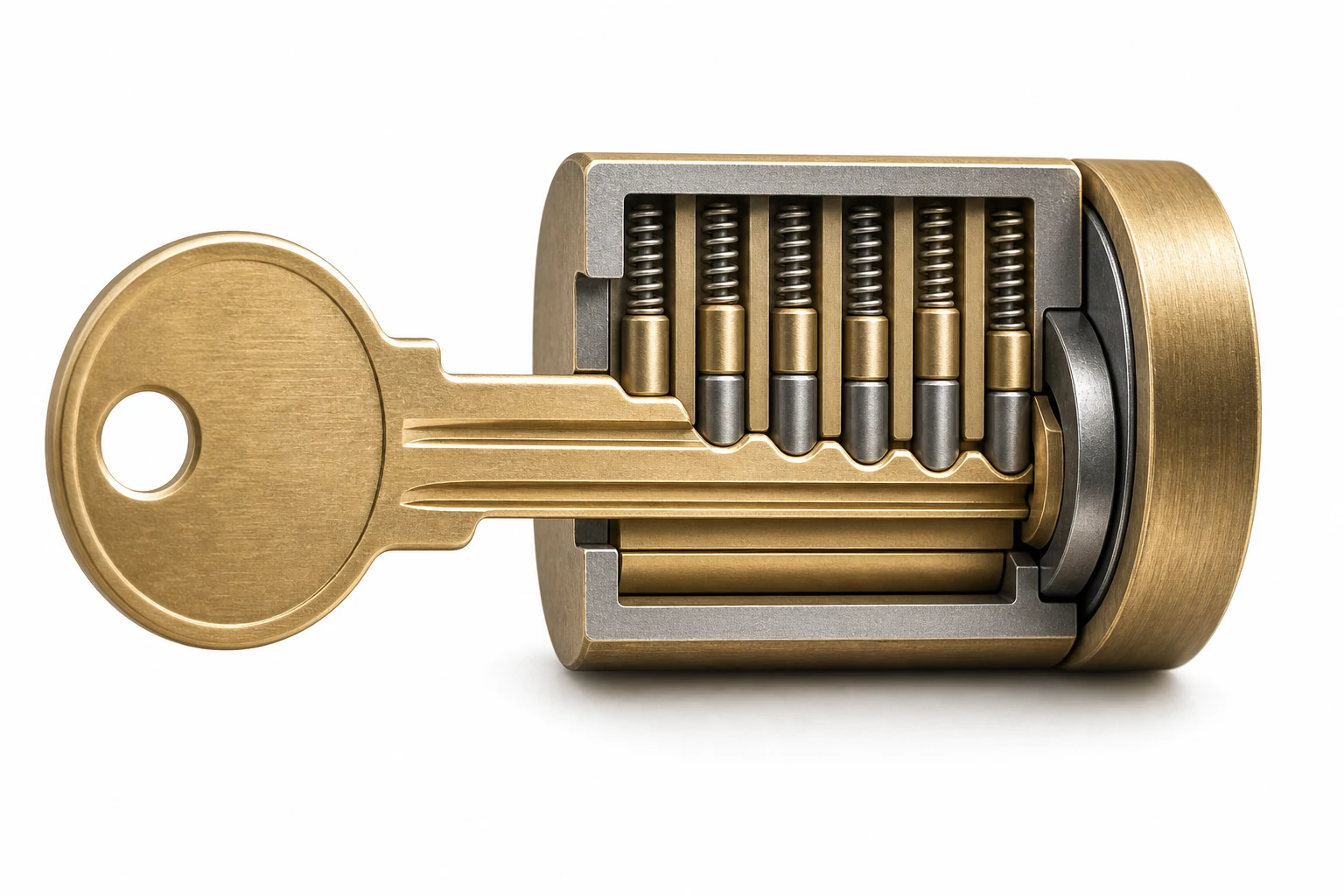
01. Key is inserted into the cylinder
The key's profile contacts each bottom pin.
Everyday Engineering
A mechanism so elegantly simple that it has barely changed in 4,000 years. Every day you push a small metal object into a cylinder, turn it, and gain access to a building, a vehicle, or a cabinet. The mechanism involved is so reliable that most people never think about it. The pin tumbler lock is one of humanity's most successful mechanical designs - and understanding it makes the humble act of unlocking a door feel considerably more interesting. The answer involves spring-loaded pins, a shear line, and a design so effective that an ancient Egyptian version worked on essentially identical principles.
Quick answer
A pin tumbler lock works by using a series of spring-loaded pins of varying heights that block the cylinder from rotating. The correct key pushes each pin to exactly the right height, aligning all pin gaps along a single line called the shear line, which allows the cylinder to rotate freely and operate the lock mechanism. The pin tumbler lock was invented in ancient Egypt using wooden pins, and the principle has remained essentially unchanged for over 4,000 years despite vastly different manufacturing materials and methods.
The mystery
The answer involves spring-loaded pins, a shear line, and a design so effective that an ancient Egyptian version worked on essentially identical principles.
The short answer
A pin tumbler lock works by using a series of spring-loaded pins of varying heights that block the cylinder from rotating. The correct key pushes each pin to exactly the right height, aligning all pin gaps along a single line called the shear line, which allows the cylinder to rotate freely and operate the lock mechanism.
The twist
The pin tumbler lock was invented in ancient Egypt using wooden pins, and the principle has remained essentially unchanged for over 4,000 years despite vastly different manufacturing materials and methods.
Common mistake
Most people assume a more complex key profile means a more secure lock.
Everyday Engineering
They manipulate the pins individually using a tension wrench and pick, setting each pin at the shear line one at a time.
The inventor of the modern pin tumbler lock
An American inventor who patented the small-format pin tumbler lock in 1861, essentially creating the modern key and lock as we know them.
Where pin tumbler mechanics appear
Modern car locks often use variations of pin tumbler mechanisms with additional security features like rotating elements.
Where pin tumbler mechanics appear
Standard padlocks use the identical pin tumbler mechanism in a portable housing.
Is a more complex key always more secure?
Security depends more on pin quality, tolerances, and pin geometry types than on key complexity alone.
Continue learning

Everyday Engineering
Another design choice shaped by practical engineering.

Everyday Engineering
Another design choice shaped by practical engineering.
Everyday Design
Another design choice shaped by practical engineering.