Everyday Design

Why Do Scissors Have a Finger Loop?

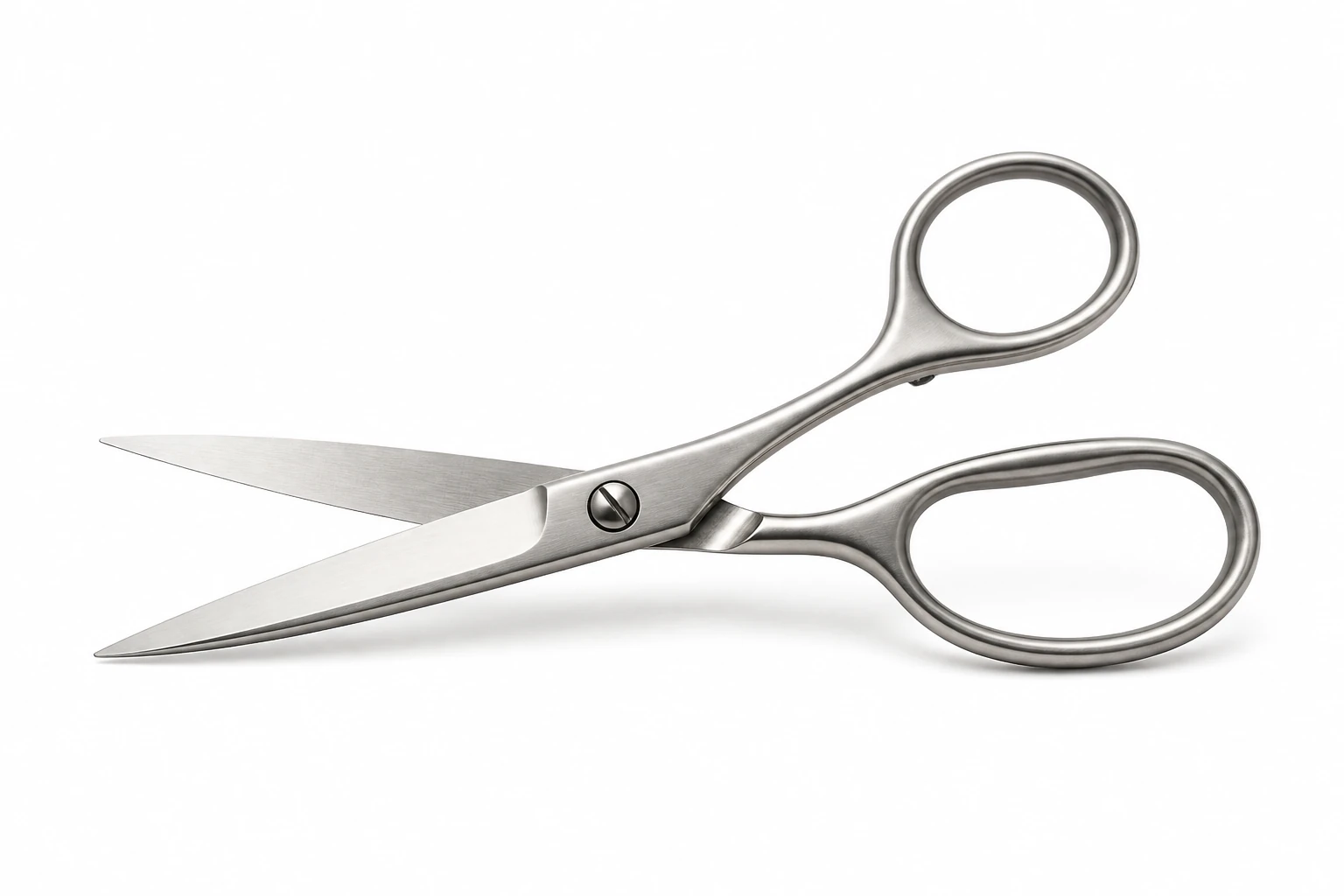
A design over 2,000 years old that has never needed significant improvement. Scissors have two blades and two loops, and the loops are not just comfortable - they are fundamental to how scissors work at all. Without the loops, scissors become dramatically harder to use. The loops are not a comfort feature added later; they are part of the mechanical system. The answer involves lever mechanics, the pivot point physics of blades, and why pivot scissors replaced spring scissors as soon as anyone thought of the design.

Quick answer

Scissors have finger loops because they function as levers, with the pivot point between the blades acting as the fulcrum. The loops provide a stable grip point for applying force to both sides of the lever simultaneously, and their closed shape allows the hand to push and pull as needed throughout the cutting stroke. The loop design was not always the standard - early scissors were spring-loaded with no pivot, working more like tweezers than modern scissors. The pivot-and-loop design represents a major ergonomic advance that eventually completely displaced the earlier style.
Why Do Scissors Have a Finger Loop? hero image

The mystery

The answer involves lever mechanics, the pivot point physics of blades, and why pivot scissors replaced spring scissors as soon as anyone thought of the design.

The short answer

Scissors have finger loops because they function as levers, with the pivot point between the blades acting as the fulcrum. The loops provide a stable grip point for applying force to both sides of the lever simultaneously, and their closed shape allows the hand to push and pull as needed throughout the cutting stroke.

The twist

The loop design was not always the standard - early scissors were spring-loaded with no pivot, working more like tweezers than modern scissors. The pivot-and-loop design represents a major ergonomic advance that eventually completely displaced the earlier style.

Common mistake

Many people assume finger loops are primarily about comfort rather than functionality.

A lever held by loops

Scissors are levers, and the loops are where the force is applied and controlled.

Scissors are a pair of levers sharing a fulcrum

Each blade of a pair of scissors is a lever, with the pivot rivet as the fulcrum. Force applied at the handle loops is transmitted to the cutting edges, magnified by the lever relationship between handle and blade length.

The closer the cutting material is to the pivot, the more cutting force is available - which is why thick materials are cut near the pivot, not the blade tips.

Scissors cut at the blade edges, but the physics happen at the loops.

The closed loop provides control in both directions

An open grip on the handle would require the fingers to constantly readjust, particularly when reversing the motion. The closed loop allows the same fingers to push the blade open and pull it closed smoothly throughout the cutting stroke.

This push-pull control through a single continuous loop grip is significantly more efficient than any open-handle alternative.

The loop lets the fingers say 'open' and 'close' from exactly the same position, without relocating.

Loop size and shape reflect specific use cases

Standard scissors have different-sized loops because the thumb and fingers they accommodate are different sizes. Embroidery scissors, surgical scissors, and children's scissors all have loop geometries tuned to their specific use context and user.

The loop is not merely structural; it is an ergonomic specification.

The loop's size and angle are a prescription for the specific hand action needed for a specific cutting task.

How finger loops enable cutting

A short sequence explains the loop's role in the scissors' operation.

1

01. Fingers are inserted into loops

The thumb occupies one loop, one or more fingers the other.

2

02. Squeezing closes the blades

The fingers pulling the loops together rotate the blades around the pivot.

3

03. The blade edges meet and cut material

Lever mechanics concentrate handle force at the blade contact point.

4

04. Extending the fingers opens the blades for the next cut

The loops allow continuous push-pull control from the same grip position.

Why spring scissors lost and loop scissors won

Early scissors were u-shaped spring tools - squeezing them closed and releasing them was how they worked. The pivot-and-loop design, which appeared in the Roman era, eventually replaced them because it offered dramatically better mechanical advantage, force control, and precision.

By the medieval period, pivot scissors had become dominant, and the spring design survives today mainly as kitchen tongs and spring-loaded kitchen scissors rather than general cutting tools.

Surprising scissors design facts

Left-handed scissors are not just mirrored
True left-handed scissors have the blade orientation inverted so the cutting action works correctly for a left-handed grip, not just the loops repositioned.
Surgical scissors often have ratchet locks
Many surgical scissors include a locking ratchet mechanism in the loops to hold them closed without continuous hand pressure.
The world's smallest scissors are used in microsurgery
Ophthalmic and neurosurgical scissors operate on the same loop-and-pivot principle at a scale requiring microscope-assisted use.

Are the loops just for comfort?

Myth

Many people assume finger loops are primarily about comfort rather than functionality.

Comfort is the most immediately obvious benefit, making the mechanical contribution of the loops less apparent.

Reality

The loops are integral to the scissors' mechanical function, enabling precise bidirectional control that open handles cannot match.

The loops are integral to the scissors' mechanical function, enabling precise bidirectional control that open handles cannot match.

Where scissors loop design appears in adapted forms

Surgical instruments
Needle holders, forceps, and various surgical clamps use the same ring-handle lever principle as scissors.
Kitchen shears
Heavy-duty kitchen scissors use loop handles scaled for stronger cuts, with the same lever geometry.

Why this design has lasted without significant change

The loop-and-pivot scissors design is a rare example of an ergonomic tool that reached near-optimal form early in its development and has required only material and scale refinement since.

It stands as one of the clearest examples in design history of a problem thoroughly solved.

Worth noting

A 2,000-year-old solution

The scissors finger loop is not decoration, not merely comfort, and not an accident. It is a lever handle, solving a mechanical problem that has not needed re-solving since Roman metalworkers got it right. Few tools have had their basic design settled for this long, by this many different cultures, without anyone finding a better answer.

Quick answers

Common questions

Why are some scissors loops coated with rubber?

Rubber coatings improve grip, distribute pressure more evenly across finger surfaces, and reduce fatigue during extended use.

Everyday Design

Related questions

Near the pivot, mechanical advantage is highest; near the tips, speed is greatest but cutting force is lowest.

The ancient engineers who fixed scissors

Roman Metalworkers

Roman metalworkers developed pivot scissors with loop handles in the 1st century CE, producing a design that superseded spring scissors and remained essentially unchanged for 2,000 years.

Where scissors loop design appears in adapted forms

Surgical instruments

Needle holders, forceps, and various surgical clamps use the same ring-handle lever principle as scissors.

Where scissors loop design appears in adapted forms

Kitchen shears

Heavy-duty kitchen scissors use loop handles scaled for stronger cuts, with the same lever geometry.

Are the loops just for comfort?

The loops are integral to the scissors' mechanical function, enabling precise bidirectional control that open handles cannot match.

The loops are integral to the scissors' mechanical function, enabling precise bidirectional control that open handles cannot match.