Everyday Engineering

Why Do Escalator Handrails Move at Different Speeds?

A machine that cannot quite synchronize its own parts, and has simply decided to live with it. Stand on an escalator and grip the handrail. Within a few steps, your hand has either rushed ahead or been left behind, requiring a subtle shuffle to return to where you started. This is not imagination. The handrail really does move at a slightly different speed, and the reason it does is deeply embedded in how escalators are built. The answer involves belt stretch, mechanical tolerance, and the genuinely difficult engineering problem of keeping two independently driven systems perfectly synchronized.

Quick answer

Escalator handrails move at a slightly different speed than the steps because handrails are driven by a separate mechanism with its own belt and friction drive, and the cumulative effects of belt stretch, wear, temperature, and manufacturing tolerance make perfect speed synchronization between the two systems extremely difficult to maintain in practice. Escalator standards actually specify that the handrail should move within 0 to 2 percent of step speed - faster is considered safer than slower, since a handrail moving slightly ahead discourages passengers from leaning backward.
Why Do Escalator Handrails Move at Different Speeds? hero image

The mystery

The answer involves belt stretch, mechanical tolerance, and the genuinely difficult engineering problem of keeping two independently driven systems perfectly synchronized.

The short answer

Escalator handrails move at a slightly different speed than the steps because handrails are driven by a separate mechanism with its own belt and friction drive, and the cumulative effects of belt stretch, wear, temperature, and manufacturing tolerance make perfect speed synchronization between the two systems extremely difficult to maintain in practice.

The twist

Escalator standards actually specify that the handrail should move within 0 to 2 percent of step speed - faster is considered safer than slower, since a handrail moving slightly ahead discourages passengers from leaning backward.

Common mistake

Many riders assume a noticeably different handrail speed indicates a broken or poorly maintained escalator.

Two systems, one escalator, perpetual desynchronization

An escalator's steps and handrail are driven by related but separate mechanical systems that resist perfect synchronization.

The handrail has its own drive system

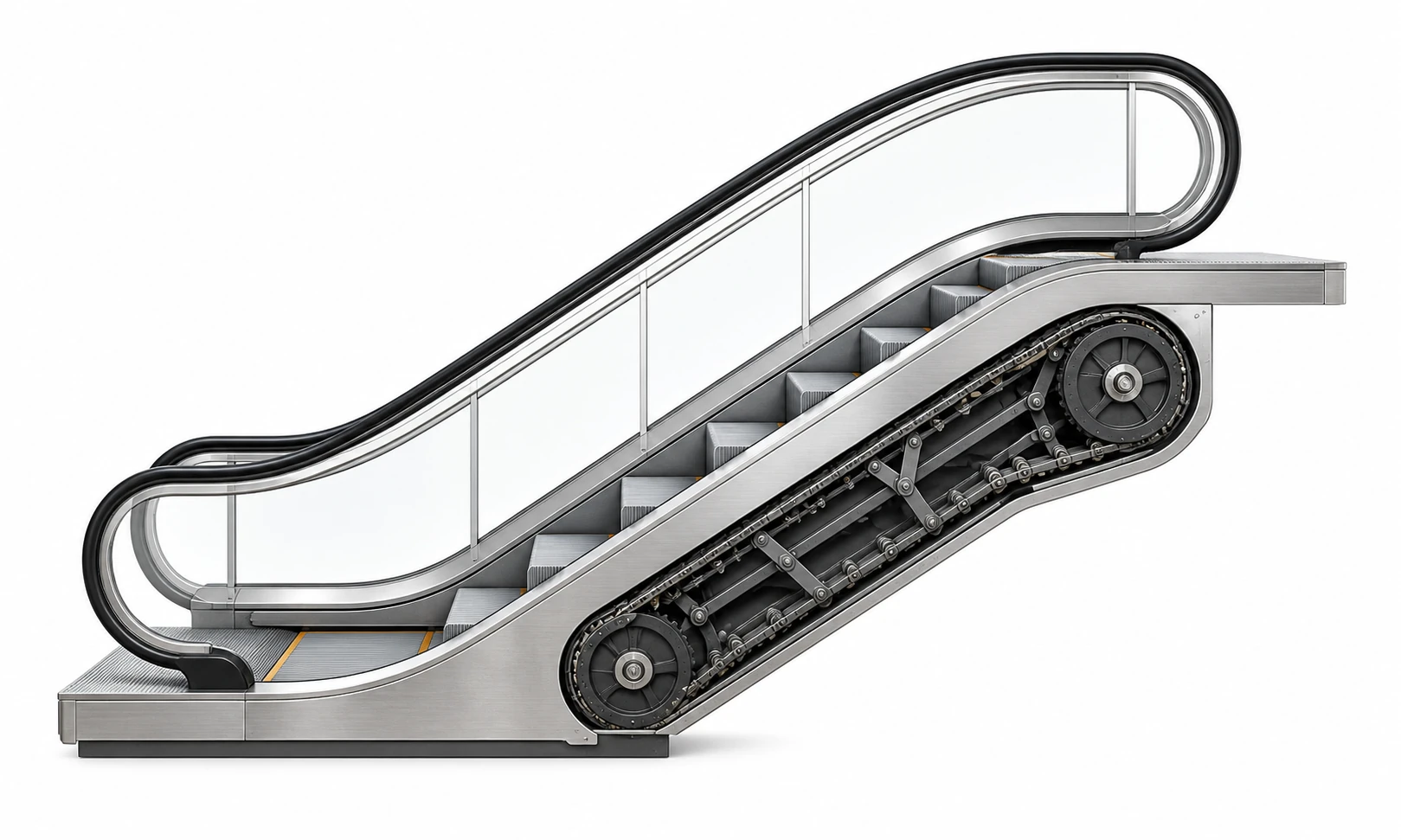
While the escalator's steps are driven by a main drive chain, the handrail runs on a separate friction drive loop connected to the main system by pulleys and belts.

This secondary linkage introduces multiple points at which speed can vary slightly from the step speed.

An escalator's handrail is not attached to its steps; it is persuaded to move at roughly the same speed by an imperfect mechanical argument.

Belt stretch and wear compound over time

The rubber drive belts that power the handrail stretch with age and use, reducing their effective grip and altering the speed ratio between steps and handrail in unpredictable ways.

Every escalator develops its own characteristic handrail speed relative to its steps over time.

An old escalator's handrail has developed its own personality, one slightly ahead or slightly behind the steps it can never quite catch.

Safety standards accept the mismatch

Escalator safety codes acknowledge the inherent difficulty of perfect synchronization and specify an acceptable tolerance range rather than demanding zero difference.

A handrail moving slightly faster than the steps is deliberately preferred since it leans passengers slightly forward, which is considered a safer failure mode than leaning backward.

The handrail speed mismatch you feel every day is not a malfunction; it is a tolerated engineering compromise with a safety rationale.

Why synchronization is difficult to maintain

Several mechanical realities prevent perfect handrail and step speed matching.

1

01. Steps and handrail are driven by separate mechanisms

A friction drive connects the handrail to the main step drive but introduces independent variables.

2

02. Belt stretch alters the effective drive ratio

As rubber belts age, their tension changes, shifting the handrail speed relative to steps.

3

03. Temperature affects belt properties

Rubber stiffness and grip change with temperature, shifting the speed ratio further.

4

04. Wear patterns differ between the two systems

Steps and handrail contact surfaces wear differently, further diverging their speeds over time.

The engineering philosophy behind tolerating the mismatch

The accepted handrail speed tolerance reflects a broader principle in mechanical engineering: when perfect synchronization is prohibitively expensive to maintain, acceptable tolerance ranges are defined, and safety implications of each failure mode are weighed.

The fact that a slightly fast handrail is safer than a slightly slow one led designers to accept a small forward drift as the preferred operational state.

Surprising escalator engineering facts

Escalator handrails return inside the escalator structure
The handrail forms a continuous loop that runs through the interior of the escalator housing, entirely out of sight.
Standing on one side is not about speed
The convention of standing on one side and walking on the other is about social norms, not engineering - escalators move at the same speed regardless of which side passengers stand on.

Is it a malfunction when the handrail speed is noticeably different?

Myth

Many riders assume a noticeably different handrail speed indicates a broken or poorly maintained escalator.

The mismatch feels wrong because we expect synchronized machines to be synchronized.

Reality

A minor speed discrepancy is within specification for nearly every operating escalator; only significant divergence suggests a maintenance issue.

A minor speed discrepancy is within specification for nearly every operating escalator; only significant divergence suggests a maintenance issue.

Where mechanical synchronization tolerance matters

Moving walkways
Airport moving walkways face the same handrail speed challenge and typically handle it the same way.
Conveyor belt systems
Multi-belt conveyor systems in manufacturing routinely specify acceptable speed tolerance ranges between connected belts.

Why this small mechanical compromise matters

Understanding that the handrail mismatch is intentional rather than accidental changes it from an annoyance to a small window into engineering design philosophy.

It illustrates how real-world engineering regularly substitutes acceptable tolerance for theoretical perfection.

Worth noting

The small imperfection built into every escalator

Every escalator you have ever ridden has had this discrepancy. The engineering community decided long ago that it was acceptable. Your hand is simply the one that notices. A perfectly synchronized escalator handrail is not impossible; it is simply not worth the cost of maintenance to achieve.

Quick answers

Common questions

Can escalator handrail speed be calibrated perfectly?

Temporarily yes, but belt stretch and wear continuously shift the ratio back, requiring ongoing maintenance to keep it within acceptable tolerance.

Everyday Engineering

Related questions

Regular maintenance, newer belts, and better mechanical condition all reduce step vibration and handrail speed discrepancy.

The first escalator engineer

Jesse Reno

The American engineer who patented the first moving stairway in 1892, installed as an amusement ride at Coney Island.

Where mechanical synchronization tolerance matters

Moving walkways

Airport moving walkways face the same handrail speed challenge and typically handle it the same way.

Where mechanical synchronization tolerance matters

Conveyor belt systems

Multi-belt conveyor systems in manufacturing routinely specify acceptable speed tolerance ranges between connected belts.

Is it a malfunction when the handrail speed is noticeably different?

A minor speed discrepancy is within specification for nearly every operating escalator; only significant divergence suggests a maintenance issue.

A minor speed discrepancy is within specification for nearly every operating escalator; only significant divergence suggests a maintenance issue.