Visual answer
What is actually in space
Different regions of space have different types and densities of content.
Interstellar medium
Gas and dust filling the space between stars in a galaxy. Mostly hydrogen and helium.
Cosmic microwave background
Faint radiation left over from the early universe. It fills all of space uniformly.
Dark matter
Invisible mass that does not emit or absorb light but makes up about 27 percent of the universe's energy content.
Quantum vacuum fluctuations
Even empty space at the quantum level is not static. Virtual particle pairs constantly appear and disappear.
Interstellar medium
The space between stars is full of gas and dust
The interstellar medium fills the galaxy with a diffuse mixture of hydrogen gas, helium, trace heavier elements, and microscopic dust particles.
It is very thinly spread, about 1 atom per cubic centimeter on average, compared to air at sea level which contains about 10 to the 19th atoms per cubic centimeter.
But it is not nothing. The interstellar medium is where new stars form when gravity pulls regions of it together.
Void myth
Are the voids between galaxy clusters truly empty?
What people think
The giant voids between galaxy filaments are completely empty space.
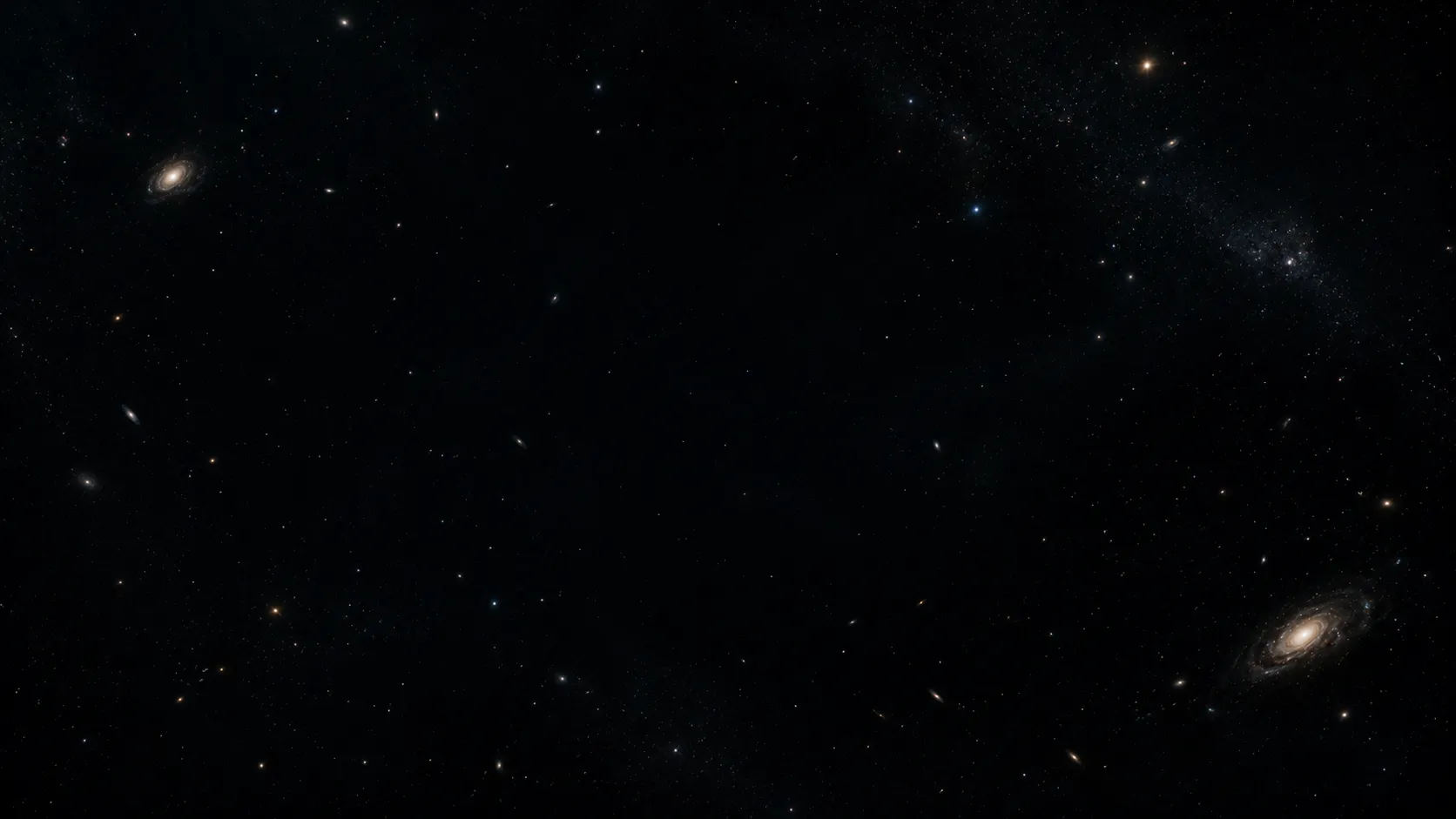
Looking at maps of the universe, the dark regions between galaxy clusters appear to contain nothing.
What actually happens
Voids contain diffuse gas, dark matter, and radiation.
Cosmic voids are underdense, not empty. They contain dark matter, isolated galaxies, intergalactic gas, and the same background radiation that fills all of space.
Space regions compared
What different regions of space contain
Near a star
Solar wind, photons, charged particles, magnetic fields.
Between stars (interstellar space)
Diffuse hydrogen, helium, dust, cosmic rays, magnetic fields.
Between galaxies (intergalactic space)
Extremely diffuse plasma, cosmic background radiation, dark matter.
Cosmic voids
Near-empty but still containing dark matter, isolated galaxies, and background radiation.
Quantum vacuum
Even a perfect vacuum is not truly empty
Quantum mechanics predicts that the vacuum is not a passive empty stage. It is filled with zero-point energy and constantly produces pairs of virtual particles that almost immediately annihilate.
This vacuum energy is real. The Casimir effect, where two metal plates placed very close together are pushed together by quantum vacuum pressure, has been measured in the lab.
A perfect vacuum, containing absolutely nothing, appears to be physically impossible.
Quick answers
Common questions
Is space completely empty? +
No. Space contains gas, dust, dark matter, radiation, and at the quantum level, constant fluctuations. There is no known region that contains absolutely nothing.
What is in between stars? +
The interstellar medium: a diffuse mixture of mostly hydrogen and helium gas, dust particles, cosmic rays, and magnetic fields.
Can a perfect vacuum exist? +
Not according to quantum mechanics. Even in a perfect lab vacuum, quantum fluctuations produce and destroy virtual particles constantly.
What is dark matter? +
An invisible form of mass that does not emit, reflect, or absorb light but has measurable gravitational effects. It makes up about 27 percent of the universe's total energy content and is distributed throughout space.
What is the cosmic microwave background? +
Faint electromagnetic radiation left over from about 380,000 years after the Big Bang, when the universe cooled enough for light to travel freely. It fills all of space at a temperature of about 2.7 Kelvin.