Visual answer
Spacetime Curvature Around Earth
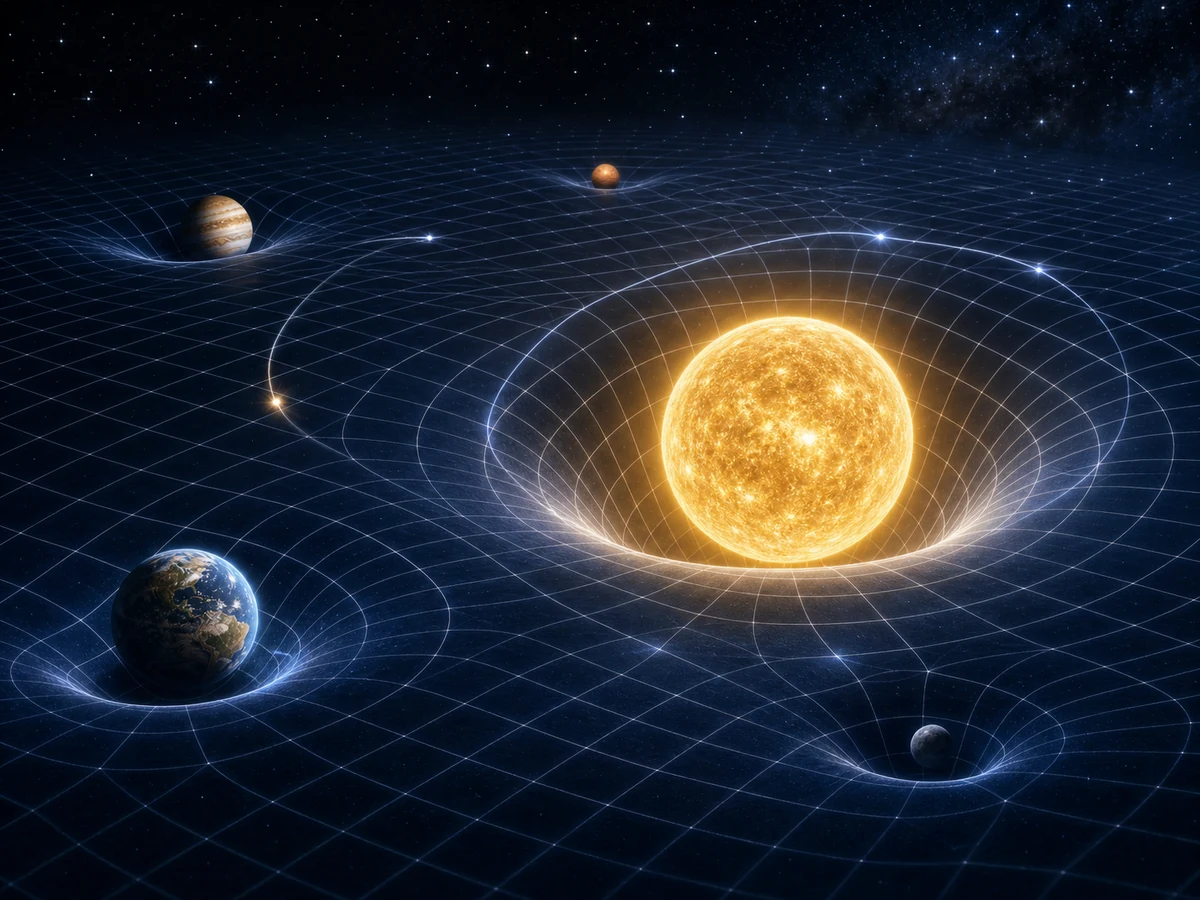
Mass bends spacetime; objects follow curved paths called geodesics.
Mass creates curvature
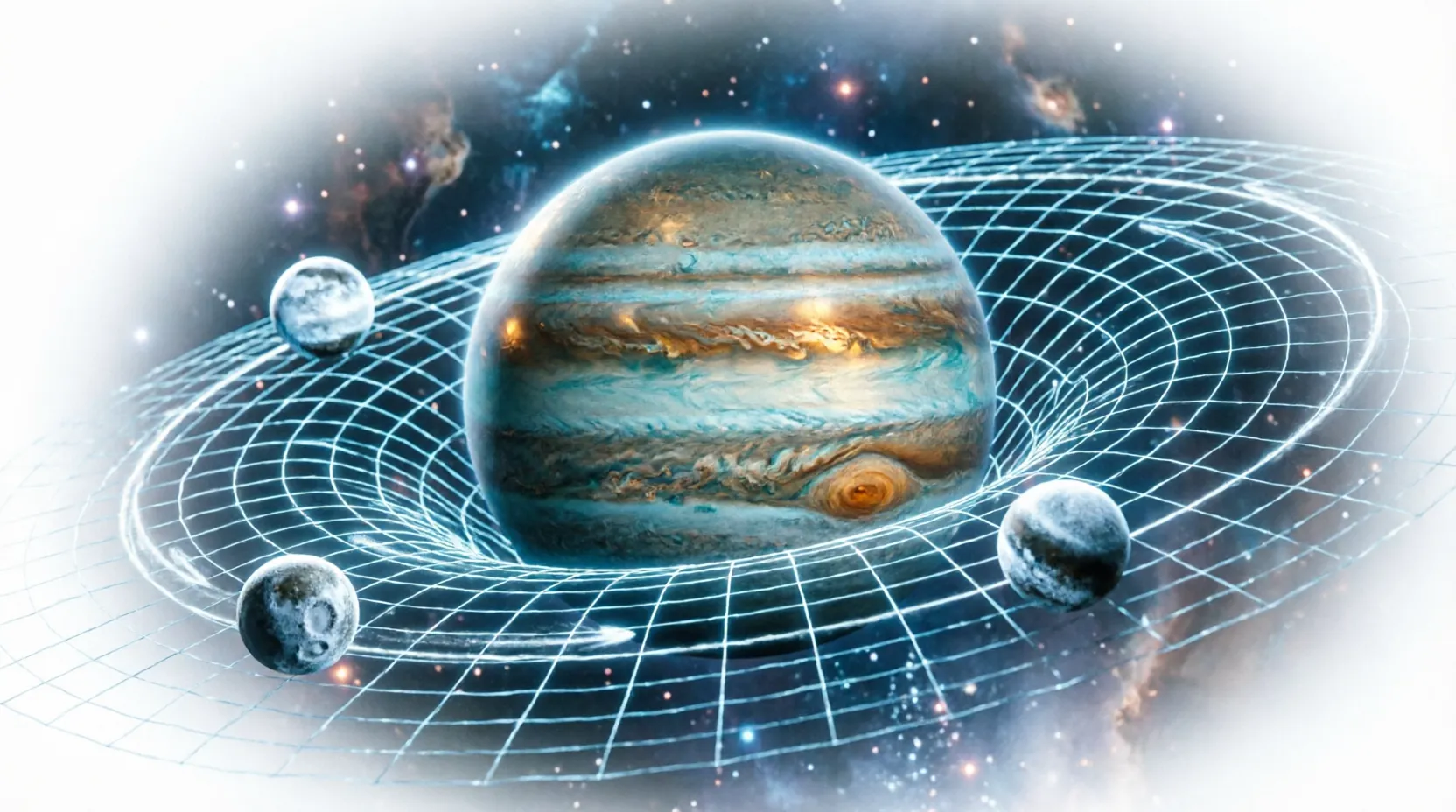
Earth's mass warps the surrounding spacetime like a heavy ball on a rubber sheet.
Geodesic path
The Moon follows the straightest possible path through curved spacetime - an orbit.
Gravitational time dilation
Clocks closer to Earth tick slower than clocks farther away.
Gravitational waves
Accelerating masses create ripples that travel at the speed of light.
Force or geometry?
The Mystery: Is Gravity a Force or a Geometry?
Newton's equations work brilliantly for everyday purposes, but they treat gravity as a mysterious force that acts instantly over infinite distances - without explaining how or why. Einstein resolved the 'how' by showing that mass bends spacetime and objects simply follow the resulting curves. The 'why' remains open: unlike the three other fundamental forces, gravity has no known quantum carrier particle, making it incompatible with quantum mechanics - one of the deepest unsolved problems in physics.
Warped spacetime
The Mechanism: Warped Spacetime
General relativity describes gravity as geometry. The more mass an object has, the more it distorts the spacetime around it. Other objects move along the straightest possible lines (geodesics) through that distorted geometry.
Key components: Mass-energy (source of spacetime curvature), Spacetime geodesics (paths objects follow), Gravitational time dilation (slowing of time near mass), and Gravitational waves (ripples in spacetime from accelerating masses).
Shaping the universe
How Gravity Shapes the Universe
1. Mass curves spacetime - Any mass warps the spacetime fabric around it. The more massive the object, the greater the curvature.
2. Objects follow curved paths - Planets, light, and even time follow the geometry of curved spacetime rather than straight lines.
3. Orbits form - A planet moving sideways relative to a star continuously falls toward it but also moves laterally fast enough that it keeps missing - producing a stable orbit.
4. Large structures assemble - Over billions of years, gravity pulls gas and dust into stars, stars into galaxies, and galaxies into the cosmic web of clusters and superclusters.
5. Black holes and extreme curvature - If enough mass concentrates in a small enough volume, spacetime curvature becomes extreme enough that not even light can escape - a black hole.
Why gravity matters
Why Does Gravity Matter for Life?
Without gravity, matter would never have clumped into stars, and stars are the furnaces that forged every element heavier than hydrogen and helium. Without gravity, Earth would have no atmosphere, no oceans, and no protective magnetic field. Gravity is the architect of the conditions that made life possible.
Benefits include: star and planet formation (gravity collapses gas clouds into stars and planets), atmospheric retention (a planet's gravity must be strong enough to hold atmosphere), and tidal forces with plate tectonics (the Moon's gravity drives tides and may have cycled nutrients for early life).
Newton vs Einstein
Newton vs Einstein: Two Views of Gravity
What is gravity?
Newton: A force acting at a distance / Einstein: Curvature of spacetime
Speed of gravity
Newton: Instantaneous / Einstein: Speed of light
Predicts light bending?
Newton: No / Einstein: Yes - confirmed by Eddington in 1919
Time affected?
Newton: No / Einstein: Yes - gravitational time dilation
Works for GPS?
Newton: No (would drift km/day) / Einstein: Yes (corrected daily)
Real-world examples
Gravity in the Real World
GPS satellite corrections: Satellites in orbit experience weaker gravity than ground-based clocks, so their clocks run slightly faster. GPS systems correct for this relativistic effect - without which navigation would accumulate roughly 10 km of error per day.
Gravitational lensing: Massive galaxy clusters bend the light from objects behind them, acting as natural cosmic telescopes that let astronomers study galaxies billions of light-years away.
Black holes: Supermassive black holes at the centers of galaxies regulate star formation rates by releasing enormous energy during matter in-fall - shaping the evolution of entire galaxies.
Ocean tides: The Moon's gravity differentially pulls Earth's near and far sides, creating tidal bulges. This gravitational interaction also gradually slows Earth's rotation.
Myths vs reality
Myth vs Reality: Gravity
What people think
There is no gravity in space
Astronauts float because they have escaped Earth's gravity.
What actually happens
Gravity extends throughout the universe
Astronauts on the ISS feel weightless because they and the station are in continuous free-fall around Earth. Earth's gravity there is about 90 percent of surface gravity.
Surprising facts
Surprising Facts About Gravity
Gravity slows time - measurably at Earth's surface. Atomic clocks at sea level tick detectably slower than identical clocks at high altitude, perfectly matching Einstein's predictions.
Gravitational waves were detected from merging black holes 1.3 billion light-years away. The 2015 LIGO detection measured a stretch and squeeze of spacetime smaller than one-thousandth the diameter of a proton.
No one has yet unified gravity with quantum mechanics. General relativity works at cosmic scales; quantum mechanics governs the subatomic world. Reconciling the two - the quest for quantum gravity - remains one of physics' biggest unsolved problems.
Quick answers
Common questions
What causes gravity? +
According to general relativity, gravity is caused by the curvature of spacetime produced by mass and energy. Massive objects warp the fabric of spacetime, and other objects follow the resulting curved paths.
Is gravity a force? +
In Newtonian physics, yes. In Einstein's general relativity, no - gravity is the geometry of curved spacetime. Both descriptions make accurate predictions, but general relativity is more fundamental and works where Newton's law fails.
How does gravity affect time? +
Stronger gravity causes time to pass more slowly - a phenomenon called gravitational time dilation. Clocks near massive objects run slower than clocks farther away, as verified by atomic clock experiments and GPS satellite corrections.
What are gravitational waves? +
Gravitational waves are ripples in spacetime caused by accelerating masses - most powerfully by merging neutron stars or black holes. They travel at the speed of light and were first directly detected in 2015 by LIGO.
Why doesn't the Moon fall into the Earth? +
The Moon is falling toward Earth - but it also has enough sideways velocity that it keeps missing. The combination of inward gravitational pull and lateral velocity produces the stable orbital path we observe.