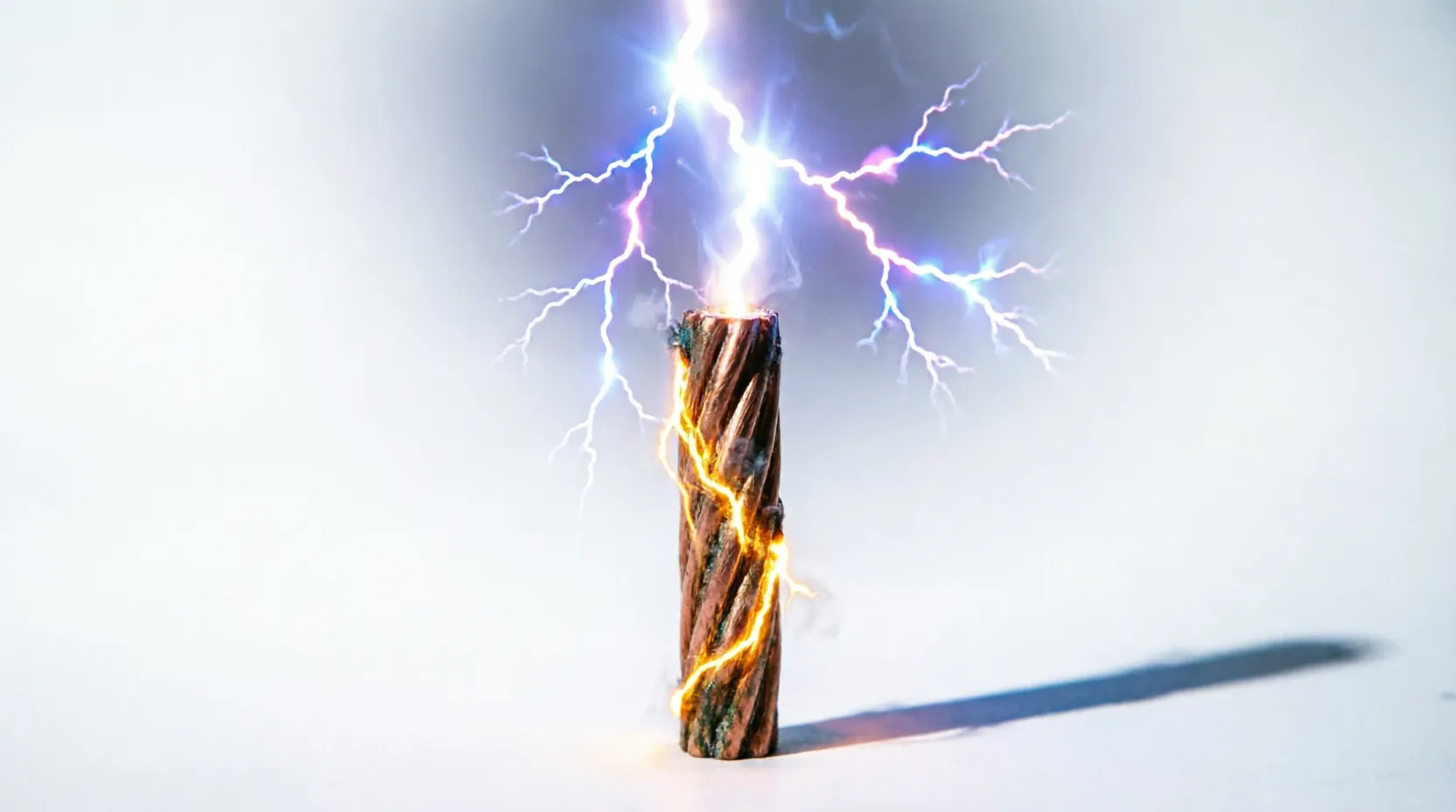
Visual answer
Ohm's Law and a Simple Circuit
Voltage pushes current through resistance. Current = Voltage / Resistance.
Voltage source (battery)
Creates potential difference that pushes electrons.
Conductor (wire)
Provides path for electron flow.
Resistor (load)
Opposes current, converts electrical energy to heat or light.
Current (I)
Flow rate of charge, measured in amperes.
Fast signal, slow electrons
The Mystery: How Does Electricity Travel at Nearly the Speed of Light If Electrons Move Slowly?
Individual electrons drift through a copper wire surprisingly slowly - on the order of millimeters per second. Yet a lamp lights up almost instantly when you flip a switch. The resolution: the electric field that drives electrons propagates at nearly the speed of light. Think of a pipe already full of water - when you push at one end, the pressure wave reaches the other end almost instantly, even though individual water molecules barely move.
Atoms to circuits
The Mechanism: From Atoms to Circuits
Electricity emerges from atomic structure. Conductive materials have loosely bound electrons that migrate under the influence of an electric field produced by a voltage source.
Key components: Electrons (charge carriers), Voltage (driving force - electric potential difference), Current (rate of charge flow), Resistance (opposition to current flow), and Electric Circuit (closed path for current flow).
Powering a bulb
How Electricity Powers a Light Bulb
1. Voltage source creates potential difference - A battery or generator creates an excess of electrons at the negative terminal and a deficit at the positive terminal, establishing a voltage.
2. Electrons enter the wire - The electric field across the conductor causes free electrons to drift toward the positive terminal, creating a current.
3. Current encounters resistance - In a light-bulb filament (high resistance), collisions between drifting electrons and tungsten atoms release energy as heat and light.
4. Electrons return to the source - After passing through the load, electrons re-enter the power source where chemical or mechanical energy re-energizes them, maintaining the current.
5. Ohm's Law governs the balance - The current that flows is exactly voltage divided by resistance. Increase the resistance and the current - and thus brightness - drops.
Electricity in nature
Electricity in Nature and Human Technology
Electrical signaling predates humanity by hundreds of millions of years - neurons in every animal nervous system communicate via electrical impulses. Humans harnessed electromagnetic induction in the 19th century to generate electricity at scale, transforming civilization.
Benefits include: Nerve signaling (all animal thought and movement depends on electrical impulses), Energy transmission (electricity can be transmitted hundreds of kilometers with low loss), and Information technology (binary data encoded as high/low voltage enables computing).
AC vs DC
AC vs DC: Key Differences
Direct Current (DC)
Electrons flow in one direction; used in batteries, electronics, solar panels; constant voltage.
Alternating Current (AC)
Electrons reverse direction periodically (50-60 Hz); used in power grids; voltage easily transformed.
Advantages of AC
Easier to step up/down voltage with transformers; more efficient for long-distance transmission.
Advantages of DC
No frequency synchronization; used in low-voltage electronics; efficient for very long HVDC lines.
Examples
Electricity in Action
Power Grid: Generators at power stations spin magnets inside copper coils, inducing alternating current (AC). Transformers step up voltage for long-distance transmission, then step it back down for homes.
Lithium-Ion Battery: Chemical reactions shuttle lithium ions between electrodes, creating a voltage that drives electrons through an external circuit to power devices - and reversing the reaction to recharge.
Solar Panel: Photons knock electrons loose from semiconductor material (the photoelectric effect), generating a direct current (DC) that an inverter can convert to AC for household use.
Lightning: Charge separation in storm clouds builds enormous voltages. When the electric field overcomes air resistance, a massive discharge leaps to the ground.
Myths vs reality
Myth vs Reality: Electricity
What people think
Electricity flows from positive to negative
Current flows from the positive terminal to the negative terminal.
What actually happens
Conventional current is a convention; electrons flow negative to positive
Benjamin Franklin chose positive to negative arbitrarily. In most circuits, electrons - the actual charge carriers - flow from negative to positive terminal.
Surprising facts
Surprising Facts About Electricity
Electrons in a wire drift at only about 1 millimeter per second, but the electric field that drives them travels at nearly light speed, so appliances respond instantly.
Lightning carries about one billion volts, but it lasts only microseconds, so the actual energy in an average lightning bolt could power a 100-watt bulb for roughly three months.
Superconductors carry current with zero resistance. Certain materials, when cooled near absolute zero, conduct electricity without any energy loss - a phenomenon with huge potential for future power grids and computing.
Quick answers
Common questions
What is electricity made of? +
Electricity is the flow of charged particles - usually electrons in solid conductors, or ions in liquids and gases. Electrons are negatively charged subatomic particles that orbit atomic nuclei.
What is the difference between AC and DC? +
In direct current (DC), electrons flow in one direction consistently - as in a battery. In alternating current (AC), the direction of electron flow reverses periodically (60 times per second in the US). AC is easier to transform to different voltages, making it ideal for power grids.
What is Ohm's Law? +
Ohm's Law states that current (I) equals voltage (V) divided by resistance (R): I = V/R. It describes how these three fundamental electrical quantities relate in a circuit.
Why do some materials conduct electricity and others don't? +
Conductors (metals) have loosely bound outer electrons that can drift freely. Insulators (rubber, glass) have tightly bound electrons that cannot move freely. Semiconductors (silicon) fall between - their conductivity can be controlled.
How is electricity generated? +
Most electricity is generated by rotating a magnet inside coils of copper wire (electromagnetic induction). The rotating force comes from steam turbines (nuclear, coal, gas, geothermal), water turbines (hydroelectric), or wind turbines. Solar panels generate directly via the photoelectric effect.