Visual answer
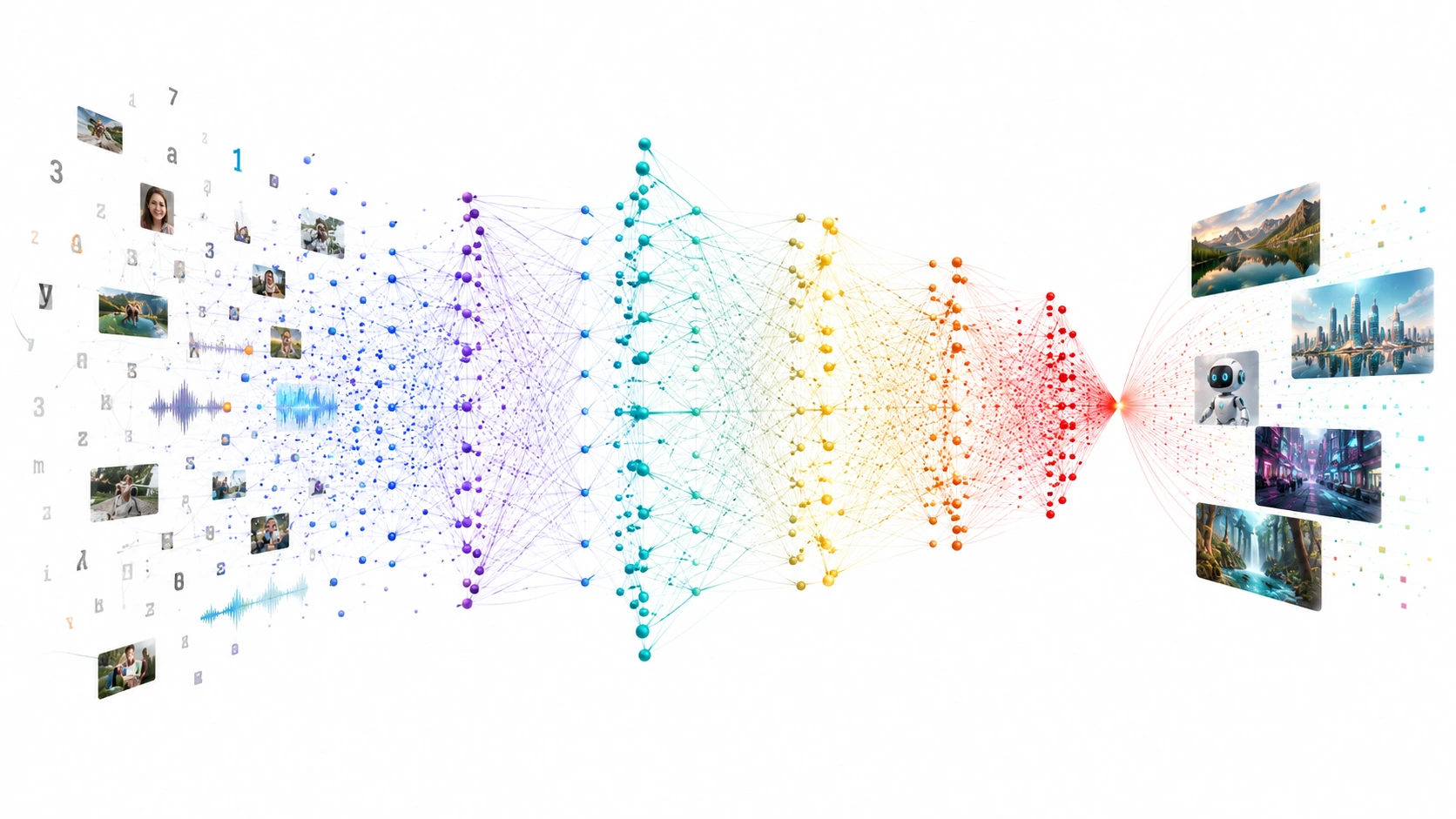
How a Neural Network Learns
The step-by-step process that turns raw data into an AI system capable of useful predictions.
Training Data
The model is fed enormous quantities of examples. For a language model this might be hundreds of billions of words from books, websites, and other text. For an image model it might be hundreds of millions of labelled photographs.
Input Layer
Data enters the network in a form the system can process. Text is converted to numbers. Images are converted to pixel values. Everything the AI works with is ultimately mathematics.
Hidden Layers
The network's internal layers transform the input through billions of mathematical operations. Early layers detect simple patterns. Deeper layers detect increasingly complex and abstract patterns. No engineer designs these patterns. They emerge from training.
Output and Prediction
The network produces an output, a word, a classification, a move in a game, an image. On its first attempts this output will be largely wrong.
Error Measurement
The system compares its output to the correct answer and calculates how wrong it was. This error signal is the core of all learning.
Weight Adjustment
The error signal is used to adjust the billions of numerical weights inside the network, making the correct output slightly more likely next time. Repeat this process billions of times across an enormous dataset and the network becomes extraordinarily capable.
What AI actually is
What AI Actually Is (And What It Is Not)
Artificial intelligence is not a thinking machine. It is not conscious. It does not have goals, desires, or understanding. What it is, at its core, is a system that has been adjusted through billions of examples until it has become extremely good at finding patterns and making predictions.
When a language model like ChatGPT writes an answer to your question, it is not reasoning through the problem the way you would. It is predicting, at each step, what word is most statistically likely to come next, given everything it learned from the text it was trained on.
The results can look remarkably intelligent because the patterns in human language encode enormous amounts of human reasoning, knowledge, and logic. The model learned those patterns. But it does not know it learned them, and it does not understand what they mean.
Neural networks
What Is a Neural Network?
A neural network is loosely inspired by the structure of the brain. It consists of layers of mathematical nodes, each connected to nodes in the next layer. Each connection has a numerical weight that determines how strongly signals pass through it.
When data enters the network, it flows through these layers, being transformed at each step. The final layer produces an output. During training, the network's weights are adjusted billions of times using a process called backpropagation, which calculates how much each weight contributed to an error and nudges it in the right direction.
No human programs the rules the network learns. They emerge from the data. This is why neural networks can perform tasks that nobody knew how to explicitly program, including recognising faces in photographs and translating between languages they have never directly been taught to pair.
ML vs AI
What Is the Difference Between AI and Machine Learning?
Artificial intelligence is the broad goal: creating systems that perform tasks that would require intelligence if a human did them. Machine learning is the most successful current approach to that goal: systems that improve their performance through exposure to data rather than through explicit programming.
Deep learning is a subset of machine learning that uses neural networks with many layers. It is the technology behind almost every impressive AI system of the past decade, from image recognition and voice assistants to large language models and protein structure prediction.
Natural language processing, or NLP, is the branch that focuses specifically on understanding and generating human language. It is what powers translation services, chatbots, and the language models that can hold conversations, write essays, and answer questions.
How ChatGPT works
How Does a Large Language Model Actually Work?
A large language model is trained on an enormous corpus of text, potentially hundreds of billions of words. During training, it repeatedly tries to predict what word comes next in a sentence, adjusting its internal weights each time it gets it wrong. Do this often enough across enough text and the model builds a deeply sophisticated statistical model of language.
After this initial training, most models go through a refinement stage called reinforcement learning from human feedback, where human raters evaluate the model's responses and the model is adjusted to produce outputs those raters prefer. This is what makes the responses feel helpful rather than merely statistically plausible.
The result is a system that can generate fluent, contextually appropriate text on almost any topic, not because it has understood those topics, but because the patterns of how humans write about those topics are encoded in its billions of weights.
AI in everyday life
How AI Works in Everyday Life Right Now
AI is already deeply woven into daily life in ways most people do not notice. The feed you see on social media is ranked by a recommendation model trained to maximise engagement. The face recognition that unlocks your phone uses a neural network trained on millions of faces. The spam that does not reach your inbox was filtered by a classifier that learned from billions of emails.
Voice assistants convert your speech to text using acoustic models, then parse the meaning using language models, then convert a response back to speech using synthesis models. Three separate AI systems working in sequence in the time it takes you to ask a question.
In medicine, AI systems now detect certain cancers in medical scans with accuracy that matches or exceeds specialist radiologists. In science, a model called AlphaFold predicted the three-dimensional structure of nearly every known protein, solving a problem that had occupied biologists for fifty years.
Misconception
Common Misconception
What people think
AI thinks and understands like a human
When an AI answers your question clearly, writes a convincing essay, or solves a difficult problem, the natural inference is that something like understanding must be happening inside. It looks like thinking. It sounds like thinking. Many people assume it is, in some meaningful sense, thinking.
What actually happens
Reality
Current AI systems have no understanding, no awareness, and no goals. A language model producing a brilliant answer about grief has no concept of what grief is. It has learned the statistical patterns of how humans write about grief and is producing output that fits those patterns. The appearance of understanding emerges from the richness of human language, not from anything happening inside the model. This distinction matters enormously for how we use, trust, and regulate these systems.
Quick answers
Common questions
What is the basic principle behind AI? +
AI systems learn patterns from large amounts of data and use those patterns to make predictions or decisions. The most successful current approach is training neural networks by repeatedly adjusting their internal parameters until their outputs match desired results.
How does machine learning differ from traditional programming? +
In traditional programming, a human writes explicit rules. In machine learning, the system learns the rules itself from examples. You do not tell it how to recognise a cat. You show it millions of cat photos and let it figure out the patterns on its own.
Can AI think for itself? +
No. Current AI systems, however impressive their outputs, have no awareness, no goals, and no genuine understanding. They are extremely powerful pattern-matching systems. The question of whether future AI might develop something like genuine thought or consciousness is deeply contested and unresolved.
What is a neural network? +
A neural network is a mathematical system loosely modelled on the brain's structure. It consists of layers of connected numerical nodes whose weights are adjusted during training. The patterns the network learns emerge from the data, not from human-programmed rules.
How does natural language processing work? +
Natural language processing models are trained on vast quantities of text. They learn statistical relationships between words, phrases, and concepts. Modern large language models predict, at each step, the most likely next word given everything that came before, drawing on patterns learned from hundreds of billions of words of training data.
What is the difference between narrow AI and general AI? +
Narrow AI is extremely good at one specific task, playing chess, recognising images, generating text, but cannot transfer its abilities to different domains. General AI would handle any intellectual task a human can. No general AI exists. Everything currently deployed is narrow AI, even when it appears versatile.