Visual answer
The Memory Formation Process
How an experience becomes a lasting memory, step by step through your brain.
Encoding
Your senses convert an experience into electrical signals. Attention acts as a filter. Only things that are new, emotional, or actively focused on get through.
Working Memory
Information sits in a temporary workspace. It can hold about 7 items for around 20 seconds. Without repetition or emotional weight, it evaporates.
Hippocampal Processing
The hippocampus acts like an index, linking new information to existing memories and deciding whether it is important enough for long-term storage.
Consolidation During Sleep
During deep sleep, the hippocampus replays the day and transfers memories to the cerebral cortex. This is when short-term experiences become lasting ones.
Long-Term Storage
Memories are distributed across the cortex as patterns of synaptic connections. Visual details, emotional weight, and meaning are stored in separate brain regions simultaneously.
Retrieval and Reconstruction
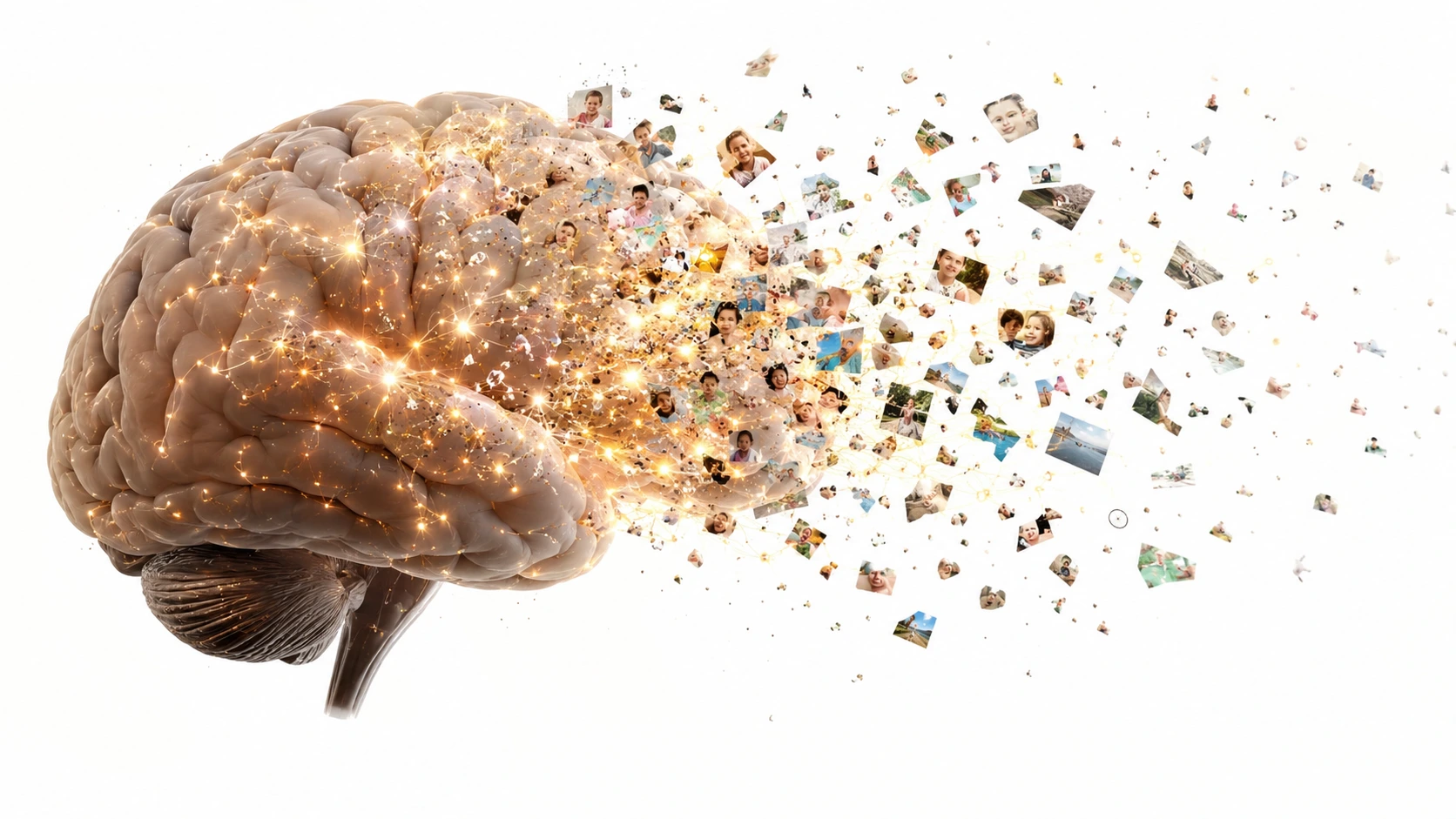
When you remember something, the hippocampus reactivates the distributed pattern. The result is a reconstruction, not a playback. New details, emotions, and experiences quietly blend in.
The mystery
Why Is Such an Important System So Unreliable?
Memory is the most important survival tool a human being possesses. It lets you remember which foods are safe, who your friends are, how language works. Yet it is notoriously, sometimes dangerously, unreliable. Eyewitnesses to crimes misidentify innocent people. People clearly remember events that never happened. Entire chapters of childhood can vanish without a trace.
A Harvard psychologist named Daniel Schacter catalogued what he calls the seven sins of memory, including misattribution, suggestibility, and absent-mindedness. For a system this critical, that seems like a design flaw.
But memory's apparent flaws are actually features. A brain that reconstructs memories rather than replaying them can update old information with new context. That flexibility, it turns out, is worth the occasional false memory.
How it works
How Memory Actually Forms Inside Your Brain
Memory is not stored in one location. It is distributed across your entire brain like a web. The hippocampus acts as a coordinator, not a storage facility. Visual details live in the visual cortex. Emotional weight is stamped on by the amygdala. The meaning of words lives in the temporal lobe.
When you remember something, the hippocampus sends signals that cause all of these regions to fire at once. The combined pattern of activity is what you experience as a memory. The physical basis of this is the synapse, the tiny gap between neurons. Every time two neurons fire together, the connection between them physically strengthens.
This is why the neuroscience maxim exists: neurons that fire together, wire together. Memory is not metaphorical storage. It is the literal reshaping of your brain.
Short vs long-term
What Is the Difference Between Short-Term and Long-Term Memory?
Short-term memory, also called working memory, holds about seven items for up to twenty seconds. It is the mental scratch pad you use when holding a phone number while you dial it. Without rehearsal or emotional significance, the information disappears completely.
Long-term memory is potentially unlimited in both capacity and duration. The transfer from short to long-term requires consolidation, which mainly happens during sleep. The two systems are neurologically separate: people with hippocampal damage can have perfect working memory while being completely unable to form any new long-term memories.
There are also different types of long-term memory. Episodic memory stores personal events. Semantic memory stores facts and language. Procedural memory stores how to do things, like riding a bike. These subtypes are so distinct that damage to one can leave the others completely intact.
Why we forget
Why Do We Forget Things?
Forgetting happens for several reasons. Memories that are never retrieved weaken as synaptic connections gradually decay. Similar memories interfere with each other. Emotional state during recall may not match the state during encoding. Or the memory was never properly encoded in the first place because attention was elsewhere.
Forgetting is not a malfunction. It is the brain curating its library, keeping the signal strong and clearing out the noise. A brain that held every detail of every experience with equal clarity would be overwhelmed and unable to function.
Crucially, every act of remembering creates a brief window where the memory becomes unstable and is then saved back slightly modified. This process, called reconsolidation, is why the memories you recall most often are often the least accurate.
False memories
Can Memories Be Completely False?
Yes, and this is one of the most unsettling findings in cognitive science. Psychologist Elizabeth Loftus spent decades demonstrating that entirely fabricated memories can be implanted with surprising ease.
In one famous experiment, she convinced a significant portion of participants that they had been lost in a shopping mall as children, a complete fiction, and many developed detailed, emotionally vivid recollections of an event that never happened. The brain has no internal authenticity tag that distinguishes real memories from constructed ones.
This has profound implications for eyewitness testimony in courts. An honest, confident eyewitness can be completely wrong in ways they cannot detect. Several countries have begun reforming legal standards around eyewitness evidence because of findings like these.
Sleep and memory
How Does Sleep Affect Memory?
Sleep is not optional for memory. During slow-wave deep sleep, the hippocampus replays the day's experiences and transfers them to the cortex for long-term storage. During REM sleep, the brain strengthens emotional memories and prunes unnecessary connections.
Studying all night before an exam is one of the worst strategies possible. The information has no time to consolidate, and fatigue impairs both encoding and retrieval. A moderate study session followed by a full night of sleep consistently outperforms marathon cramming.
The brain also uses sleep to clear away metabolic waste products that accumulate during waking hours, including proteins associated with neurological disease. Sleep is not downtime. It is when the most important maintenance work happens.
Discovery
The Man Who Could Not Make New Memories
In 1953, a 27-year-old man named Henry Molaison, known for decades only as H.M., underwent experimental brain surgery to treat severe epilepsy. Surgeons removed large portions of both his hippocampi. The seizures stopped. But so did his ability to form any new long-term memories.
For the next 55 years, until his death in 2008, H.M. lived in a permanent present. He could remember everything from before the surgery clearly. But nothing after it would stick. Every person he met was a stranger the next day. He read the same magazines fresh each time.
H.M. was the single most studied individual in the history of neuroscience. He taught us where memory lives, what the hippocampus actually does, and why short-term and long-term memory are separate systems. Without his tragedy, much of modern memory science would not exist.
Misconception
Common Misconception
What people think
Memory works like a video camera
Most people assume memory records events accurately, like a camera, and that remembering is simply pressing play. This is why eyewitness testimony has long been trusted in courtrooms, and why people are shocked when they misremember something vividly.
What actually happens
Reality
Memory is reconstructive, not reproductive. Every time you remember something, your brain rebuilds it from fragments, filling gaps with assumptions, later experiences, and current emotions. Two people at the same event can remember it completely differently and both be entirely sincere. False memories are not lies. They are the inevitable output of how the system is built.
Quick answers
Common questions
What are the three stages of memory? +
Encoding (converting an experience into a biological signal), storage (holding the information, first in the hippocampus and then across the cortex), and retrieval (reconstructing the memory from distributed fragments). Each stage can fail independently for different reasons.
Where is memory stored in the brain? +
There is no single storage location. Long-term memories are distributed across the cerebral cortex, with visual details in the visual cortex, emotional weight in the amygdala, and language in the temporal lobe. The hippocampus coordinates retrieval but does not store memories itself. This is why specific brain damage causes specific memory deficits rather than wiping everything at once.
Why do we forget things? +
Memories weaken when their synaptic connections are not reinforced through retrieval. Similar memories interfere with each other. Encoding may have been weak in the first place due to inattention. And reconsolidation slowly alters memories over time. Forgetting is a feature of the system, not a bug.
What is the difference between short-term and long-term memory? +
Short-term working memory holds about seven items for up to twenty seconds. Long-term memory has no known capacity limit and can last a lifetime. Transfer between them requires consolidation during sleep. Neurological damage can destroy one while leaving the other completely intact, confirming they are separate systems.
How does sleep affect memory? +
During deep sleep, the hippocampus replays the day's experiences and transfers them to the cortex for long-term storage. During REM sleep, the brain strengthens emotional memories. Missing sleep after learning something new prevents consolidation and can reduce retention by up to 40%.
Why does a smell trigger such vivid memories? +
Smell is the only sense that connects directly to the hippocampus and amygdala without first routing through the thalamus, the brain's sensory relay station. Every other sense is processed before it reaches memory centres. Smell arrives raw, which is why a specific scent can return you to a moment from decades ago with startling emotional clarity.