Visual answer
How Sunlight Becomes Household Electricity
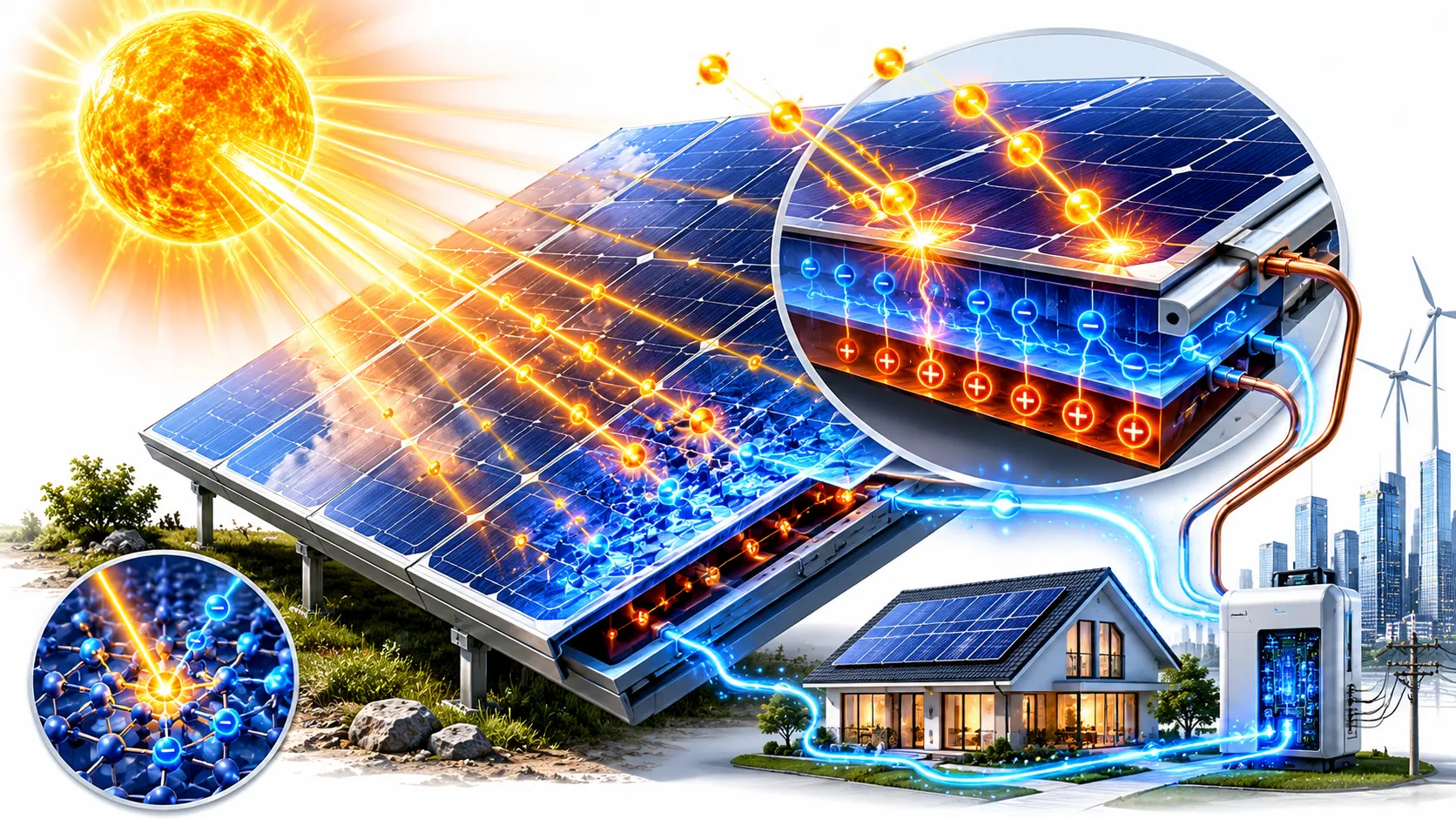
The panel does not create energy from nothing. It captures photon energy, turns electron motion into DC electricity, and sends that electricity through an inverter so the home can use it.
Sunlight arrives as photons
Packets of light energy from the Sun strike the glass surface of the solar panel.
Silicon absorbs the energy
Photons reach the photovoltaic cells and transfer energy to electrons in the silicon.
Electrons are pushed into flow
The cell's p-type and n-type silicon layers create an electric field that drives electrons in one direction.
The panel produces DC
That one-way electron movement becomes direct current electricity, like the current from a battery.
The inverter makes AC
The inverter converts panel DC into alternating current that matches home wiring and the grid.
Power runs the home
Electricity powers appliances first, then surplus energy can charge a battery or flow back to the grid.
Quick answer
The Short Version
Solar panels work because light can move electrons. When photons from the Sun hit silicon cells inside a panel, they transfer energy to electrons and knock some of them loose from their atoms.
A solar cell is built so those loose electrons do not wander randomly. Two engineered silicon layers create a built-in electric field, which pushes electrons in one direction through metal conductors. That directed electron movement is electricity.
The raw electricity from a panel is direct current. A home needs alternating current, so the system sends the panel's output to an inverter. Once converted, the electricity can power lights, appliances, batteries, or the grid.
Mechanism
How Solar Panels Work Step By Step
The whole chain runs from sunlight to silicon to electron flow to inverter to home wiring. Each step is simple, but together they turn nuclear energy from the Sun into electricity on a roof.
- 1
Sunlight reaches the panel
Photons travel from the Sun and strike the panel surface. Each photon carries a packet of energy determined by its wavelength.
- 2
Photons hit silicon cells
The photons pass through the protective glass and reach silicon semiconductor cells. Silicon is used because its electrons can be disturbed by light without needing a huge energy input.
- 3
Electrons become energized
A photon with enough energy knocks an electron loose from a silicon atom. The electron is now free to move instead of staying bound in the crystal lattice.
- 4
The electric field gives direction
The cell has n-type silicon with extra electrons and p-type silicon with electron gaps. Where they meet, an electric field forms and sweeps freed electrons in one direction.
- 5
Direct current is produced
Electrons moving steadily through conductors attached to the cell create DC electricity, the same basic kind of one-way current a battery supplies.
- 6
The inverter translates the current
The inverter rapidly switches and shapes the DC electricity into AC electricity, matching the form used by household appliances and the electrical grid.
- 7
The home uses or stores the power
The AC electricity enters the home's wiring. Appliances use it immediately, while surplus power can charge a battery or flow back to the grid.
Core concepts
The Two Ideas That Make Solar Power Work
Solar panels feel mysterious because they hide semiconductor physics inside a silent sheet of glass. These are the two ideas that unlock the whole machine.
The photovoltaic effect
The photovoltaic effect is the phenomenon where certain materials generate voltage when exposed to light. A photon transfers energy to an electron, the electron breaks free, and a carefully engineered material turns that motion into current.
Edmond Becquerel first observed the effect in 1839, but practical silicon solar cells did not arrive until Bell Laboratories built one in 1954.
Silicon is the Goldilocks material
Metals conduct too freely and insulators barely conduct at all. Silicon sits in the middle. It can be made to conduct when light gives its electrons the right push, which is exactly what a solar cell needs.
Silicon is abundant, durable, scalable, and semiconductor-friendly, which is why it still dominates commercial solar panels.
Big questions
The Questions That Make Solar Panels More Interesting
The basic mechanism is elegant, but the larger story is about limits, grids, storage, economics, and a star doing nuclear physics on our behalf.
Why don't solar panels work better?
Single-junction silicon cells face a physics ceiling called the Shockley-Queisser limit, around 33 percent theoretical efficiency. Some photons carry too little energy to free electrons, while others carry too much and waste the excess as heat.
Commercial panels usually reach about 18 to 24 percent, while advanced multi-junction lab cells can go much higher but are expensive to manufacture.
Could every roof power itself?
Many roofs could generate a major share of household electricity, especially if they are sunny, unshaded, and well oriented. The harder problem is that grids were built for centralized power plants, not millions of homes exporting electricity at noon.
A distributed solar future needs smarter grids as much as cheaper panels.
Could humanity run entirely on sunlight?
The energy mathematics say yes. The solar energy reaching Earth dwarfs human energy demand. The obstacles are storage, long-distance transmission, land use, policy, and matching daytime generation to nighttime demand.
Solar solved much of the generation problem. Storage is now the hidden bottleneck.
Why do panels still work on cloudy days?
Clouds scatter sunlight rather than stopping it completely. Diffuse light still carries photons with enough energy to trigger the photovoltaic effect, although output falls compared with direct sun.
A heavily overcast day may produce only a fraction of rated output, but not zero.
Einstein
How Einstein Helped Make Solar Panels Possible
In the late 19th century, physicists were puzzled by the photoelectric effect. When ultraviolet light hit certain metal surfaces, electrons were ejected. The strange part was that the ejection depended on the light's frequency, not simply its brightness. Dim violet light could eject electrons. Bright red light could not.
In 1905, Albert Einstein explained the mystery by proposing that light behaved as packets of energy, later called photons. A single photon had to carry enough energy to knock an electron free. More brightness meant more photons, but if each photon lacked enough energy, nothing happened.
Einstein won the 1921 Nobel Prize in Physics for this explanation, not for relativity. Decades later, silicon solar cells turned that theoretical insight into a practical energy technology. Einstein did not set out to invent solar power. He set out to explain something nobody else could explain.
Surprises
Surprising Facts About Solar Panels
Solar panels are familiar enough to disappear into the background, but the details are still genuinely strange.
Solar panels make electricity from moonlight
Moonlight is reflected sunlight, so it still contains photons. A panel can produce a tiny measurable current under a full moon, though far too little to be useful.
Cold panels perform better
Heat increases electrical resistance and reduces semiconductor efficiency. A cold, bright winter day can be excellent for panel performance.
Silicon wafers must be extremely pure
Solar-grade silicon is refined to extraordinary purity so impurities do not disrupt the delicate electron behavior that the photovoltaic effect depends on.
Solar costs collapsed
The first practical silicon cell in 1954 was wildly expensive. Modern solar capacity costs a tiny fraction of that, mostly because manufacturing scaled and improved relentlessly.
Myths
Solar Panel Myths Versus Reality
Myth: Solar panels need heat to work
Reality: They need light, not warmth. Heat actually reduces semiconductor efficiency. Bright and cool is better than equally bright and very hot.
Myth: Solar panels stop working in winter
Reality: Winter reduces output because days are shorter and the Sun is lower, but panels still operate whenever light reaches them.
Myth: Panels only work in direct sun
Reality: Diffuse light scattered by clouds still triggers the photovoltaic effect. Output drops on overcast days, but it does not vanish.
Myth: Going solar means going off-grid
Reality: Most residential systems remain grid-connected, using solar to reduce bills while relying on the grid or batteries when sunlight is unavailable.
Myth: Solar panels use more energy to make than they produce
Reality: Modern panels usually repay their manufacturing energy within one to three years, then keep generating for decades.
Hidden forces
The Hidden Forces Behind The Solar Revolution
The physics is old. The revolution happened when manufacturing, economics, and infrastructure began catching up.
Solar won by getting cheap
Solar panels became competitive less through one dramatic breakthrough than through relentless manufacturing improvements and scale. Prices fell by more than 90 percent in the 2010s.
Transformative technologies often win when they become the cheapest option, not merely the cleverest.
Storage is the real bottleneck
Humanity can now generate large amounts of solar electricity. The harder question is how to store enough of it for nights, cloudy weeks, and seasonal demand.
The future of solar depends on batteries, grid storage, demand management, and transmission as much as panels.
Solar democratizes energy
Coal, gas, oil, hydro, and nuclear require centralized infrastructure. Solar lets a homeowner, farmer, school, or clinic produce electricity locally with no moving parts and little maintenance.
Distributed energy changes not only engineering, but power in the political sense.
Quick answers
Common questions
How do solar panels work step by step? +
Photons from sunlight strike silicon cells, knock electrons loose, and create a directional flow of DC electricity. An inverter converts that DC into AC electricity, which enters the home's wiring and powers appliances. Surplus electricity can charge a battery or flow back to the grid.
How do solar panels work on a house? +
Roof-mounted panels generate DC electricity when light hits them. An inverter converts the DC to AC, a meter tracks generation and use, and the home's wiring uses the solar power just like grid electricity.
How do solar panels work at night? +
They do not generate electricity at night because the photovoltaic effect requires incoming light. A solar home uses battery storage, grid electricity, or both after sunset.
How is solar energy converted into electricity? +
Solar energy becomes electricity through the photovoltaic effect. Photons transfer energy to electrons in silicon, freeing them from their atoms. A built-in electric field pushes the electrons into a one-way flow, creating current.
What are solar panels made of? +
Most are made from crystalline silicon cells sealed between tempered glass and a protective backsheet, held in an aluminum frame, and connected by metal conductors that carry current out of the panel.
What is the biggest downside to solar electricity? +
Intermittency. Solar panels only generate electricity when enough light is available, so reliable round-the-clock solar power depends on battery storage, grid backup, or other forms of energy storage.
How many years does it take solar panels to pay for themselves? +
Common payback periods are around six to twelve years, depending on sunlight, electricity prices, incentives, system size, and installation costs. Panels commonly last 25 to 30 years.