Visual answer
Where Neanderthal DNA ended up and what happened to it
The journey of Neanderthal genetic variants into the modern human genome, and what selection has done to them since
The interbreeding event
~50,000–60,000 years ago in the Middle East Homo sapiens meets Neanderthal populations already resident in Eurasia
Fertile offspring
Hybrids were viable and fertile Neanderthal DNA entered the human gene pool permanently
Spreading with migration
As Homo sapiens spread across Eurasia, they carried their Neanderthal inheritance with them
Selection over 50,000 years
Harmful Neanderthal variants were gradually selected out; useful ones (immune, skin) persisted leaving the 1–4% signature we see today
The verdict
Verdict
Yes non-African humans are part Neanderthal, and the evidence is definitive
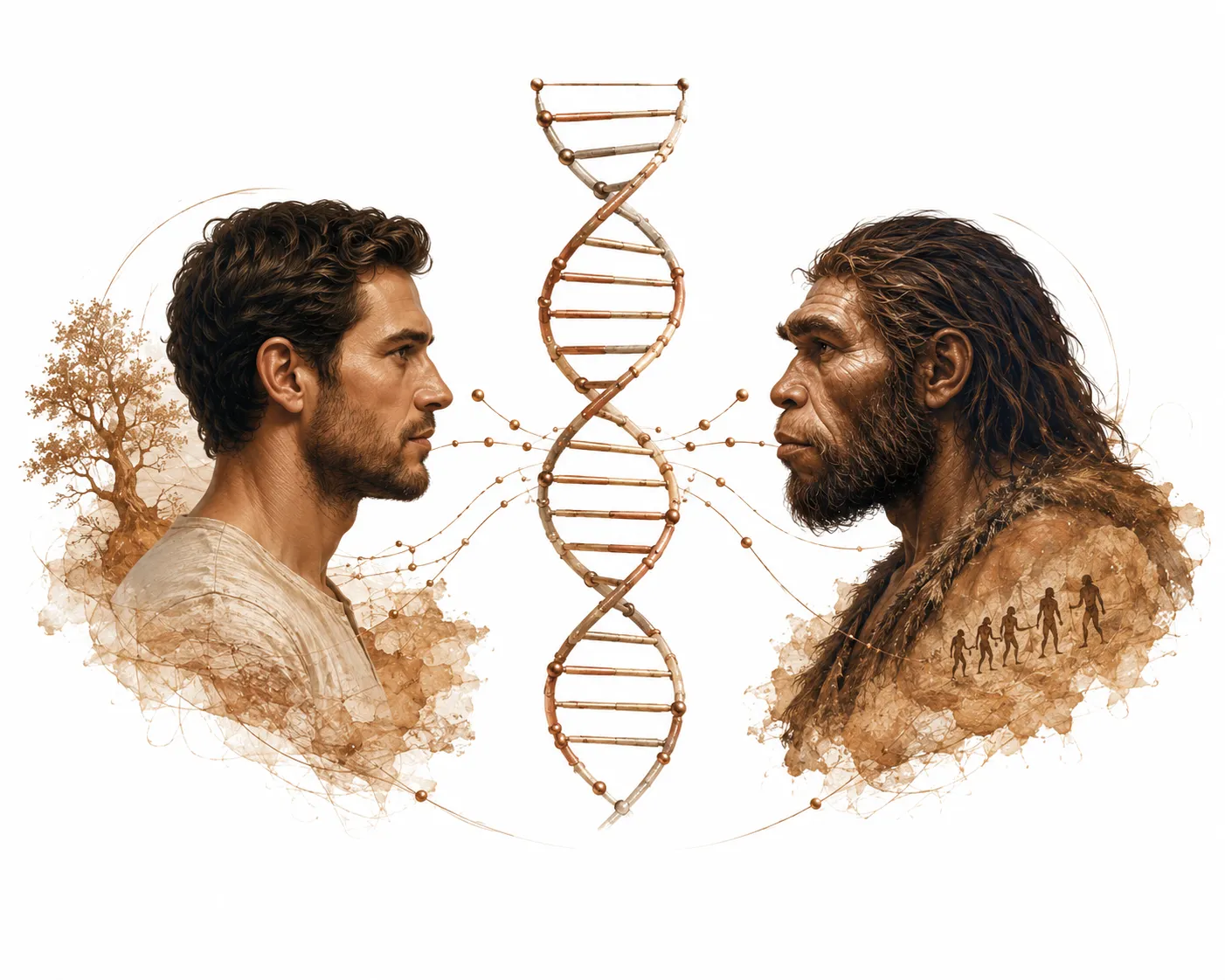
The discovery was made in 2010 by Svante Pääbo and colleagues at the Max Planck Institute, who sequenced the Neanderthal genome from bone fragments and compared it to modern human genomes. They found that non-African humans share more DNA with Neanderthals than African humans do the signature of interbreeding after the Out of Africa migration. This has since been replicated and refined extensively. We now know hybridization occurred multiple times, in multiple locations, and that the resulting offspring were fertile. Pääbo received the Nobel Prize in Physiology or Medicine in 2022 for this work.
Useful analogy
Think of the human genome as a text that has been copied, hand to hand, for 300,000 years. Most of the text is ours. But scattered through the chapters written in Europe and Asia are sentences sometimes whole paragraphs that were borrowed from a different manuscript. Some of those borrowed passages are doing something useful. Some may be causing problems. Most we don't yet fully understand.
The catch
While non-African humans are ~1–4% Neanderthal, the Neanderthal variants aren't randomly distributed they cluster in certain functional regions of the genome, particularly immune genes, and are notably absent from others, particularly regions involved in brain development and fertility. This suggests that most of the rest of the inherited Neanderthal DNA was gradually selected out over tens of thousands of years because it was slightly harmful in a modern human context.
How we found out
How scientists extracted a genome from a 40,000-year-old bone
Neanderthal DNA was recovered from bone fragments found in Croatian caves. Ancient DNA is not pristine it's broken into tiny fragments, chemically degraded, and thoroughly contaminated with bacterial DNA and the DNA of every human who has ever handled the specimen. Pääbo's team developed techniques to chemically distinguish ancient DNA from modern contamination, then laboriously assembled the fragments into a genome like a billion-piece jigsaw where most of the pieces are damaged and some belong to completely different puzzles.
The resulting Neanderthal genome was compared to modern human genomes from five people on different continents. The finding was stark: the European and Asian genomes were more similar to the Neanderthal genome than the African genomes were. The only explanation that fits is interbreeding at some point after Homo sapiens left Africa but before they spread across Eurasia, they encountered and interbred with Neanderthals.
Subsequent work has refined the picture considerably. We now know the mixing happened in the Middle East around 50,000–60,000 years ago, as well as possibly in Europe later. It happened multiple times. And it wasn't just Neanderthals populations in East Asia and the Pacific carry additional DNA from a separate archaic group called the Denisovans, known from a single finger bone found in a Siberian cave.
What Neanderthal DNA does
What inherited Neanderthal variants actually do in modern humans
Immune genes (HLA)
Some Neanderthal immune variants are more common today than chance would predict suggesting they provided protection against Eurasian pathogens that Homo sapiens hadn't encountered before.
Skin and hair
Certain Neanderthal variants influence skin pigmentation and hair texture. Neanderthals had lived in Europe for 300,000 years; inheriting some of their adaptations to lower UV environments made sense.
Blood clotting
Some inherited variants increase blood clotting tendency potentially useful in wounds, but associated with higher risk of stroke and miscarriage in modern contexts.
Depression and mood
A cluster of Neanderthal-derived variants on chromosome 12 has been associated with increased risk of depression. How and why is not well understood.
Brain and fertility
Neanderthal variants are notably absent from genes involved in brain development and sperm production suggesting these were selected out because they were harmful in a modern human background.
Were they really different species?
If Neanderthals were a separate species, how could they interbreed with us?
What people think
"Neanderthals and Homo sapiens were completely separate species they couldn't possibly have interbred"
Species are defined, in part, by reproductive isolation. If Neanderthals were a separate species, the thinking goes, they couldn't have produced fertile offspring with Homo sapiens.
What actually happens
They were separate enough to be called a different species and similar enough to produce fertile children
This is precisely what makes the Neanderthal story so philosophically interesting. Neanderthals and Homo sapiens diverged roughly 600,000 years ago far more recently than humans and chimpanzees (6 million years), and close enough that chromosomal compatibility was maintained. The fertile hybrids are the evidence that the species boundary, at that divergence distance, was real but permeable. Some biologists argue that Neanderthals shouldn't be classified as a separate species at all that they and modern humans were subspecies of Homo sapiens. The genome data, which keeps revealing more mixing, not less, tends to support the fuzzier view.
Quick answers
Common questions
Final insight
You are not quite what you thought you were
For most of human history, we assumed Homo sapiens was a clean story: one lineage, one species, marching forward from Africa in unbroken succession. The genome says otherwise. We are a palimpsest a document written over earlier documents, with traces of older text showing through. The Neanderthal in your genome isn't a curiosity or a contaminant. It is part of the story of how you came to exist. Evolution has never been tidy, and the people who walked out of Africa 60,000 years ago were already, by the time they reached Europe, something new made partly from something old.
Quick answers
Common questions
Does having Neanderthal DNA make you less or more human? +
Neither it makes you more interesting. The question assumes a clean boundary between 'human' and 'not human' that the genetics simply doesn't support. Homo sapiens and Neanderthals were different enough to diverge into separate populations over hundreds of thousands of years, and similar enough to find each other attractive and produce children who lived and reproduced. The categories are real. They are also, evidently, porous. Most things in biology are.