Visual answer
How three canids became one hybrid lineage
The sequence of hybridisation events that produced the modern eastern coywolf population
Pre-1900: separate ranges
Eastern wolves in the forested northeast; coyotes confined to central and western plains competition keeps them apart
Early 1900s: wolves eliminated
Hunting and habitat loss remove wolves from most of eastern North America; coyotes begin expanding into the vacancy
Great Lakes hybridisation
Eastward-moving coyotes meet remnant wolf populations around Ontario and Quebec; interbreeding produces the initial hybrid
20th–21st century: coywolf spreads
Fully fertile hybrid population expands across eastern North America, colonising suburbs and cities a new predator in an ecosystem reshaped by humans
The verdict
Verdict
The coywolf is a real, thriving hybrid population and possibly a new species in formation
Genetic analysis of eastern coyote populations consistently finds wolf DNA that isn't present in western coyotes and that wolf DNA correlates with larger size, stronger jaws, and more pack-oriented behaviour. The hybridisation happened when European settlers eliminated eastern wolf populations in the 19th century and coyotes, historically absent from eastern North America, expanded into the vacancy. As they moved east, they encountered remnant wolf populations around the Great Lakes and interbred. The resulting hybrids were more capable of taking deer (wolf-influenced) and more tolerant of human-altered landscapes (coyote-influenced) than either parent. They have been ecologically successful in a way that suggests the hybrid combination may genuinely outperform either source species in the modern eastern landscape.
Useful analogy
Evolution normally works on timescales of thousands to millions of years. The coywolf is a case study in what happens when human activity reshapes an ecosystem fast enough that evolution, in the form of hybridisation, responds within a century. We removed the wolves. We expanded the coyotes' territory. Evolution found a middle path, and it turns out the middle path goes through your bin on Tuesday night.
The catch
The 'coywolf' label is contested. Some biologists prefer 'eastern coyote' and argue that the wolf content is too low to justify treating this population as meaningfully distinct. Others point out that the animal's behaviour, morphology, and genome are sufficiently different from western coyotes that a new name is warranted. The disagreement is less about the facts the hybridisation is not in doubt and more about what the species concept requires before a new name is earned.
How it happened
How human activity accidentally created a new predator
Coyotes were historically animals of the open plains of central and western North America. Wolves occupied the forests of the east. The two species overlapped in behaviour and diet enough to be competitors, which kept them apart. European settlement changed this arrangement comprehensively: eastern wolves were hunted to effective extinction in most of their range by the early 20th century, and the eastern forests were simultaneously opened up by logging and farming, creating habitat that suited coyotes.
Coyotes moved east through Ontario and Quebec in the early-to-mid 20th century. As they passed through the Great Lakes region, they encountered the remnant eastern wolf population. The wolves, with their own populations declining and potential mates scarce, interbred with the incoming coyotes. The hybrids inherited a larger body, stronger jaws capable of taking deer, and from the domestic dog ancestry that crept in over generations an unusual tolerance for humans and human-modified environments.
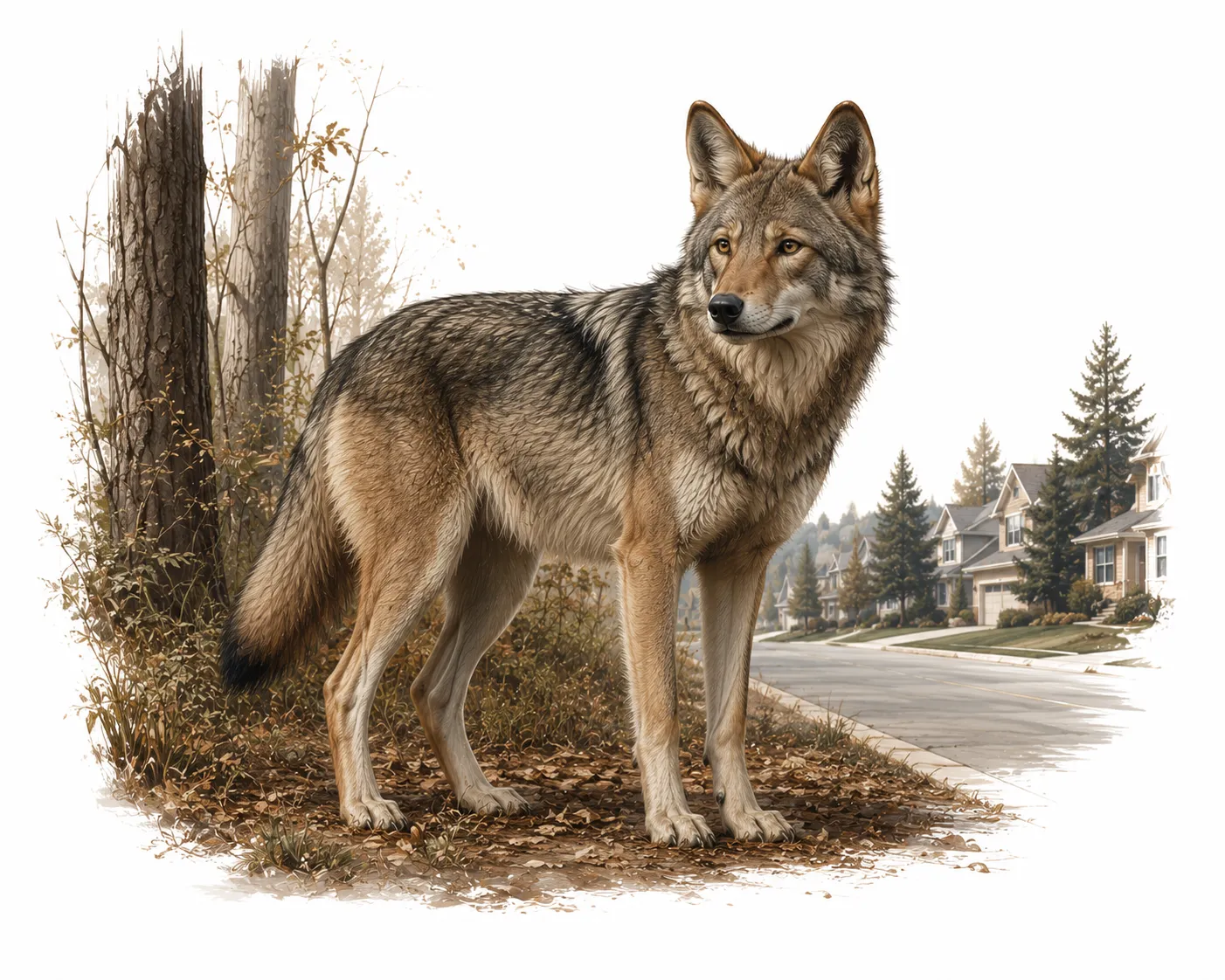
By the 1940s, a distinctly different-looking coyote was appearing in New York and New England. By the late 20th century, it had colonised every major city in eastern North America. It hunts deer in New Jersey suburbs, raises pups under Boston highway exchanges, and has been photographed in Central Park. It arrived quietly, without announcement, and appears to have absolutely no intention of leaving.
Coyote vs wolf vs coywolf
Coyote, wolf, and coywolf: what the hybridisation changed
Body weight
Western coyote: 20–30 lbs. Eastern wolf: 55–80 lbs. Coywolf: 35–45 lbs average, with individuals reaching 60 lbs.
Jaw strength
The wolf component gave coywolves significantly stronger jaws than pure coyotes enabling them to take deer, which western coyotes rarely do alone.
Social behaviour
More pack-oriented than western coyotes but less rigidly so than wolves coywolves cooperate when hunting large prey and disperse individually in suburban environments with smaller prey.
Habitat tolerance
Far more tolerant of human environments than wolves coywolves thrive in cities, suburbs, and agricultural land where wolves would not persist.
Vocalisation
The coywolf's howl is intermediate higher-pitched than a wolf, lower and more sustained than a coyote. Residents of eastern cities report hearing it regularly without always knowing what they're hearing.
Should we be worried?
Are coywolves dangerous and should we be doing something about them?
What people think
"A wolf-coyote hybrid spreading through cities is obviously a serious public safety threat"
Bigger than a coyote, with wolf instincts and no fear of humans the coywolf sounds like a wildlife management crisis waiting to happen.
What actually happens
Coywolves are remarkably cautious around people and likely beneficial to urban ecosystems
Despite their size and proximity to human populations, coywolf attacks on humans are extraordinarily rare. They are, in general, far more afraid of us than we are of them. In urban areas they primarily hunt small mammals, deer, and Canada geese controlling populations that would otherwise cause considerable agricultural and ecological damage. The main recorded threat is to outdoor cats and very small dogs, which wildlife managers consistently address with hazing programmes rather than culling. The coywolf appears to have found, in the human-dominated eastern landscape, exactly the ecological role it was accidentally engineered to fill.
Final insight
The animal that shouldn't exist is winning
We spent the 19th century systematically eliminating wolves from eastern North America. We fragmented forests, shot predators, and remade the landscape for agriculture. And then, quietly, in the space between what we destroyed and what remained, something new arrived larger than what we left, more versatile than what we removed, perfectly suited to the degraded, human-dominated environment we'd created. The coywolf is not a conservation success story, exactly. It is more like evolution's dry comment on what we did. We cleared the board. Something moved into the empty squares. It is not what was there before. It is, in its own way, something better adapted to what we have made the world into.
Quick answers
Common questions
What should you do if you see a coywolf? +
The same thing you'd do with any wild coyote: don't feed it, don't run from it, and if it approaches, make yourself large, make noise, and walk away calmly. A coywolf that has lost its fear of humans is a coywolf that wildlife managers may have to euthanise so doing nothing, however tempting when faced with a large, wolfish animal at close range, is genuinely the best outcome for everyone involved.
Can coywolves breed with domestic dogs? +
Yes, though it's uncommon in practice. Wolves, coyotes, and domestic dogs are all members of Canis lupus in the broad sense and remain interfertile. The domestic dog ancestry already present in coywolf genomes estimated at 5–10% came from historical interbreeding, not recent encounters. Ongoing hybridisation with domestic dogs does occur at low rates but appears to be actively selected against in established coywolf populations, probably because domesticated traits reduce survival fitness.
Why don't western coyotes have the same wolf hybridisation? +
Because western wolf populations primarily grey wolves are more genetically and behaviourally distinct from coyotes than eastern wolves were. Eastern wolves are now thought by many researchers to be a separate species (Canis lycaon) that is actually more closely related to coyotes than to grey wolves. This close relationship made hybridisation not just possible but, under the right social conditions, natural.
Is the coywolf a threat to wolf conservation? +
Potentially, yes it's a genuine concern for eastern wolf conservation efforts. Hybridisation with coyotes threatens to dilute the remaining eastern wolf gene pool. In areas where both occur, pure eastern wolf populations are difficult to maintain, because the interbreeding that created coywolves continues wherever wolves and coyotes meet. Conservation managers in some Canadian wolf refuges actively try to prevent coyote immigration for this reason.