Visual answer
Why meiosis fails in mules
How mismatched chromosome numbers prevent reproductive cell formation
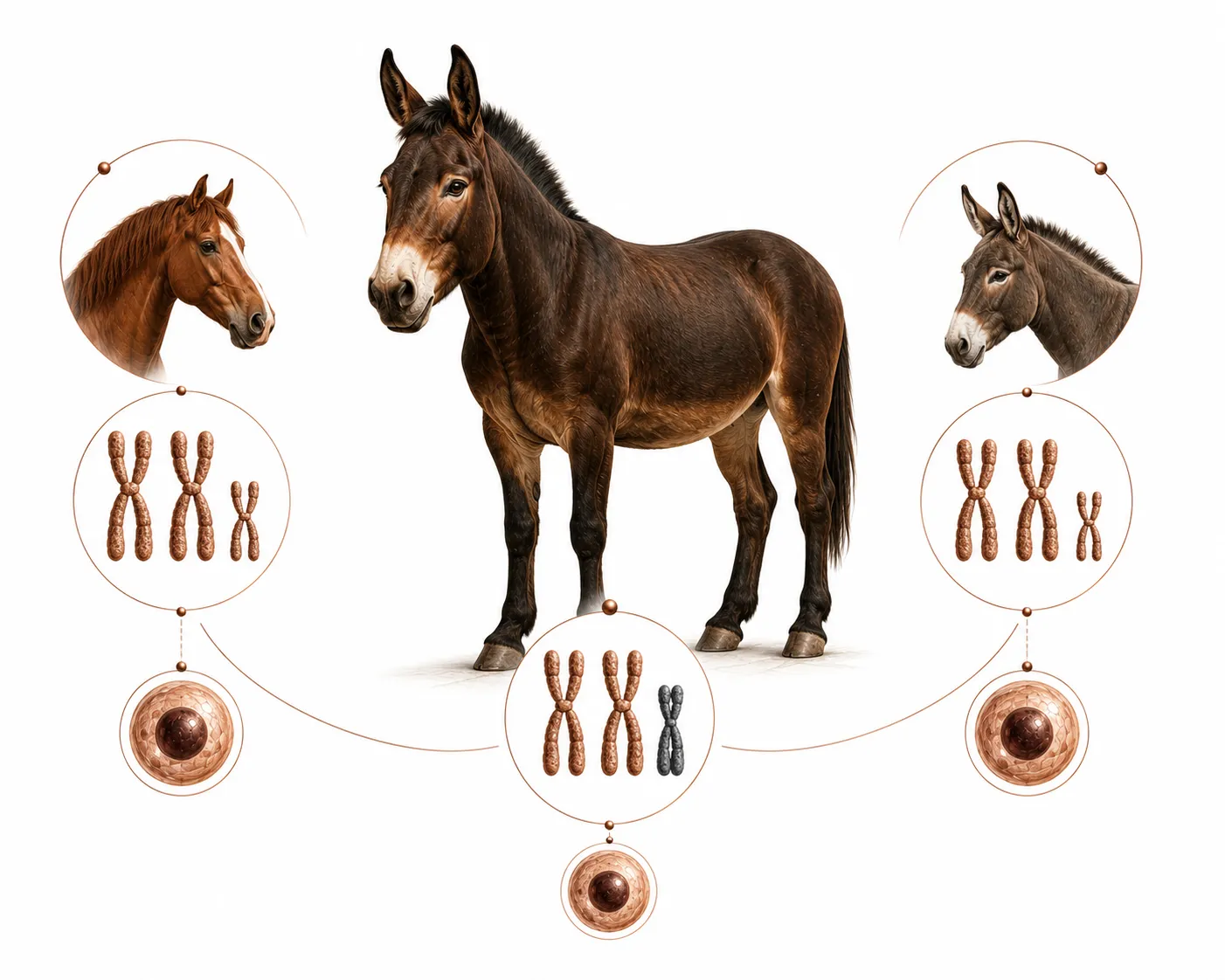
Horse meiosis
64 chromosomes form 32 perfect pairs, meiosis proceeds normally
Donkey meiosis
62 chromosomes form 31 perfect pairs, also proceeds normally
Mule meiosis
63 chromosomes attempt to pair, one is always left unmatched, stalling division
Result
No functional eggs or sperm are produced, the mule cannot reproduce
The verdict
Verdict
Mule sterility is the near-inevitable result of chromosomal arithmetic, and almost no exceptions exist
When a horse and donkey produce a mule, each parent contributes half their chromosomes. The mule ends up with 63, one from each pair the horse contributes, plus one from each pair the donkey contributes, but since the parents had different totals (64 and 62), there's no way to get an even number. The cell division that produces sperm or eggs, meiosis, requires chromosomes to pair up precisely. One unpaired chromosome derails the whole process. The mule develops normally, lives a full life, works harder than its parents, and simply cannot reproduce.
Useful analogy
Imagine trying to sort a deck of 63 cards into pairs. You can do 31 pairs perfectly, but the 63rd card will always be left on the table, without a match. That leftover card is the problem. Meiosis cannot proceed with an unmatched chromosome any more than you can finish a card game with an odd deck.
The catch
There are rare documented cases of female mules producing offspring, about a dozen confirmed in the scientific literature. In each case, the mule's reproductive system apparently managed to exclude the unpaired chromosome during egg formation. Male mules have never been confirmed fertile. The exceptions are so rare that they were each treated as international news when they occurred.
The cell division problem
What meiosis is, and why odd numbers break it
Most cells in your body divide by mitosis, each chromosome is copied, the cell splits, and both daughter cells get a full identical set. This works fine with any number of chromosomes. Meiosis is different. It's the cell division that produces sperm and eggs, and it has a specific requirement: every chromosome must find an identical partner and pair up. The pairs then separate, sending one of each pair into the new cell.
In a horse, 64 chromosomes form 32 tidy pairs. In a donkey, 62 form 31. In a mule, 63 chromosomes try to form pairs, and one is always left without a match. That unpaired chromosome can't be reliably distributed during cell division. The resulting cells either get it or they don't, producing sperm or eggs with the wrong chromosome number. These gametes are non-functional, which is why mules can't reproduce.
The mule is otherwise perfectly healthy. Its immune system works. Its muscles work. Its brain works. Only the one system that requires paired chromosomes, reproduction, is broken. This is why working with mules has been practical for three millennia: you get all the vigour of a hybrid animal with none of the risk of an uncontrolled breeding population.
Chromosome counts
Chromosome counts: horse, donkey, mule, and a few neighbours
Horse
64 chromosomes. Pairs up perfectly for meiosis. Can reproduce normally.
Donkey
62 chromosomes. Also pairs up perfectly. Can reproduce normally.
Mule (horse × donkey)
63 chromosomes. Cannot pair up fully. Almost always sterile.
Hinny (donkey × horse)
Also 63 chromosomes, same cross, different direction, same result. Even rarer and generally considered weaker than a mule.
Zebra hybrids ('zebroids')
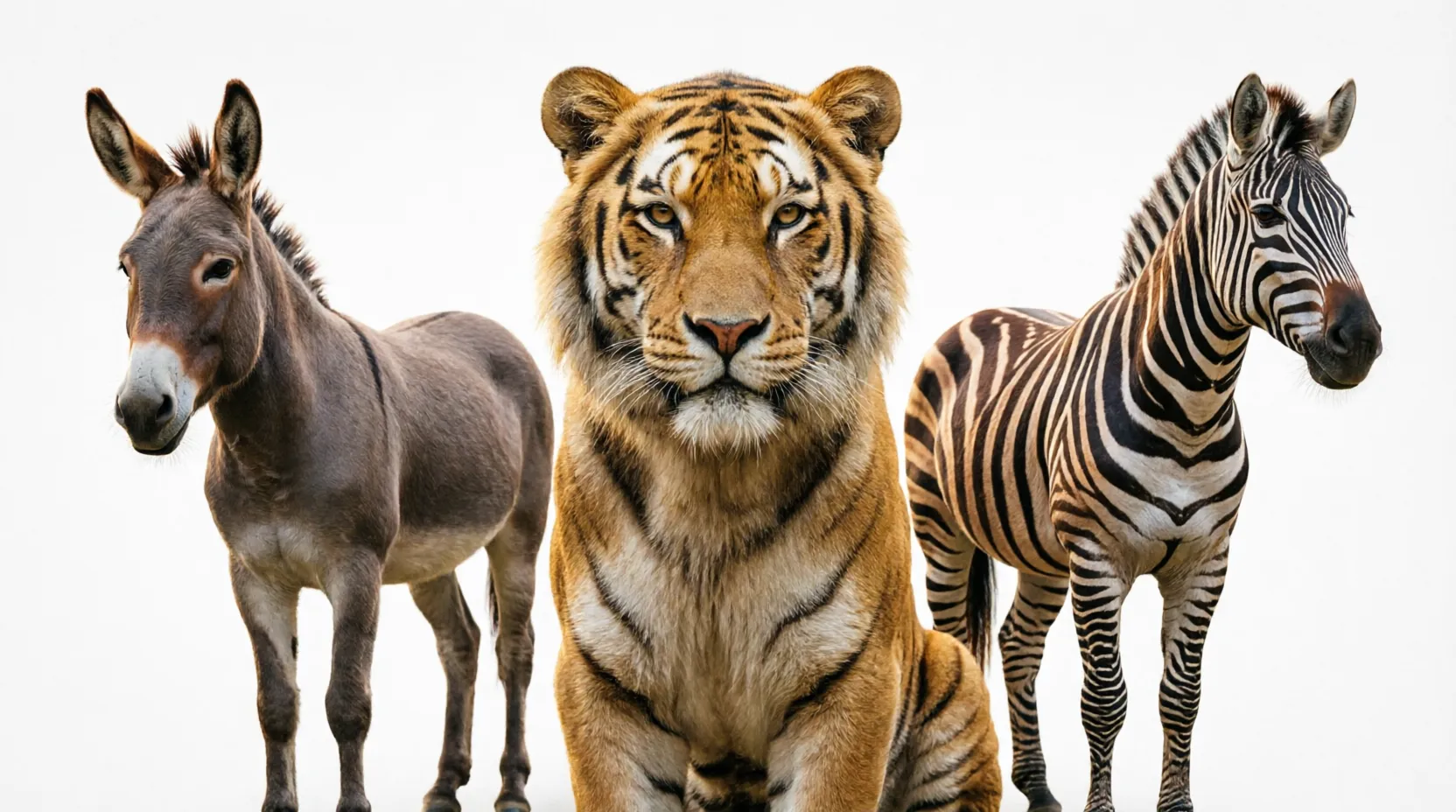
Zebras have between 32 and 46 chromosomes depending on species. All zebroids are sterile for the same reason.
The exceptions
Can mules ever reproduce?
What people think
"Mules are completely, absolutely, always sterile, no exceptions"
It's the standard fact you learn alongside mules: they are the textbook example of hybrid sterility, full stop.
What actually happens
Almost always, but a handful of female mules have produced offspring
About a dozen cases of female mules giving birth have been documented and verified, mostly in China and Morocco. In each case, the mule apparently managed to exclude the problematic unpaired chromosome during egg formation, a rare but not impossible error in the other direction. The foals were always either horses or donkeys, never mules, because the father was always a pure-species stallion or jack. Male mules have never been confirmed fertile. The exceptions are extraordinary enough that each one prompted scientific papers.
Final insight
The mule as an argument about the nature of species
The mule's sterility is often cited as proof that species are real, a genuine biological boundary enforced by chromosomal incompatibility. And it is. But it's also a reminder that the boundary is thin enough to produce a living, breathing, exceptionally hardworking animal that sits right on the line. The mule is the universe's way of saying: the categories are real, and the categories are also somewhat arbitrary, and both of these things are true at once.
Quick answers
Common questions
Why do people still breed mules if they can't reproduce? +
Because sterility is a feature, not a bug. You get a reliably superior working animal without any risk of it establishing a feral population. Every mule is made fresh, to order, from horses and donkeys you already control. For most of human history, before engines, that was an extraordinarily useful arrangement.
Is a hinny the same as a mule? +
A hinny is the reciprocal cross: a male horse (stallion) with a female donkey (jenny), as opposed to a mule, which is a male donkey (jack) with a female horse (mare). Both have 63 chromosomes and are almost always sterile. Hinnies are rarer because the cross is harder to achieve, and they tend to be smaller and less hardy than mules. The difference matters to breeders; it's largely invisible to everyone else.
Could you ever breed a fertile mule through genetic engineering? +
In principle, you could try to correct the chromosome mismatch, but you'd essentially be creating a new species rather than a mule. A mule with an artificially adjusted chromosome count would no longer be a horse-donkey hybrid in any meaningful sense. It's technically conceivable; it's also a great deal of work to solve a problem that the ancient world managed fine by just keeping horses and donkeys around separately.
Do any other common animals have the same sterility mechanism? +
Yes, it's the same principle behind the sterility of ligers (lion × tiger) and most other hybrid animals with mismatched chromosome numbers. It also underlies the sterility of some plant hybrids, though plants have a workaround humans and animals lack: polyploidy, the ability to duplicate the entire genome and suddenly give every chromosome a partner. That's how wheat became wheat.